
- 20 min read
Best Cheap Social Listening Tools in 2026
You don't need an enterprise-level budget to get powerful features like real-time brand monitoring, sentiment analysis, and competitor tracking. For small businesses, platforms like Mention, Brand24, and our own ForumScout offer affordable ways in, often starting under £50 per month. It's now genuinely possible to tap into customer conversations and market trends without breaking the bank.
Why Small Businesses Use Social Listening
Social listening has officially moved out of the corporate boardroom. It's now a critical tool for small and medium-sized businesses (SMEs) all across the globe. At its core, it's just the practice of tracking online conversations about your brand, your competitors, and your industry to find insights you can actually use.
For a growing business, this is huge. It means you can spot an unhappy customer before a crisis brews, find new sales opportunities, and get a raw, unfiltered look at what people genuinely think about your products.

Cost has always been the main hurdle, but that's changing fast. A new wave of affordable tools has emerged, levelling the playing field and giving SMEs the same strategic advantages once reserved for FTSE 100 companies. This shift couldn't be better timed, especially as the social media analytics market is set to explode.
The Growing Demand for Affordable Insights
The numbers speak for themselves. Projections show the UK market hitting USD 2,764.48 million by 2033, growing at a remarkable compound annual rate of 22.00%. Globally, SMEs are the ones adopting these tools the fastest, thanks to flexible cloud-based pricing and interfaces that don't require a data scientist to understand.
This growth proves that more UK businesses are realising they can't afford to ignore the online chatter. With the right tool, you can turn messy, unstructured social data into a clear competitive edge.
By actively listening, businesses can move from reactive problem-solving to proactive strategy. You’re not just monitoring mentions; you're building a deeper understanding of your market, which informs everything from product development to your marketing messages.
Key Benefits for SMEs
Tuning into these conversations delivers tangible benefits that directly impact your bottom line. An effective, low-cost strategy can help you:
- Protect Brand Reputation: Instantly catch negative feedback on platforms like Reddit or X (formerly Twitter) and sort out issues before they snowball. A solid strategy involves more than just social media; check out our guide on the best brand tracking software to learn more.
- Generate High-Quality Leads: Find users who are actively looking for solutions you provide by monitoring specific keywords and pain points they're talking about.
- Conduct Competitor Analysis: See what customers love (and hate) about your rivals. It’s basically a free roadmap for improvement and a great way to find your unique selling point.
- Improve Customer Service: Stop waiting for customers to come to you. Engage with them directly where they are, offering support and building loyalty through real, authentic interaction.
A Buyer's Guide to Affordable Social Listening Tools
Choosing the right platform from a sea of cheap social listening tools means looking way beyond the monthly price. To make a smart investment, you need a clear framework for what actually matters. This guide breaks down the essential criteria to help you tell a genuinely valuable tool from one that’s just inexpensive.
Before you commit, it’s vital to understand the core features that will either supercharge or cripple your strategy. A low price tag is tempting, but if the tool fails on the important stuff, it quickly becomes a wasted expense. This framework will help you pick a platform that delivers a real return.
Data Volume and Sources
The first thing to check is the mention volume. Many affordable plans come with surprisingly strict monthly limits on how many mentions they’ll collect for your keywords. A plan with a 5,000-mention limit might sound generous, but a popular brand or a trending topic can burn through that in a few days, leaving you blind for the rest of the month.
Equally important are the data sources. Your audience isn't just on one platform. A tool that only watches the big social networks might miss critical conversations happening on niche forums, blogs, or news sites. Make sure the tool’s coverage lines up with where your customers actually hang out. For instance, effective brand monitoring on X needs a tool built for its rapid-fire environment; you can learn more about the specifics of Twitter monitoring to see why this is so critical.
Accuracy and Alerting Cadence
Not all data is created equal. A massive differentiator among cheap social listening tools is the quality of their sentiment analysis. An inaccurate algorithm that mislabels neutral comments as negative can send your team on a wild goose chase. Look for tools that offer more nuanced analysis or, even better, let you manually correct sentiment to train the algorithm for future results.
Next, think about how fast you need the information. Some budget tools only send daily or weekly email digests. That’s fine for trend analysis but completely useless for crisis management.
For proactive customer support or reputation management, real-time alerts are non-negotiable. Getting instant notifications via Slack, email, or your CRM when a negative mention pops up can be the difference between a minor blip and a full-blown PR disaster.
Retention and Usability
How long does the tool hang on to your data? Data retention policies vary wildly, with some affordable plans deleting mentions after just 30 days. This makes it impossible to track year-on-year trends or analyse long-term campaign performance. A longer retention period gives you a historical baseline to measure growth and strategic impact.
Finally, think about integrations and workflow. Does the tool play nicely with the software you already use, like Slack, Zapier, or your CRM? A seamless integration saves a ton of time by automatically sending important mentions to the right people or systems, turning passive data collection into an active, organised process. If you're on a tight budget, researching the capabilities of the best free social media management tools is a great first step, as many include basic listening features that help you understand these workflows.
Right, you've got your evaluation checklist sorted. Now it's time to put the top affordable social listening tools under the microscope in a proper head-to-head comparison.
The goal here isn't to crown one single "best" tool, because that doesn't really exist. Instead, it’s about digging into the subtle differences that make each platform a perfect fit for some businesses and a poor one for others. We'll break down the main contenders, focusing on the practical details that actually matter when you're an SME.
The social listening market is getting crowded, valued at USD 1.5 billion in 2024 and featuring huge names like Brandwatch, Hootsuite, and Sprout Social. For businesses on a tight budget, this fierce competition is fantastic news. It means providers are fighting for your attention with more accessible plans that can grow with you.
When you're comparing tools, you're essentially trying to find the right balance between these three core controls: how many mentions you can track, what sources you can cover, and how far back you can look.
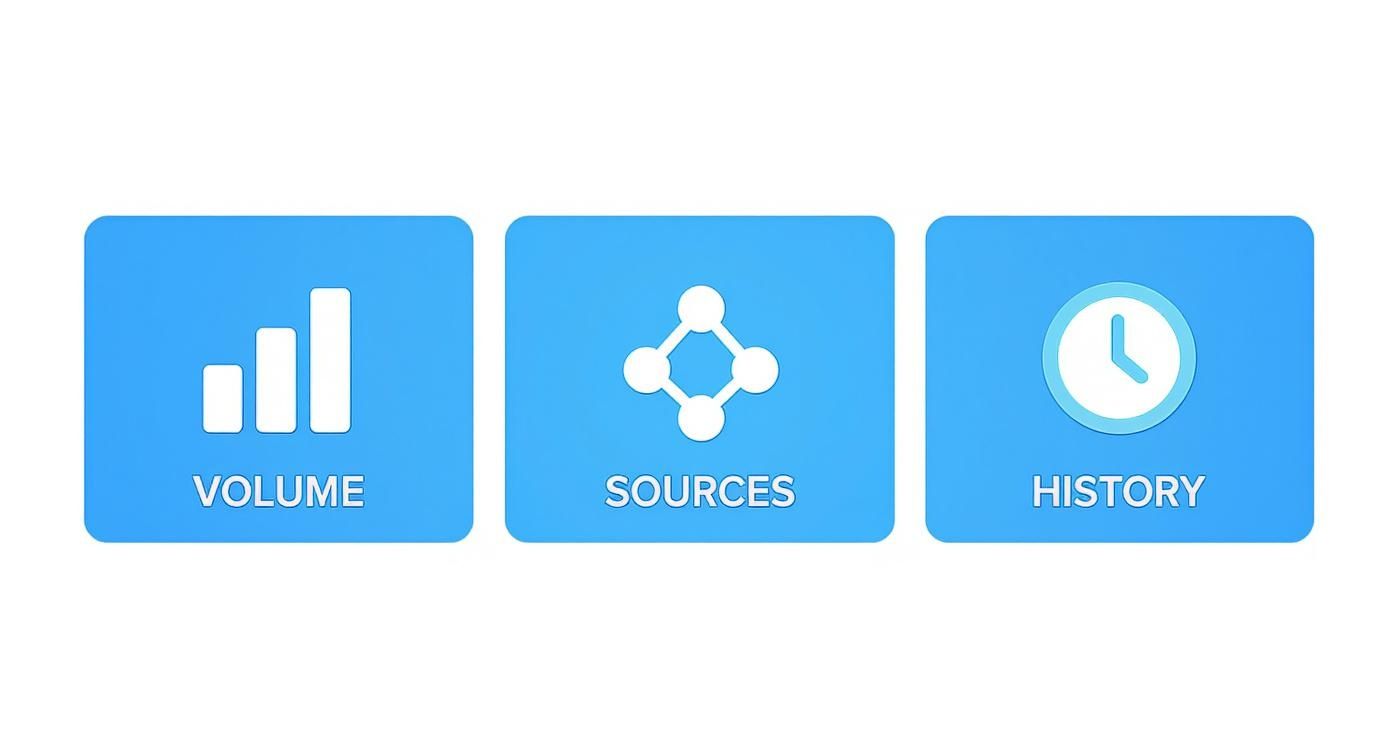
Nailing this balance is the key to picking a tool that fits your budget without crippling your strategy.
Mention: A Comprehensive and User-Friendly Option
Mention is often the first stop for businesses dipping their toes into social listening, and for good reason. It hits that sweet spot between a clean, friendly interface and a genuinely powerful set of features. It’s easy to get started with but doesn’t feel watered down.
Right out of the box, its entry-level plans cover the big social networks plus news sites, blogs, and forums, making it a solid all-rounder for keeping an eye on your brand's health. But where Mention really shines, even on its cheaper tiers, is with its alert system and influencer identification.
Differentiator Insight: Mention's influencer dashboard is a huge plus. It doesn't just flag influential accounts talking about your keywords; it gives them scores to help you prioritise who to engage with. That's a feature you'd typically expect to find in much pricier enterprise software.
The main catch? The mention limit. The starter Solo plan, which costs around £41 per month, caps you at 5,000 mentions. If your brand gets a fair bit of online chatter, you could burn through that limit pretty fast, forcing an upgrade sooner than you'd like.
Brand24: The Data-Rich Contender
Brand24 markets itself as a more data-heavy option for those who want deeper analytics without the enterprise price tag. Its dashboard is absolutely packed with metrics, from share of voice and sentiment analysis to estimated social media reach.
Starting at around £99 per month for its Individual plan, Brand24 only gives you 2,000 mentions per month—less than half of Mention's starter plan. But its real strength is in the quality and breadth of its data, pulling in conversations from places many competitors miss, like podcasts and newsletters.
Its interactive PDF reports are a key advantage. They look great and are easy to share with colleagues or clients who don't have a login, making it much simpler to show the value of what you're doing. If you're totally new to this, it's worth checking out some free social listening tools for your brand in 2026 first to get a feel for the basics before you invest.
Just be warned, the learning curve with Brand24 is a bit steeper. The sheer amount of data can feel a little overwhelming if you're a complete beginner.
Agorapulse: The All-in-One Social Management Hub
Agorapulse is a different beast entirely. It's first and foremost a social media management platform, with social listening included as part of a wider suite of tools for scheduling, reporting, and engagement. This makes it a brilliant choice for small teams looking to consolidate their tech stack.
Its listening features are baked right into the social inbox, so you can jump from replying to DMs to engaging with untagged brand mentions without missing a beat. For teams focused on proactive customer service, this workflow is incredibly efficient.
The price reflects its all-in-one nature. The Standard plan starts at around £49 per user per month, which is a great deal when you remember you're also getting publishing and analytics tools. The listening is solid enough for most SMEs, with good coverage of the main social platforms.
The trade-off is that its focus is almost entirely on the big social networks. If you need to keep a close eye on forums, blogs, or news sites, Agorapulse probably won't cut it on its own. It's built for social-first listening, not deep web monitoring.
ForumScout: The Specialist for Community and Forum Monitoring
ForumScout carves out its own unique space by zeroing in on the sources that many other affordable tools barely touch: Reddit, forums, and niche online communities. While it also covers platforms like X (formerly Twitter) and LinkedIn, its real power is in unearthing the authentic, detailed conversations happening on discussion-based platforms.
This makes ForumScout perfect for businesses that want to do deep customer research, find product pain points, or generate highly qualified leads. By tuning into specific subreddits or industry forums, you can find people actively looking for the exact solution you offer.
Our pricing is built to be accessible, with the Growth plan starting at just $19 per month for 5,000 mentions. This plan comes with powerful features like our proprietary AI filtering, which lets you score mentions for relevance using plain English rules, cutting straight through the noise.
Differentiator Insight: ForumScout’s AI-powered smart notifications are a game-changer. Instead of drowning you in alerts, it only pings you when it finds a conversation that perfectly matches your lead gen or support criteria. It saves you hours of manual sifting.
The whole platform is designed to find actionable conversations, not just track vanity metrics. For a wider view of how different platforms approach this, checking out a comprehensive social listening tools comparison can give you some valuable context.
Affordable Social Listening Tool Feature Comparison
To help you see the differences at a glance, we've put together a side-by-side breakdown of the key features, limitations, and ideal use cases for the most popular cheap social listening tools available to small businesses. This table compares the starter plans to give you a clear picture of what you get for your money at the entry level.
| Tool Name | Starting Price (per month) | Mention Limit (Starter Plan) | Key Platforms Covered | Best For (Use Case) |
|---|---|---|---|---|
| Mention | ~£41 | 5,000 | Social media, news, blogs, forums | Solopreneurs and small teams needing a balanced, easy-to-use tool. |
| Brand24 | ~£99 | 2,000 | Social, news, blogs, podcasts, newsletters | Marketers who need detailed data and comprehensive web monitoring. |
| Agorapulse | ~£49 per user | Unlimited (within reason) | Major social media networks | Teams wanting to combine publishing, engagement, and listening in one tool. |
| ForumScout | ~$19 (~£15) | 5,000 | Reddit, forums, social media, news | B2B lead generation and customer research in online communities. |
This table really clarifies the trade-offs. Mention gives you a great all-round package with a generous mention limit for the price. Brand24 offers richer data, but it comes at a higher cost with a lower mention cap. Agorapulse is the obvious choice if you live on social media, while ForumScout is the specialist for uncovering gold in the often-ignored corners of the web.
Ultimately, your choice comes down to which of these use cases best matches your business goals.
Matching a Tool to Your Business Goals
A features list only tells you half the story. The best cheap social listening tools aren’t just about hoovering up data; they’re about solving real business problems. The trick is to align a platform’s core strengths with what you actually want to achieve.
This practical, goal-oriented approach is what separates a smart investment from just another data dashboard you never look at. Let's break down three common business goals and pinpoint which types of tools are best equipped to get you there.
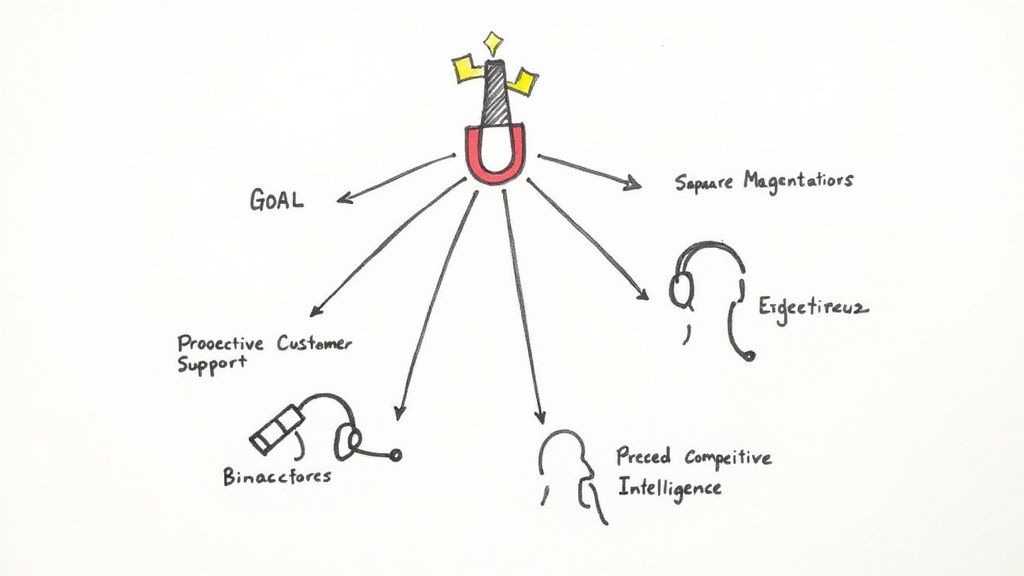
This method shifts your mindset from feature-shopping to solution-finding, guaranteeing you’ll see a much better return on your money.
Goal 1: B2B Lead Generation
If your main goal is to find new B2B customers, your focus needs to be laser-sharp. You're looking for tools that are brilliant at monitoring professional networks and specific, high-intent keywords. Generic brand mentions are mostly noise here; you need to find conversations where potential clients are actively asking for help with a problem you can solve.
For this, you’ll need a tool with: * Deep Keyword Monitoring: The ability to track complex phrases like "looking for new accounting software" or "recommendations for a marketing agency in Manchester." * Strong Forum and Community Coverage: B2B professionals often seek advice on Reddit, niche industry forums, or even LinkedIn communities. A tool that prioritises these sources is a must. * Smart Filtering and Alerts: You don’t want to be swamped with irrelevant chatter. The best tools for lead gen use AI or Boolean logic to filter the noise and ping you with only the most promising opportunities.
Situational Recommendation: Tools like ForumScout are purpose-built for this. Its strength lies in monitoring Reddit and professional forums, combined with AI filtering that scores leads for relevance. This lets you find high-quality prospects without the manual slog. A more general tool like Mention can also work if you're very precise with your keyword setup.
Goal 2: Proactive Customer Support
When you’re aiming to deliver exceptional customer service, speed and sentiment analysis are everything. The goal is simple: find and fix customer issues before they escalate, turning potential complaints into positive experiences. This requires a tool that acts as an early warning system.
Key features to look for include: * Real-Time Alerts: Daily digests are far too slow. You need instant notifications—ideally piped straight into Slack or your helpdesk—the moment a frustrated customer posts online. * Accurate Sentiment Analysis: The platform absolutely has to distinguish between a sarcastic comment and a genuine complaint. This helps your team prioritise the most urgent fires first. * Integrated Workflow: A tool that merges listening with engagement, like Agorapulse, is perfect. It lets your support team respond directly from the dashboard, streamlining the whole process.
This approach transforms social listening from a passive monitoring task into an active customer retention strategy. That's a huge deal, especially when you remember that acquiring a new customer can cost five times more than keeping an existing one.
Goal 3: Competitive Intelligence
Knowing your competitors' strategies, strengths, and weaknesses gives you a serious advantage. This goal requires a tool that can track your rivals just as closely as it tracks your own brand, giving you a clear, unbiased view of the market.
Look for a platform that offers: * Robust Competitor Tracking: You need the ability to set up dedicated queries for multiple competitors, tracking their mentions, campaigns, and customer feedback side-by-side. * Share of Voice Analysis: This metric is crucial for competitive intelligence. It shows you what percentage of the online conversation your brand owns compared to your rivals, helping you measure brand awareness and market presence. * Comprehensive Reporting: You'll need a tool that can generate easy-to-digest comparison reports. Platforms like Brand24 excel here, offering visual dashboards and shareable reports that make it simple to present findings to your team.
By focusing on these specific use cases, you can pick a tool that’s not only affordable but also perfectly aligned with your business objectives. This ensures it becomes an indispensable part of your growth strategy, not just another subscription.
Alright, you’ve seen what’s out there, weighed up the features, and have a good idea of which tools might fit. Now for the final step: pulling the trigger with confidence. This isn’t just about what you need today, but picking a platform that can grow with you.
Before you lock anything in, do one last gut check. Think about scalability—if your mention volume doubles next year, is the next pricing tier still within budget? What about multi-user access? A tool that’s a dream for a one-person show can become a serious bottleneck once you hire a marketing assistant. And please, don't forget customer support. When you’re stuck trying to build a tricky query, fast, helpful support is worth its weight in gold.
The UK market for these tools is buzzing, worth a cool £208.5 million in 2024, which is great news for you. It means there are plenty of solid, affordable options competing for your business. This fierce competition has pushed providers to offer excellent, locally-compliant solutions without slapping on enterprise-level price tags. You can dig into the numbers in this UK social media monitoring market analysis.
Our Top Picks for Specific Needs
To make things even simpler, here are our recommendations for a few common scenarios. These choices balance price, features, and the most logical growth path.
- Best for Solopreneurs and Freelancers: Mention. It’s just so easy to get started with. The interface is clean, the starter plan is generous with its mention limits, and the coverage is solid. It gives you everything you need for brand monitoring without making you read a manual.
- Best for Small Agencies: Brand24. Agencies live and die by the data they provide clients. Brand24 serves up deep analytics and slick reports that make it easy to show your value. It’s a bit pricier, but the insights it uncovers will more than justify the cost.
- Best for Basic Brand Health Monitoring: Agorapulse. If you just want to fold listening into your daily social media management, this is your best bet. It pulls all your brand conversations into one unified inbox, which is perfect for keeping things simple and efficient.
Final Takeaway: The best tool isn't the one with a million features; it's the one you'll actually use consistently. Pick the platform that feels the most natural for your workflow and solves your biggest problem, whether that's finding leads, handling support, or spying on the competition.
Your First Steps to Success
Once you've made a decision, don't let it sit there. The real value comes from taking action, and you can start getting insights from day one.
Here’s what to do in your first hour:
- Set Up Your Core Keywords: Start with your brand name, any common misspellings, and your main product or service.
- Add Your Top 2-3 Competitors: Get them in there right away. You need a baseline to see how your share of voice and sentiment stack up.
- Create Your First Alert: Set up a real-time notification for your brand name paired with negative words like "problem," "issue," or "disappointed." This is your early warning system for customer service fires.
Do these three simple things, and you’ll have turned your new subscription into an active intelligence-gathering machine from the get-go.
Got Questions? We’ve Got Answers
Jumping into the world of affordable social listening tools usually brings up a few last-minute questions before you’re ready to pull the trigger. Getting clear, honest answers is the difference between choosing a tool you’ll love and one you’ll regret. This section tackles the most common queries we hear, so you can feel confident you’re making the right call.
We’ll cover everything from whether free tools are worth your time to how long it really takes to see a return on your investment. Let's get you equipped with the practical knowledge you need to pick the right platform.
Are Free Social Listening Tools Good Enough to Start With?
Honestly, yes—for absolute beginners, they can be a great way to dip your toes in the water. Platforms like Google Alerts or the free plans of more robust tools let you get a feel for brand monitoring without spending a penny. They’re fine for tracking a couple of keywords and seeing the general flow of online chatter.
But you'll hit a wall with them, and you'll hit it fast. Expect to see tight limits on how many mentions you can track, very few data sources (they almost always miss key forums like Reddit), and a total absence of useful features like sentiment analysis or competitor tracking. They’re a solid entry point, but any growing business will outgrow them in a matter of months.
The biggest mistake you can make is choosing a tool just because it’s cheap. If the data is patchy, misses platforms where your customers are actually talking, or has a tiny mention limit, it’s not a bargain—it’s a waste of your time and money.
How Quickly Can I Expect to See Results?
This one really depends on what you’re trying to achieve. The timeline for seeing a real impact varies a lot based on your goals.
- For Customer Support: You can see results almost immediately. Seriously. Set up real-time alerts for negative mentions, and you can jump on issues within minutes. From day one, you can turn a potential PR nightmare into a glowing customer review.
- For Lead Generation: This takes a bit more patience. While you might get lucky and spot a hot lead in your first week, building a reliable pipeline takes time. Expect it to take around 30-60 days to really nail down the right keywords and pain points to monitor for a steady flow of opportunities.
- For Brand Strategy: This is the long game. Using social listening to uncover deep insights that inform your product roadmap or marketing campaigns requires data over time. You'll need at least three to six months of data to spot meaningful trends, understand how audience sentiment is shifting, and accurately measure your share of voice.
At the end of the day, social listening isn’t a magic wand; it’s a strategic process. The more consistently you use the tool and act on the insights you find, the faster you'll see a return.
Ready to turn online conversations into revenue? ForumScout offers powerful AI filtering and deep community monitoring to find the insights that matter most. Start your free 7-day trial and find your next customer today.