
- 17 min read
A Modern Guide to Benchmarking the Competition
Ever seen a rival suddenly blow up online and been left wondering, how on earth did they do that? That's the exact moment you realise you need to be benchmarking the competition. It's not just some corporate buzzword; it’s a systematic way of measuring your performance against others to uncover strategic gold, turning reactive guesswork into proactive, data-driven moves.
Why You Must Benchmark Your Competitors
Let's be honest, benchmarking isn't some complex exercise reserved for massive corporations anymore. It's a fundamental survival skill. In today's ridiculously crowded markets, understanding where you stand is the first step toward getting a real edge. Without it, you’re flying blind and making calls based on gut feelings instead of hard evidence.

The whole process forces you to look outside your own bubble. It’s way too easy to get obsessed with internal metrics and last quarter's performance, but that data tells you nothing about the wider market. Benchmarking gives you that missing context, showing you what "good" actually looks like in your industry right now.
Uncover Strategic Gold in a Crowded Market
The insights you get from proper benchmarking help you spot critical market gaps, sharpen your value proposition, and even see industry shifts coming before they hit. This is about so much more than just counting who has more followers; it’s about digging into the why behind their success.
Just look at the UK social media market, which is on track to be worth £12.5 billion in 2025. In an arena that fierce, every single mention counts. With Facebook alone having 38.3 million UK users who spend an average of 39 minutes a day on the platform, the opportunities are massive. Yet, so many brands miss the low-hanging fruit buried in untapped forums and LinkedIn chatter. You can explore more data on the UK social media industry to really grasp the scale of it all.
By systematically comparing your strategies to those of your rivals, you can stop guessing and start making informed choices that directly impact your bottom line. It's the difference between trailing the pack and leading it.
Ultimately, this process isn't just about playing defence; it's about going on the offensive. You learn what truly resonates with your shared audience, pinpoint competitor weaknesses you can exploit, and discover successful tactics you can adapt for your own brand. This is how you turn competitor analysis into your most powerful growth driver, giving you a clear roadmap for what to do next.
Building Your Benchmarking Framework
A solid plan is the difference between collecting random data and gathering strategic intelligence. Before you even think about data, you need to lay the groundwork for a meaningful analysis. This is all about moving past vague goals and defining sharp, specific objectives that will guide your entire process.
What are you really trying to achieve? It’s not enough to say you want to "do better." Are you trying to boost customer sentiment, steal market share from a specific rival, or figure out why your competitor's new feature is getting so much buzz?
Your objectives need to be specific and measurable. For instance, a clear goal might be, "Increase our share of voice on key industry forums by 20% in the next quarter." That’s a target you can actually work towards and measure.
Defining Your Competitive Landscape
Once you know your goals, you need to decide who you're actually measuring against. And trust me, it’s not just about your direct rivals selling a similar product. A proper competitor analysis needs a much wider view of the market.
Think about these three categories:
- Direct Competitors: These are the obvious ones. They target the same audience with a nearly identical offering. You probably know them by name.
- Indirect Competitors: They solve the same core problem for your customers but with a completely different solution. Think about it: a project management tool and a simple spreadsheet can both be used to manage tasks. One is just a lot more sophisticated than the other.
- Aspirational Brands: These might not even be in your industry, but they’re absolute leaders in an area you want to excel in, like customer service or community building. Learning from them gives you a high bar to aim for.
The goal isn't just to see what your direct rivals are doing; it's to understand the full range of options your potential customers have. This wider perspective is often where the most valuable opportunities are hiding.
Selecting KPIs That Actually Matter
With your goals set and competitors identified, the final piece of the framework is choosing the right Key Performance Indicators (KPIs). These are the specific metrics that will tell you if you're winning or losing. A pile of vanity metrics, like raw follower counts, won’t help you make strategic decisions. They just look nice on a slide.
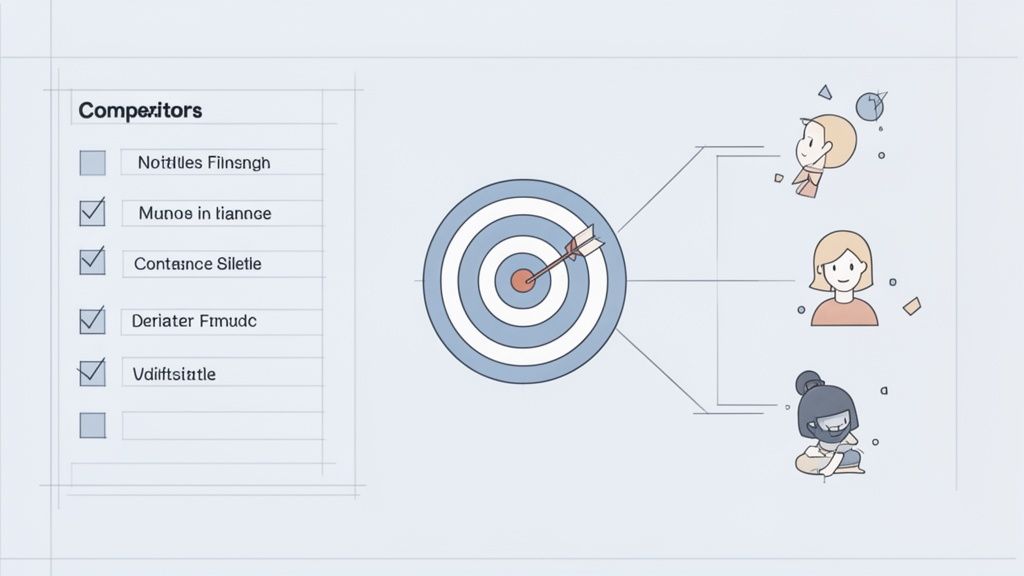
This chart gives a great high-level view of how big objectives get broken down into measurable indicators—a crucial step for effective benchmarking. Instead of chasing meaningless numbers, you need to focus on metrics that align directly with your objectives. To get a deeper understanding of this process, you can explore our detailed guide on how to conduct a competitor analysis.
Here's a breakdown of the kinds of KPIs that will give you a real competitive edge.
Essential KPIs for Competitive Benchmarking
| Metric Category | KPI Example | What It Measures | Strategic Importance |
|---|---|---|---|
| Brand Awareness | Share of Voice (SoV) | The percentage of online conversations in your niche mentioning your brand vs. competitors. | Reveals your market presence and brand visibility relative to the competition. |
| Audience Sentiment | Sentiment Score | The ratio of positive, negative, and neutral mentions about your brand or product. | Gauges public perception and helps identify areas for reputation management. |
| Content Performance | Engagement Rate | Audience interactions (likes, shares, comments) relative to follower or audience size. | Shows how well your competitor's content resonates with their audience. |
| Web Performance | Website Traffic & Sources | Where a competitor's web traffic comes from and which pages are most popular. | Uncovers effective marketing channels and content strategies you might be missing. |
| Customer Feedback | Product Review Ratings | Average star ratings and qualitative feedback on sites like G2, Capterra, or Trustpilot. | Highlights competitor strengths and weaknesses directly from their users' mouths. |
| Community Health | Forum/Reddit Mentions | The volume and context of discussions happening in niche communities. | Taps into unfiltered user opinions and identifies emerging trends or pain points. |
By tracking these KPIs, you move beyond simple observation and start generating real, actionable insights.
Choosing the right KPIs ensures your benchmarking efforts produce a clear roadmap for what to do next, rather than just a collection of numbers.
Gathering Your Competitive Intelligence
Okay, you've got your framework sorted. Now for the fun part: digging in and gathering the actual intelligence. To get a complete picture of what your competitors are up to, you need to look past the vanity metrics and go where the real insights are hiding. This is where you shift from planning to doing—collecting the raw data that fuels your entire analysis.
Think of it like building a puzzle. Each data source gives you a different piece, from unfiltered customer rants to hard data on web performance. You need them all to see the final image.
Tapping into Unfiltered Customer Conversations
The most honest feedback lives where customers feel safe enough to speak their minds. This is where social and community listening comes in. It’s not just about tracking mentions; it's about getting the why behind the conversation.
Here’s where you should be looking:
- Niche Forums and Communities: These are absolute goldmines. You’ll find incredibly detailed feedback on products, from feature requests to bugs that drive people mad.
- Reddit: Industry-specific subreddits are packed with candid discussions, head-to-head product comparisons, and user reviews you simply won't find anywhere else.
- Mainstream Social Platforms: Don’t ignore the big ones. Places like X (formerly Twitter) and Facebook are crucial for seeing how people react to public announcements, marketing campaigns, and customer service screw-ups.
Getting a handle on what is social listening is the first step, as it’s the key to capturing what people really think about a brand.
Dissecting Your Competitor's Digital Footprint
If community listening gives you the "why," then analysing a competitor’s web and SEO performance gives you the "what." By picking apart their website and search presence, you can pretty much reverse-engineer their digital strategy.
I always focus on these key data points first:
- Traffic Sources: Where are their visitors coming from? Are they crushing it with organic search, or are they just throwing money at paid ads?
- Top-Performing Content: Which blog posts, landing pages, or free resources are bringing in the most traffic and getting all the shares?
- Backlink Profile: Who’s linking to them? A list of high-authority backlinks can reveal strategic partnerships and killer PR campaigns.
For a few more practical ideas on this, check out this great article on 5 ways to spy on competitors and dominate e-commerce.
The goal isn't to copy your competitors' every move. It's to identify the patterns and strategies that are working for them so you can adapt and improve upon them for your own brand.
Mining Customer Review Platforms
Finally, don’t forget the obvious spots. Dedicated review sites like G2, Capterra, and Trustpilot offer structured, direct feedback from real users. This is where you go to understand customer satisfaction on a granular level.
As you comb through these platforms, keep an eye out for recurring themes in both the five-star raves and the one-star rants. People will tell you exactly what they love about a competitor's product and, more importantly, what they wish it did better.
Those weaknesses are your openings. A "missing feature" that pops up again and again in a competitor’s reviews could be the exact gap your product is perfectly positioned to fill.
Turning Data into Actionable Insights
Let's be honest: a pile of data is just noise. The real skill is turning that noise into a clear signal that tells you exactly what to do next. This is where your raw intelligence becomes actionable, moving from simple collection to smart analysis.
But before you can spot any meaningful trends, you need to make sure you're making fair comparisons.
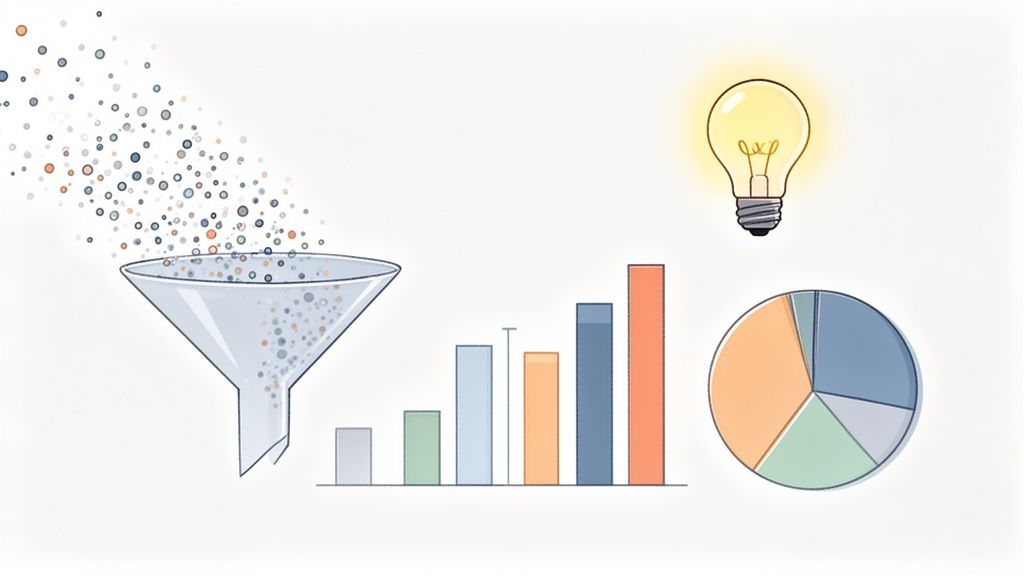
This starts with data normalisation. Comparing the raw number of likes on your posts to a competitor with ten times the audience is completely pointless. Instead, you have to focus on ratios and rates—like engagement rate per follower—to create a level playing field. Only then can you get a true sense of performance.
Calculating Your Share of Voice
Once your data is normalised, you can start digging into the more powerful stuff. A crucial metric for benchmarking the competition is Share of Voice (SoV). It’s a simple concept: what percentage of the total online conversation in your market do you actually own?
Calculating SoV helps you:
- See where you stand: Understand exactly how visible your brand is compared to everyone else.
- Spot competitor weaknesses: A rival with high visibility but terrible sentiment is an opportunity just waiting for you.
- Track your impact: Measure how your marketing efforts are actually shifting the conversation over time.
This isn’t just about who gets mentioned most. You can slice and dice SoV for specific topics, features, or keywords to figure out who is leading the discussion in different corners of your industry. Our full guide has more on effective share of voice measurement.
Moving Beyond Basic Sentiment
Standard sentiment analysis—positive, negative, or neutral—is a decent starting point, but it barely scratches the surface. Real insight comes from understanding the emotions driving those conversations.
Imagine you discover that the chatter around a competitor's new feature isn't just 'negative,' but overwhelmingly 'frustrated' because of a clunky user interface. That’s not just data; it’s a direct order for your own product and marketing teams.
This deeper emotional context is where you find the real competitive advantages. It shows you the precise pain points you can solve and the exact emotional triggers your messaging needs to hit.
Pinpointing Gaps and Opportunities
With normalised data, SoV figures, and emotional analysis in hand, you can finally start connecting the dots. Look for patterns. Is a competitor dominating the conversation but getting hammered with negative sentiment around a core feature? That’s a massive gap in the market.
It's one thing to collect data, but another to actually process it effectively. For more on this, check out this guide on a practical workflow for analyzing the competition.
Your goal here is to transform your observations into a concrete list of strengths, weaknesses, and—most importantly—opportunities. Has a competitor taken over a niche forum you've been ignoring? Are customers constantly asking for a feature that your product already has? These are the insights that fuel winning strategies, turning your benchmarking from a research chore into a genuine growth engine.
Turning Your Insights into Winning Actions
Data is just a collection of numbers until you do something with it. The final, and honestly most important, part of this whole process is turning your hard-won insights into a concrete plan that actually moves the needle for your business. Skip this part, and all that analysis was just a fun academic exercise.
The goal here is to bridge the gap between what you’ve found and what your team does next. The best way I've found to do this is by creating a compelling, straightforward report that gets everyone on the same page. Forget hundred-page documents nobody reads; we’re aiming for clarity and impact.
Crafting a Report That Inspires Action
Your report needs to be visual, concise, and laser-focused on what matters. No one has the time or patience to wade through endless spreadsheets. The most effective reports I’ve ever seen all lead with the conclusion.
Kick things off with your top three actionable takeaways. What are the most urgent opportunities or threatening gaps you uncovered? Frame them as crystal-clear recommendations.
For instance:
- The Opportunity: "Competitor X has a 40% negative sentiment around their new user interface, which users are calling 'confusing'. We should immediately launch a marketing campaign highlighting our intuitive design."
- The Threat: "Competitor Y is absolutely dominating conversations on Reddit's /r/gadgets forum, a community we've completely ignored. We need to build a presence there, starting this week."
- The Strategic Shift: "Aspirational Brand Z gets 50% of its engagement from short-form video. It's time we reallocate some content resources and prioritise video."
When you present clear, evidence-backed actions, you shift the conversation from "so, what did you find?" to "okay, what are we going to do about it?". That’s where the magic happens.
The purpose of a competitive report isn't to show how much data you collected. It's to persuade your team to take specific, decisive action that gives you an edge.
Building a System for Continuous Monitoring
Great benchmarking isn’t a one-and-done project you dust off each quarter. The market moves way too fast for that. The real power comes from turning this into a continuous, automated process—a live feed of competitive intelligence. This is how you stop reacting and start anticipating.
This proactive stance is absolutely vital, especially in the fiercely competitive UK social media landscape. In 2025, Facebook is set to keep its crown with a commanding market share of around 67.88% of social media visits, leaving rivals like X in the dust at 10.18%. This just hammers home why tools that offer ongoing monitoring are so essential for smaller businesses trying to carve out their space. You can discover more insights about UK social media trends on Statcounter.
Setting up a proper monitoring system involves a couple of key pieces:
- Smart Alerts: Configure notifications for things that actually matter. Get pinged when a competitor is mentioned alongside negative keywords like "broken" or "complaint," or when their share of voice suddenly spikes.
- Real-Time Dashboards: Create a single screen showing your most important metrics. This lets your team spot shifts in sentiment, competitor activity, and market trends as they happen, so you can react in minutes, not days.
This is how you transform competitive benchmarking from a reactive report into a proactive, sustainable advantage that keeps your entire organisation informed and ready to act.
Common Questions About Benchoping Competitors
Diving into a competitive benchmarking program can feel like a lot at first, and it's totally normal for a few key questions to pop up. Let's clear the air on some of the most common ones I hear—it’ll help demystify the process and make sure your effort is focused where it counts.
One of the first questions is always, "How can I possibly compete with a much larger, better-funded rival?" It’s a fair point. Trying to beat them at their own game is a losing battle.
Instead of a broad, head-to-head fight, the smart move is to narrow your focus. Find a specific niche, a unique product feature, or an underserved customer segment where you can realistically win. Look for their blind spots—maybe they ignore certain online communities or specific channels—and make those your territory. This is how you outmanoeuvre, not outspend.
How Often Should I Run a Benchmark?
When it comes to benchmarking, consistency beats intensity every time. There’s no single "perfect" schedule; it really depends on what you're tracking.
For the fast-moving stuff that can change in a day, you’ll want a tighter cadence:
- Weekly: Keep an eye on metrics like social media mentions, share of voice, and overall sentiment. These can swing wildly based on a marketing campaign or a bit of bad press.
- Quarterly: This is the time for deeper dives into slower-moving data points. Think web performance, SEO rankings, and overall market share.
- Annually: Take a step back and review the entire competitive landscape. Look for new players, assess long-term trends, and adjust your big-picture strategy.
The goal here is to build a rhythm. Regular check-ins mean you’re never caught off guard. It turns benchmarking into a proactive habit rather than a reactive scramble to catch up.
What Are the Best Free Tools to Get Started?
You absolutely can start gathering intel without a big budget. Free tools are perfect for dipping your toes in the water and getting a feel for the landscape. Something like Google Alerts is great for tracking brand mentions, and the free versions of various SEO platforms can give you a solid overview of competitor website traffic and keyword performance.
But it’s important to know their limits. While these tools give you a starting point, a dedicated competitive intelligence platform provides the depth, automation, and real-time data needed for a serious strategy. Manual collection is a huge time-sink and often misses the nuanced conversations happening in niche forums and communities—which is where the real gold is often found.
Ready to move beyond basic tools and automate your competitive intelligence? ForumScout tracks mentions across Reddit, forums, and social media in real time, giving you the actionable insights you need to find competitor weaknesses and win over their customers. Start your free 7-day trial today.