
- 22 min read

A Practical Guide to Benchmarking with Competitors
Benchmarking with competitors means sizing up your business against key rivals in your industry. It's a structured way to compare performance metrics, spot your strengths, uncover weaknesses, and set realistic, data-driven goals to get a strategic edge. This isn't just about glancing at what others are doing; it’s a deep dive into specific, measurable data.
Why Benchmarking with Competitors Drives Growth
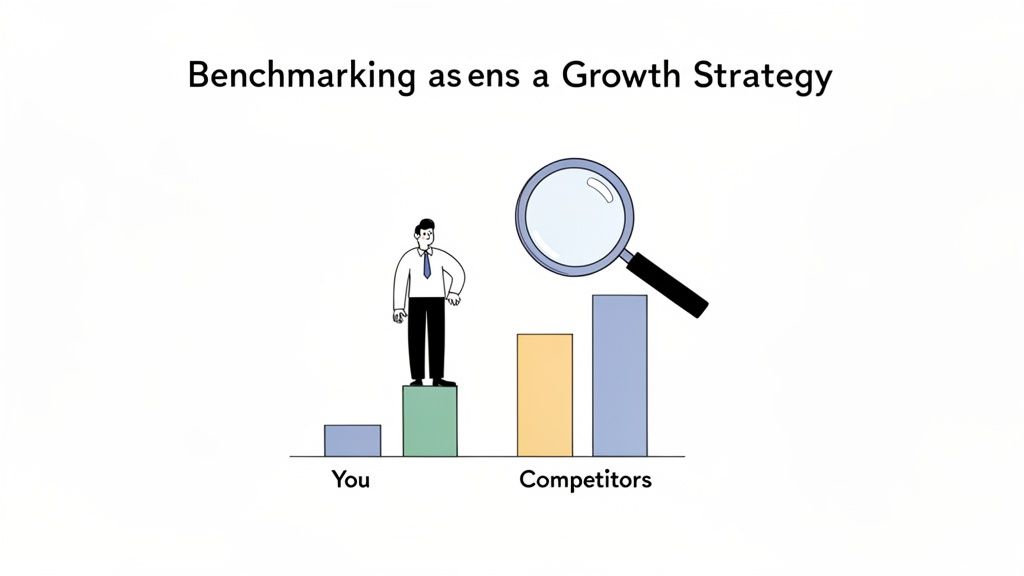
Operating in a vacuum is a surefire way to fall behind in a crowded market. Benchmarking isn’t just about keeping score; it's a fundamental practice for survival and growth. It gives you an objective framework to turn competitor data into your most powerful strategic asset, so you can make informed decisions instead of just guessing.
By systematically measuring your performance against others, you gain crucial context. Are your social media engagement rates actually any good, or just average for your sector? Is your pricing model truly competitive, or are you leaving money on the table? Answering these questions is the first step toward real improvement.
The Power of Authentic Customer Insights
Modern competitor benchmarking digs deeper than just website analytics and official reports. The real gold is often found in the unfiltered conversations happening every day on platforms like Reddit, industry forums, and social media. This is where customers share their honest opinions, frustrations, and desires about your competitors' products.
Tapping into these authentic insights allows you to:
- Identify Unmet Needs: Discover pain points your competitors are completely missing. This creates a clear opening for you to innovate and win over their unhappy customers.
- Anticipate Market Shifts: Track emerging trends and sentiment changes in real-time. You'll be able to adapt your strategy long before it’s too late.
- Refine Your Messaging: Understand the exact language customers use to describe their problems, which helps you create marketing that genuinely connects with them.
Here's a quick look at the core components we'll be breaking down. Think of this as your roadmap for building a benchmarking process that actually works.
Key Components of Modern Competitor Benchmarking
| Component | Objective | Key Metrics to Track |
|---|---|---|
| Share of Voice | Measure your brand's visibility against competitors in online conversations. | Mention volume, reach, keyword ownership, trending topics. |
| Sentiment Analysis | Understand the emotional tone (positive, negative, neutral) of audience conversations. | Sentiment score, emotion analysis, changes over time. |
| Product & Pricing | Compare your offerings, features, and pricing structure to the market standard. | Feature sets, pricing tiers, customer reviews, discount frequency. |
| Web & SEO | Evaluate your online presence and search engine performance against rivals. | Organic traffic estimates, keyword rankings, backlink profiles, domain authority. |
| Social Engagement | Assess how effectively you and your competitors are engaging with your audience. | Engagement rate (likes, comments, shares), audience growth, post frequency. |
Each of these components gives you a different piece of the puzzle. When you put them all together, you get a crystal-clear picture of where you stand and what you need to do next.
This guide provides a comprehensive, step-by-step framework for benchmarking with competitors. We'll cover everything from defining your objectives and gathering intelligence to analysing the data and turning your findings into a prioritised action plan.
Ultimately, effective benchmarking isn't a one-off project but a continuous cycle of learning and adapting. It empowers you to stop reacting to the market and start shaping it. By understanding exactly where you stand, you can confidently chart a course for where you want to go. This whole process transforms abstract data into a clear roadmap for outperforming the competition.
Building Your Benchmarking Framework

Diving straight into data collection without a plan is like setting sail without a map. You’ll just find yourself adrift in a sea of numbers with no real destination. A solid framework is non-negotiable for any competitor benchmarking that’s actually going to be useful. It keeps your efforts focused, your goals clear, and your findings actionable.
Let’s run through a real-world scenario. Imagine a new SaaS company, "ConnectSphere," trying to break into the crowded project management market. They think their user collaboration features can give them an edge, but a vague goal like "be better than the competition" is pretty much useless. They need specific, measurable targets.
Defining Your Objectives and KPIs
First things first, you have to translate those broad business goals into sharp Key Performance Indicators (KPIs). For ConnectSphere, that means getting way more specific than just tracking follower counts. Their KPIs need to directly reflect their strategic aim of owning the "collaboration" space.
So, instead of generic vanity metrics, they should be focusing on KPIs that reveal how the market actually perceives collaboration tools. Here are a few examples of what they could track:
- Share of Voice (SoV): What percentage of online chatter about "team collaboration tools" mentions ConnectSphere versus its rivals? This is a direct measure of brand awareness and relevance.
- Customer Sentiment Score: Are people talking about their competitors' collaboration features in a positive, negative, or neutral light? A spike in negative sentiment for a rival is a golden opportunity.
- Feature Adoption Mentions: When customers praise or complain about the competition, which specific features come up most? This is pure gold for prioritising ConnectSphere's own product roadmap.
Your KPIs should act as a compass, guiding every decision you make in the benchmarking process. If a metric doesn't tie back directly to a core business objective, it’s probably just noise.
This laser-focused approach saves you from "analysis paralysis"—that awful feeling of being drowned in data but starved of actual insights. By defining what success looks like right from the start, you can filter everything you collect down to what truly matters.
Identifying Your True Competitors
With your objectives clear, you need to figure out who you’re really up against. It’s tempting to just list the industry giants, but that rarely gives you the full picture. Your true competitive set includes the obvious market leaders, sure, but also the up-and-comers and indirect players fighting for the same customer attention.
ConnectSphere might see Asana and Trello as their main rivals. But a good social listening tool might reveal a smaller, newer tool is getting a ton of buzz in conversations about "agile workflows for remote teams"—one of their key target segments. Ignoring that rising star would be a massive oversight.
To build out your framework effectively, you'll want to use the best SEO benchmarking tools available. A structured guide can also be a huge help; we cover this in detail in our article on https://forumscout.app/blog/how-to-conduct-a-competitor-analysis.
Use this checklist to build a well-rounded competitor set:
- Direct Competitors: These are the brands with a similar product targeting the same audience (e.g., Asana for ConnectSphere). List your top 2-3 rivals.
- Indirect Competitors: These companies solve the same customer problem but with a different solution (e.g., a communication tool like Slack that also has project management features). Pinpoint 1-2 of these.
- Aspirational Competitors: These are the market leaders you look up to for a specific strength, even if they aren't direct competitors (e.g., a company known for its incredible customer community). Pick 1 to learn from.
- Emerging Competitors: Use social listening to spot new players who keep popping up in your target conversations. Add 1-2 promising newcomers to your list.
This balanced approach ensures your benchmarking with competitors gives you a complete view of the landscape. You move beyond a simple head-to-head and get a much richer understanding of threats, opportunities, and what "best practice" really looks like. By nailing this framework first, every step that follows—from data collection to analysis—becomes sharper and more impactful.
How to Gather Actionable Competitor Intelligence
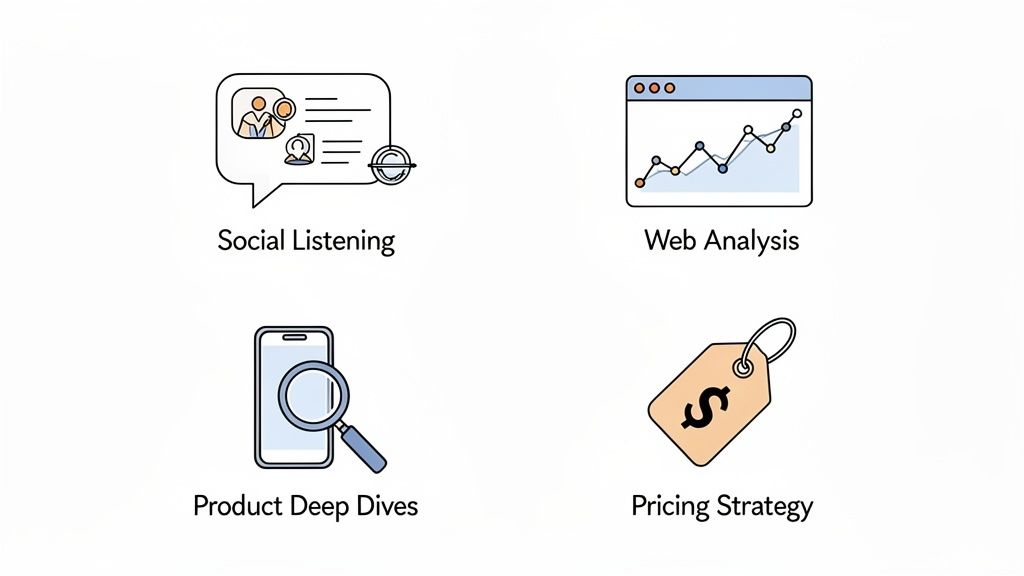
With a solid framework in place, it’s time to get your hands dirty and gather the raw data. This can feel like a mammoth task, but breaking it down makes it completely manageable. Instead of trying to boil the ocean, focus on the four areas that deliver the most valuable intelligence.
We're going to walk through how to efficiently pull information from social conversations, web presence, product offerings, and pricing structures. The real goal here isn’t just to collect data, but to gather actionable intelligence—information you can use right away to spot weaknesses and seize opportunities.
Harnessing Social Listening for Raw Insights
Social listening is your direct line to the unfiltered voice of the customer. It's where you’ll find people sharing their real experiences with your competitors, often with a level of honesty they wouldn't express anywhere else. Platforms like Reddit and X (formerly Twitter) are goldmines for candid feedback.
Your mission is to tune into these conversations and track specific signals. A great starting point is to monitor your competitors' brand names, key products, and any relevant industry keywords. For a deeper dive, check out our guide on what is social listening.
Keep an eye out for patterns in:
- Brand Mentions: Track the sheer volume of conversation. Is a competitor suddenly getting a lot of buzz? Why?
- Sentiment Shifts: Notice if the tone around a rival’s new feature is overwhelmingly positive or negative. A sudden dip in their sentiment is an opportunity you can act on.
- Trending Topics: What specific problems or features are users actually talking about? This tells you what the market really cares about right now.
Looking at the UK social media landscape in 2025, for instance, benchmarking shows that brands on Instagram and TikTok are miles ahead of those who ignore competitor analysis. UK Instagram brands average 1 million followers with a 2.1% monthly growth rate, proving the value of competitive intelligence tools that track share-of-voice against rivals. Without this, small businesses risk falling behind in a market where 49.3% of UK adults use social media for product discovery.
Analysing Your Competitor's Web Presence
A competitor’s website and digital footprint are a treasure trove of strategic information. This goes way beyond just glancing at their homepage; you need to dissect how they attract and engage their audience online.
Start by digging into their SEO performance. What keywords are they ranking for? This shows you exactly which market segments they're actively targeting. You can also estimate their website traffic to get a sense of their overall digital reach and authority.
Don’t just look at what content they publish—look at how it performs. A competitor might have hundreds of blog posts, but if only a handful drive significant traffic, those are the ones you need to analyse closely.
This kind of analysis helps you find gaps in their content strategy. Are there valuable keywords they’re completely ignoring? Could you create a better, more in-depth resource on a topic they only skimmed? These are the openings that effective web analysis reveals. To make this easier, it’s worth exploring effective SaaS competitor analysis tools that automate a lot of this data collection.
Conducting Product and Feature Deep Dives
You can't really understand a competitor without understanding their product. This means going beyond a quick look at their feature list and actually getting your hands on it. If you can, sign up for a free trial or a demo to experience their product just like a customer would.
Systematically evaluate these aspects:
- Core Features: How does their feature set stack up against yours? Do they offer something unique that customers rave about?
- User Experience (UX): Is their product intuitive and easy to use, or is it clunky and confusing? Customer complaints about a poor UX are a massive signal of a competitor's weakness.
- Onboarding Process: How do they guide new users? A seamless onboarding experience is a huge competitive advantage.
This hands-on approach gives you a much richer understanding than just reading their marketing copy. You can pinpoint exactly where their product shines and, more importantly, where it falls short.
Evaluating Pricing and Packaging Strategies
Finally, a thorough analysis of your competitors' pricing models is non-negotiable. Pricing isn’t just about the numbers; it reflects a company's positioning, target audience, and perceived value. Look at their pricing page and try to get inside their heads to understand the logic behind their tiers.
Ask yourself these questions:
- Who is their pricing built for? Are they targeting small businesses, enterprise clients, or a mix?
- What features do they use to separate tiers? Understanding their value metrics can give you ideas for your own packaging.
- Do they offer discounts or promotions often? This could be a sign that they're struggling with customer acquisition or retention.
By systematically picking apart their pricing strategy, you can find opportunities to position your own offerings more competitively. Maybe there's an underserved slice of the market that would jump at a simpler, more affordable plan, or perhaps there's demand for a premium tier with features nobody else is offering. Gathering this intelligence is what sets the stage for turning data into a decisive advantage.
Turning Competitor Data Into Actionable Insights
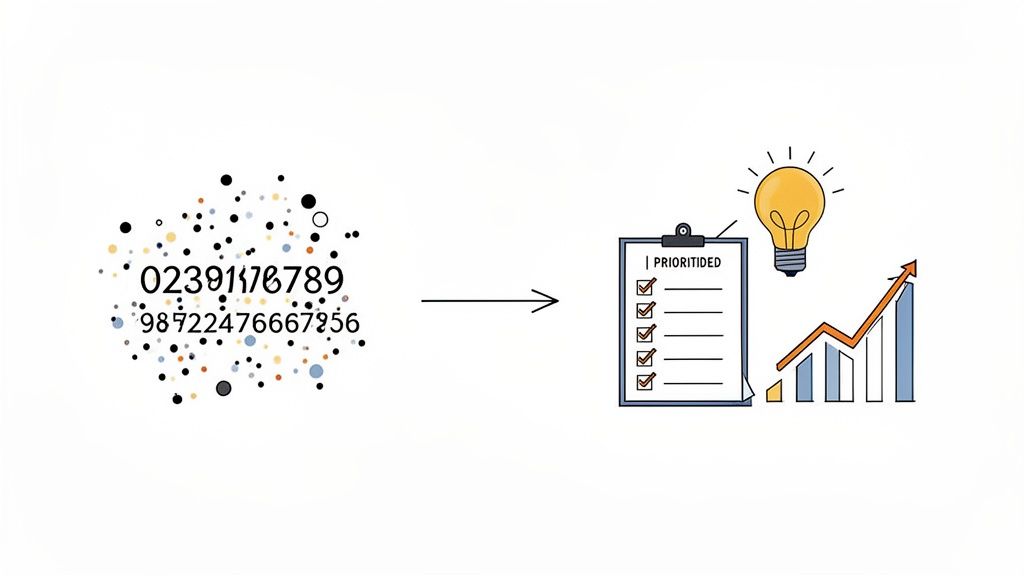
You’ve gathered streams of data—mentions, traffic estimates, pricing tiers—but right now, it’s just noise. The real value in benchmarking with competitors comes from turning those raw numbers into a clear story that actually guides your strategy. This is where you connect the dots between data points and genuine business opportunities.
It all starts with normalising your data to make sure you’re making fair, apples-to-apples comparisons. It's not enough to know a competitor got 1,000 likes on a post; you need to know their engagement rate relative to their audience size. Without that context, you risk jumping to all the wrong conclusions.
Calculating Key Benchmarking Metrics
To start telling that story with your data, you need to calculate a few core metrics. These simple formulas turn abstract numbers into comparable benchmarks, revealing who is truly winning the audience's attention.
Let's begin with one of the most important metrics for gauging market presence.
Share of Voice (SoV)
This metric shows how much of the online conversation in your niche your brand owns compared to competitors. It’s a direct indicator of brand awareness and market penetration.
- Formula:
(Your Brand Mentions / Total Market Mentions) x 100 - Example: If there were 1,000 total mentions of relevant keywords and your brand was mentioned 250 times, your SoV is 25%.
Understanding your SoV is critical for any campaign. For a deeper dive, you can learn more about effective Share of Voice measurement in our detailed guide.
Social Media Engagement Rate
This reveals how actively an audience interacts with content, giving you a much clearer performance picture than follower counts alone.
- Formula:
(Total Engagements [Likes + Comments + Shares] / Total Followers) x 100 - Example: A post with 500 engagements from an account with 10,000 followers has an engagement rate of 5%.
This context is absolutely vital. Recent UK social media benchmarks show a stark divide: TikTok is leading with a 2.50% average engagement rate while Instagram has fallen to just 0.50%. This shift is exactly why monitoring rivals with competitive intelligence tools is essential for UK marketing teams.
Conducting a Strategic Gap Analysis
With your metrics calculated and normalised, you can finally perform a gap analysis. This is where you compare your performance against your competitors' to find exploitable weaknesses and strategic opportunities. It's all about asking, "Where are they failing their customers, and how can we fill that void?"
Imagine a SaaS company, "InnovateTask," benchmarking against a market leader, "TaskMaster."
InnovateTask’s social listening data reveals a sudden 30% spike in negative sentiment around the TaskMaster brand. Digging deeper, they discover the negativity is tied to a clunky new user interface (UI) update. Users on Reddit are complaining that simple actions now require way too many clicks.
This is more than just a data point; it's a strategic opening.
A competitor's weakness is a roadmap for your success. Every customer complaint you find is a detailed brief on how to build a better product or craft a more resonant marketing message.
InnovateTask now has a clear opportunity. They can immediately launch a targeted digital ad campaign highlighting their own intuitive, streamlined UI. Their messaging can directly address the pain points TaskMaster's users are experiencing, offering a clear solution to their frustrations.
This is the kind of insight a good competitive intelligence dashboard can surface, allowing you to track sentiment and share of voice over time to spot these exact opportunities as they unfold.
Prioritising Actions for Maximum Impact
Uncovering opportunities is one thing; acting on them effectively is another. Not every gap you find warrants immediate, full-scale action. You need a system to prioritise your initiatives based on potential impact and the effort required.
A simple prioritisation matrix is perfect for this. Just categorise your findings:
- Quick Wins (High Impact, Low Effort): These are the no-brainers. For InnovateTask, this is launching the ad campaign targeting disgruntled TaskMaster users. It’s fast to implement and likely to yield immediate results.
- Major Projects (High Impact, High Effort): These are your big, strategic moves. If InnovateTask noticed ongoing complaints about TaskMaster lacking a specific integration, building that feature would be a major project. It requires significant resources but could capture a huge market segment.
- Fill-Ins (Low Impact, Low Effort): Think of these as small improvements you can make when you have spare capacity. This might include creating a blog post comparing their UI to TaskMaster’s, reinforcing their advantage without a massive investment.
- Reconsider (Low Impact, High Effort): These are ideas that sound good on paper but likely won't deliver a strong return. Avoid these time sinks at all costs.
By categorising each opportunity, you create an actionable roadmap. This simple step ensures you're balancing immediate gains with long-term strategic positioning, turning your competitor benchmarking from a research exercise into a powerful engine for growth.
Making Your Benchmarking Workflow Repeatable
This is where the magic happens. Bringing all these pieces together transforms a one-off analysis into something you can run continuously. It stops being a project and becomes a core part of your business rhythm, ensuring you’re always capturing insights and turning them into action, not just reacting when it’s already too late.
To show you what this looks like in practice, let’s walk through a real-world scenario. We'll follow "SupportSync," a B2B software company that sells helpdesk solutions. They know their customer support is brilliant, but they're struggling to win against their bigger, more established rival, "LegacyDesk."
Finding the Chink in the Armour
The team at SupportSync decided to set up a simple, repeatable process focused on brand sentiment and share of voice. Using a social listening tool, they started tracking mentions of LegacyDesk, paying special attention to conversations popping up on Reddit—particularly in subreddits like r/sysadmin and r/customerservice where their ideal customers hang out.
They weren't just collecting mentions; they were looking for patterns. The tool's AI filtering helped them cut through the marketing noise and get straight to genuine user feedback. It didn’t take long for a clear trend to emerge: a growing number of LegacyDesk customers were complaining about painfully slow ticket response times.
One Reddit thread, in particular, really took off. A user laid out their frustrating multi-day wait for a critical fix, and the comments section lit up with others echoing the same experience. This wasn't just a single disgruntled user; it was a systemic problem and a huge crack in LegacyDesk's reputation. Their sentiment dashboard confirmed it, showing a 20% drop in positive sentiment for LegacyDesk over the last quarter, tied directly to mentions of "support" and "tickets."
Turning Insight Into a Surgical Strike
Armed with this intel, the SupportSync team knew exactly what to do. They had concrete proof that their biggest strength—amazing customer support—was their competitor's most glaring weakness.
They wasted no time, launching a targeted marketing campaign with a sharp, direct message: "Tired of Waiting for Support? Get a Resolution in Minutes."
This wasn't some broad, spray-and-pray effort. It was a precision strike, focused on:
- Digital Ads: They targeted keywords like "LegacyDesk alternative" and "better customer support software," making sure their ads showed up for people actively looking to switch.
- Content Marketing: The team quickly published a blog post titled, "Why Slow Customer Support Is Costing Your Business Money," subtly highlighting their own award-winning response times.
- Social Proof: They reached out to their happiest customers, gathering fresh testimonials about speedy support and splashing them across their social channels and homepage.
This entire strategy came from one crucial insight found through consistent competitor benchmarking. Without that repeatable workflow, the opportunity on Reddit would have just been another signal lost in the noise.
The Payoff: Measurable Results from a Simple Workflow
The results were almost immediate. SupportSync's campaign, speaking directly to a proven pain point, hit home with LegacyDesk's frustrated customer base. In the first month alone, they saw a 40% increase in demo requests from leads who specifically mentioned "poor support from a previous provider" as their reason for looking elsewhere.
Their share of voice in conversations around "customer support tools" also jumped by 15% as their content and ads started intercepting the conversation. This little case study perfectly shows the ROI of a smart benchmarking process. It's not about creating dense, complicated reports; it's about building a simple, repeatable system to listen, learn, and act.
By setting up your own workflow, you can stop guessing what your competitors' weaknesses are and start knowing them for a fact. The right tools give you the intelligence, but a repeatable process is what turns that intelligence into a real, sustainable advantage.
Got Questions About Competitor Benchmarking?
Putting a competitor benchmarking plan into action usually sparks a few practical questions. Let's tackle some of the most common ones I hear, so you can move forward with confidence and make sure your efforts actually pay off.
How Often Should I Actually Do This?
There’s no single right answer here, but the best approach is to think of it in two parts: always-on monitoring and less frequent deep dives. It’s a bit like checking your car's dashboard daily versus taking it in for a full service every few months.
Continuous Monitoring: This is your daily or weekly pulse check. You should be tracking things like brand mentions, social media sentiment, and share of voice in near real-time. If a rival suddenly gets hit with a wave of negative sentiment, that's an opportunity you need to jump on now, not next quarter.
Periodic Deep Dives: This is the big-picture review you’ll run quarterly or maybe twice a year. Here, you’re analysing broader trends in things like web traffic, pricing changes, and major content campaigns. This is where the long-term strategic planning happens.
My advice? Automate the continuous part as much as possible. That frees up your brainpower for the strategic insights that only come from the deeper, less frequent analyses.
What Are the Biggest Mistakes People Make?
Even with the best of intentions, it's incredibly easy to fall into a few common traps. Knowing what they are from the start can save you a ton of wasted time and effort.
One of the biggest errors is choosing the wrong competitors. It's tempting to only go after the huge, well-known names in your industry. But you might learn a lot more from a small, scrappy startup that's quietly winning over your target audience. Your competitor set needs to be a smart mix of direct rivals, indirect players, and those up-and-comers.
Another classic misstep is getting hung up on vanity metrics. Who cares if a competitor has 100,000 followers? It means nothing if their engagement rate is a pathetic 0.1%. Always, always prioritise metrics that show genuine audience connection and business impact, like engagement rates, sentiment scores, and discussions related to buying decisions.
But the single biggest mistake? Failing to do anything with the insights. Data is useless if it just sits in a report on a shared drive. Every bit of analysis should lead to a clear, actionable next step, whether that's a small tweak to a marketing campaign or a major product decision.
How Can I Do This on a Shoestring Budget?
You absolutely do not need an enterprise-level budget to get powerful competitor intelligence. Plenty of incredibly valuable insights can be found using free or cheap methods.
Start by just manually exploring the platforms where your audience hangs out. Spend some real time on Reddit, industry forums, and social media groups to see what people are really saying about your competitors. You can also set up free Google Alerts for competitor names to keep an eye on their news and blog mentions.
For more structured data, get a bit scrappy:
- Use Free Trials: Nearly every paid social listening and SEO tool offers a free trial. You can strategically use these to run a deep-dive analysis every few months without paying a penny.
- Find Freemium Tools: Lots of platforms have a free tier that gives you basic data on things like website traffic, keyword rankings, or social media performance.
- Focus on Public Data: Systematically check out competitor pricing pages, product update logs, and customer review sites. All this information is out there in the open, and it's pure strategic gold.
Good competitor benchmarking is about being resourceful, not just throwing money at the problem. A smart combination of these methods can give even the leanest teams a powerful intelligence operation.
Ready to uncover competitor weaknesses and find your next growth opportunity? ForumScout gives you the real-time intelligence you need to stay ahead. Start your free 7-day trial and see what your competitors' customers are really saying.