- 21 min read
A Practical Guide to the Measurement of Brand Awareness
Measuring brand awareness isn't just about counting likes or followers. It's the process of figuring out how familiar your target audience actually is with your brand, and then connecting that feeling back to real business results. It involves a mix of direct feedback from things like surveys and indirect digital clues, like search volume and what people are chattering about online.
Why Consistent Brand Awareness Measurement Matters

It’s a huge, yet common, mistake to write off brand awareness as a fluffy "nice-to-have" metric. The truth is, it’s one of the strongest predictors of your future success. It has a direct line to customer loyalty, how much you can charge, and ultimately, how much of the market you own. When you measure it consistently, you turn a vague idea into a sharp tool for predicting business health.
Imagine a direct-to-consumer brand that sees a subtle 10% drop in social media mentions and branded searches over one quarter. Sales look fine for now, so no alarms are going off. But that dip is an early warning flare. It’s telling you the brand is becoming less top-of-mind. Without consistent tracking, this quiet trend can easily go unnoticed until it’s too late—and the next quarter's sales report takes a nosedive.
The Proactive Advantage of Continuous Tracking
This is exactly why shifting from occasional spot-checks to continuous monitoring is such a game-changer. Good measurement isn't a one-and-done task you tick off after a campaign. It's a constant rhythm of listening, analysing, and adapting to the market’s pulse.
- Anticipate Market Shifts: Continuous tracking lets you spot rising negative sentiment or see a competitor’s share of voice creeping up before these problems hit your bottom line.
- Optimise Marketing Spend: When you can directly link a spike in awareness to a specific campaign, you suddenly have the proof you need to allocate your budget more effectively.
- Strengthen Customer Loyalty: Truly understanding how your audience sees you is the foundation for building trust and cultivating stronger, long-term relationships.
For most businesses I've worked with, the real power of brand awareness tracking is its ability to draw a straight line from marketing activities to revenue. It’s the bridge between what people think and how they spend.
Connecting Awareness to Business Outcomes
Every pound you put into marketing needs to pull its weight. Getting a firm grip on the wider impact of your efforts, including solid marketing ROI measurement techniques, is absolutely fundamental. Consistent brand awareness tracking gives you the hard data to justify your budget and show how all that top-of-funnel work eventually leads to sales and customer lifetime value.
Take a software company launching a new feature. They might run a targeted PR and social media push. By running quick pulse surveys to track aided recall and using a tool like ForumScout to monitor mention volume, they can see a tangible lift in awareness right within their target demographic. That data tells a much more compelling story about the campaign's success than vanity metrics like impressions ever could.
The good news is that modern tools have made this possible for companies of all sizes. You don't need to hire a massive research agency anymore to get a read on audience perception. Agile platforms give you the real-time data needed to be more responsive and strategic, turning brand awareness from a passive metric into an active driver of growth.
Defining Your Brand Awareness Goals and KPIs

Before you can measure anything, you need to know what success actually looks like. Trying to track brand awareness without clear goals is like setting off on a road trip with no destination in mind — you’ll just burn through your budget and have no idea if you ever arrived.
The trick is to tie your awareness efforts directly to real business objectives. Too many teams get bogged down in vanity metrics like social media followers or impressions. Sure, those numbers might look good in a report, but they don't tell you if you're reaching the right people or if your message is landing. The best Key Performance Indicators (KPIs) are specific, measurable, and connected to a tangible outcome.
Aligning Goals with Business Scenarios
Your brand awareness goals will change depending on where your business is right now. A vague goal like "increase awareness" is pretty much useless. You need to get specific and tailor your objectives to your current situation.
Let’s look at a few common scenarios:
- Entering a New Market: The main goal here is just to get a foothold. You’re not trying to outsell the market leader on day one; you’re carving out a space in the consumer's mind. A solid KPI might be to hit 10% aided brand recall with your target audience within the first six months.
- Launching a New Product: When a new product drops, it's all about educating a specific group of people. A meaningful goal could be driving a 25% increase in branded search volume for the new product’s name or generating 500 user-generated posts featuring it in the first three months.
- Executing a Rebrand: After a rebrand, success means making sure people understand your new identity. A powerful objective would be to achieve a positive sentiment score of 75% or higher in online discussions about the new brand within 90 days.
The best brand awareness goals aren’t just about being known, but being known for the right things. The real progress happens when you shift from asking "Do they know us?" to "Do they associate us with quality, innovation, or value?"
Choosing the Right KPIs to Measure
Once you've set your strategic goals, it's time to pick the right KPIs to track your progress. The most accurate picture comes from a balanced approach, pulling data from different sources. Don't put all your eggs in one basket; instead, create a small, focused group of KPIs that work together.
Survey-Based KPIs
These are gold for measuring what's actually going on inside your audience's heads.
- Unaided Awareness: This is the percentage of people who can name your brand without any hints when asked about your industry. It's the ultimate test of top-of-mind relevance.
- Aided Awareness: This is the percentage of people who recognise your brand from a list of competitors. It’s a great indicator of market penetration and general familiarity.
Web Traffic KPIs
Your website analytics are a direct window into how people are acting on their awareness of your brand.
- Direct Traffic: The number of visitors who type your URL straight into their browser. This shows strong brand recall and a clear intent to engage.
- Branded Search Volume: The number of people actively searching for your brand or product names on Google. It's a powerful signal of genuine interest.
Social Media and Conversation KPIs
These metrics show you how your brand is being discussed out in the wild.
- Mention Volume: Simply the total number of times your brand is mentioned online. It’s a basic but essential measure of buzz.
- Share of Voice (SOV): This is a critical one. It tracks your brand’s mentions as a percentage of the total mentions for you and your key competitors. We have a whole guide on share of voice measurement if you want to dive deeper.
- Sentiment Analysis: This uses AI to figure out if online chatter about your brand is positive, negative, or neutral. It adds crucial context to your mention volume.
Choosing Your Brand Measurement Toolkit
Once you’ve got your goals locked down, it’s time to pick the right tools for the job. Measuring brand awareness effectively isn’t about chasing a single metric. If you’re only tracking social media likes, you’re getting a tiny, and often misleading, piece of the puzzle.
To build a proper toolkit, you need to blend two core approaches: the direct feedback you get from traditional surveys and the indirect, real-time data from digital metrics. Each gives you a unique lens for seeing how your brand is really doing out in the wild.
Starting with Surveys: The Original Brand Metric
Surveys are the classic, direct way to measure what people actually think. Instead of trying to interpret digital signals, you’re just asking your target audience straightforward questions. That kind of qualitative insight is gold, and it’s something purely quantitative data can’t always give you.
There are two fundamental types of survey questions you need to know:
- Unaided Awareness: This is the gold standard. You ask an open-ended question like, "When you think of accounting software for small businesses, which brands come to mind first?" If they name you without any prompting, that’s a powerful sign of strong brand recall.
- Aided Awareness: This measures recognition. You give them a list of brands in your category (including yours) and ask, "Which of these brands have you heard of?" This helps you understand your overall market penetration, even if you aren't yet top-of-mind.
For example, a new fintech startup might find its unaided awareness is near zero. But after a targeted campaign, their aided awareness could jump to 20%. This tells them the campaign successfully introduced the brand to the market, even if people don't recall the name on their own yet.
The Power of Digital Signals
While surveys give you direct feedback, digital metrics provide a continuous stream of behavioural data. This is where you can see if that awareness is translating into action. The best part? These signals are often free to track and offer immediate insight into your brand's momentum.
Three digital metrics are absolutely essential:
- Direct Website Traffic: This is a simple one to track in Google Analytics. It counts visitors who type your URL directly into their browser. A steady increase here is a strong sign that more people know your brand by name and are intentionally seeking you out.
- Branded Search Volume: This is the number of people searching for your brand name or specific products on Google. Tools like Semrush or Ahrefs can track this. A rising search volume signals growing interest and intent.
- Social Media Reach and Engagement: Native analytics on platforms like LinkedIn, X (formerly Twitter), or Instagram show how many unique users see your content. Reach is a great top-level indicator, but you need to pair it with engagement (likes, comments, shares) to see if your message is actually landing.
As you build out your toolkit, consider content creation aids like a solid Facebook Post Generator. It can streamline your social media workflow and help you consistently boost these very metrics.
The real magic happens when you synthesise both survey and digital data. A spike in branded search volume right after a survey shows a lift in aided awareness tells a compelling story about your campaign’s impact.
Combining Methods for a Complete Picture
Look, neither surveys nor digital metrics are enough on their own. A purely digital approach can be misleading; a viral post might inflate your reach numbers but do little for long-term brand recall. On the other hand, relying only on quarterly surveys means you’re blind to the real-time shifts happening every single day.
This hybrid model is what the pros use. Take Vision One, a leading UK brand tracking firm. They champion blending aided and unaided survey methods with quantitative polls to create robust, benchmarked data. As they point out, this is vital for accurately evaluating campaigns because social media monitoring can often be skewed by ad spend rather than reflecting true consumer recall. You can see more about these professional brand tracking methods on their website.
By combining the "what" from digital analytics with the "why" from surveys, you create a holistic view. You can see not only that your direct traffic increased by 15%, but you can also correlate it with survey data showing that brand sentiment improved among a key demographic. This powerful combination turns simple data points into actionable business intelligence, giving you a true measure of your brand’s health.
Mastering Social Listening for Real-Time Insights

While surveys and analytics give you a structured, historical view of brand awareness, social listening is where the real, unfiltered action happens. Think of it as switching from a scheduled quarterly review to having a live microphone in the middle of your market’s most important conversations.
This isn’t just about counting mentions. It’s about understanding the context, the emotion, and the competitive chatter happening right now. Effective social listening turns raw online conversations into sharp business intelligence, revealing not just if people are talking about you, but how they feel and where you fit into their world.
You can uncover everything from simmering customer service issues to new ways people are using your products that your team never even considered.
Going Beyond Simple Mention Counting
The most basic step in social listening is tracking mention volume—the raw count of how often your brand, products, or key people are named online. It’s a start, but it's a pretty superficial metric on its own. To get genuine insight, you need to dig deeper.
This is where you layer on more meaningful metrics:
- Share of Voice (SOV): This is your brand’s slice of the conversation pie. It measures your mention volume against your direct competitors or the industry as a whole. A rising SOV is a great sign your marketing is cutting through the noise.
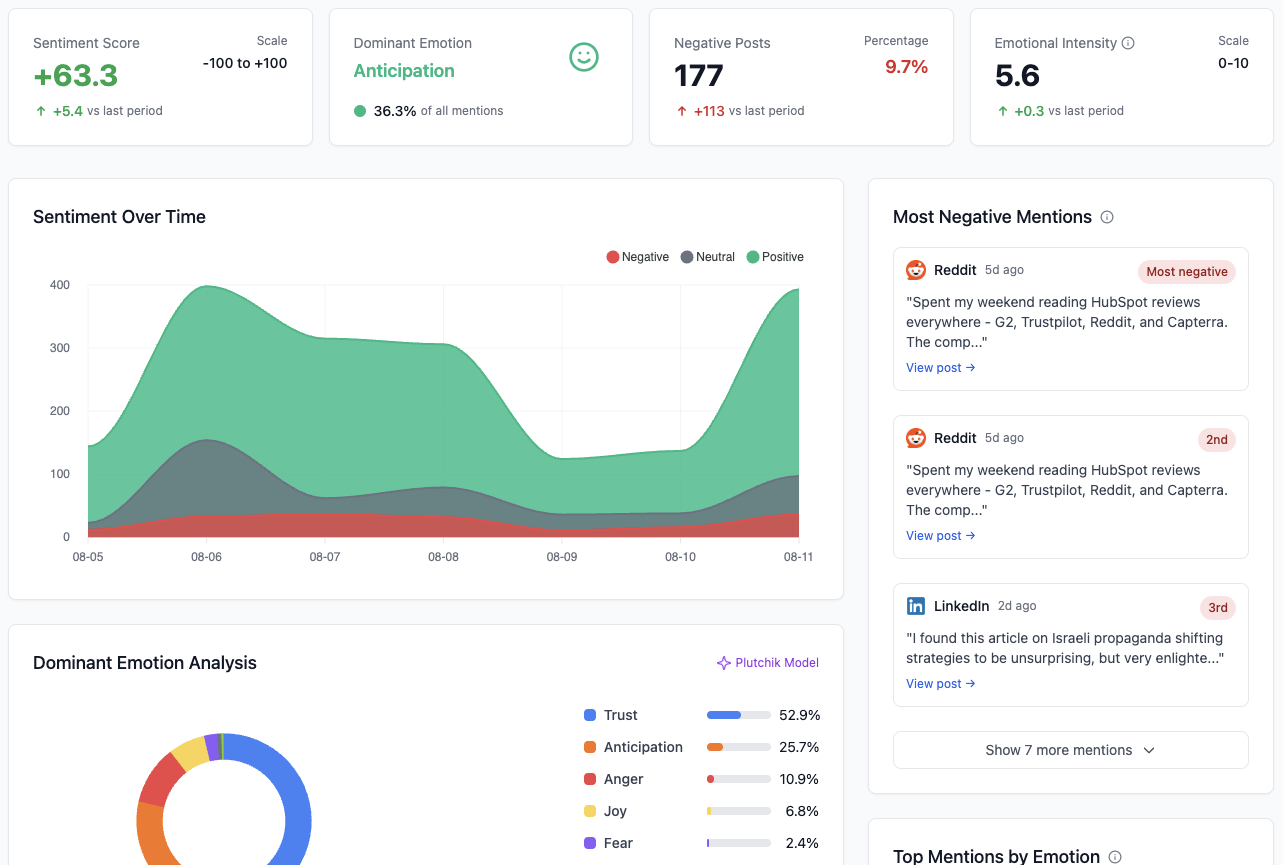
- Sentiment Analysis: Using AI, this classifies mentions as positive, negative, or neutral. A sudden nosedive into negative sentiment can be the canary in the coal mine for a PR crisis or product flaw, giving you a chance to get ahead of it.
- Conversation Trends: This involves tracking the topics and themes that pop up alongside your brand mentions. Are people talking about your pricing? Your customer service? A specific feature? This tells you what’s actually resonating with your audience.
These metrics work together to tell a complete story. For example, a high mention volume looks great on paper. But if 80% of that volume is negative and a new competitor is eating into your share of voice, you’ve got a serious problem that a simple mention count would have completely missed.
Setting Up Your Social Listening Workflow
A practical workflow turns social listening from a passive chore into a proactive strategy. With a tool like ForumScout, you can automate the whole process and get real-time alerts from the places where people have authentic conversations, like Reddit, niche forums, LinkedIn, and X (formerly Twitter).
Here’s a simple way to set it up:
- Define Your Keywords: Start with the obvious: your brand and product names. Then, get creative and add common misspellings, key executives, and branded hashtags.
- Add Your Competitors: You need a benchmark. Track two or three of your main rivals to see how you stack up. This is essential for calculating share of voice and spotting their weaknesses (or wins).
- Monitor Industry Topics: Go broader and track industry terms or the problems your product solves. This is a brilliant way to find potential customers who don’t know you exist yet but are actively looking for a solution.
This setup ensures you’re not just listening for your own name but are also tuned into the wider competitive and industry context, giving you much richer data to work with.
The Power of AI in Analysing Sentiment
Understanding audience emotion is where AI-powered tools really prove their worth. AI sentiment analysis can instantly process thousands of mentions, saving you countless hours of manual work and giving you a clear, immediate snapshot of brand perception.
This is especially important in a market like the UK, where consumer sentiment can be incredibly nuanced.
For instance, a recent report from Jones Knowles Ritchie, Ipsos, and the British Chambers of Commerce surveyed over 3,000 members of the British public on their perception of 'Brand Britain'. It found that brands tapping into traditional British traits—like wit and endurance—saw a 43% uplift in emotional connection. This just goes to show how understanding specific cultural sentiments can directly impact your brand’s health.
For a UK-based tool like ForumScout, which uses AI-driven sentiment analysis to monitor these conversations, insights like these prove the tangible value of tracking not just what is said, but the feeling behind it.

A dashboard that visualises sentiment makes it incredibly easy to spot trends at a glance. You can instantly see if the online buzz is positive or negative, allowing you to quickly diagnose problems or double down on what’s working. By mastering these techniques, you can turn the endless stream of online conversation into your most valuable source for real-time brand awareness measurement.
Building Your Brand Awareness Dashboard

So you’ve started collecting data from surveys, social listening, and web analytics. That’s a great first step, but isolated metrics are just noise. The real power comes from pulling all those disparate data points into a single, cohesive view. A well-built dashboard is what turns raw numbers into a clear story, letting your team spot trends, measure campaign impact, and make informed decisions on the fly.
Your goal here is to move from simply gathering data to taking data-driven action. This means creating a central hub where key metrics aren't just stored, but visualised in a way that’s dead simple for anyone in the business to understand. A good dashboard eliminates the need to jump between five different tools just to get an answer.
Designing Your Dashboard Blueprint
Think of your dashboard as the cockpit for your brand’s health. It needs to show the most critical information at a glance, but also let you drill down into the details when something catches your eye. A truly effective dashboard blends those high-level performance indicators with the more granular, diagnostic metrics.
Here’s a practical blueprint for the essential components:
- Top-Level Brand Health: This section should feature your North Star metrics. Dedicate a couple of widgets to unaided and aided brand recall from your latest survey results. This gives you a clean snapshot of both memory and recognition.
- Web-Based Awareness Signals: Next, pull in key data from Google Analytics. You’ll want a trend line for Direct Traffic and another for Branded Search Volume. These are powerful, direct indicators of brand-driven intent.
- Social and Conversational Context: This is where you bring in your social listening data. Visualise your Share of Voice (SOV) with a pie or bar chart that stacks your brand against key competitors. Right alongside it, display a Sentiment Trend graph showing the percentage of positive, neutral, and negative mentions over time.
A great dashboard doesn’t just report what happened; it provides the context to understand why it happened. Seeing a dip in Direct Traffic alongside a spike in negative sentiment tells a much richer story than either metric alone.
Operationalising Your Data with Automation
Manually updating a spreadsheet every week just isn’t going to cut it. The key to making your dashboard a living, breathing tool is automation. This ensures the data is always fresh, cuts down on tedious manual work, and frees up your team to focus on analysis instead of data entry.
Modern tools make this process surprisingly straightforward. A social listening platform like ForumScout, for instance, can be connected to other tools to automate the entire information flow.
- Google Sheets Integration: Many tools offer a direct integration. You can set up a connection that automatically pushes new mention data—including the content, source, and sentiment score—into a Google Sheet every hour. That sheet then becomes the live data source for all your charts.
- Webhooks for Advanced Dashboards: For a more advanced setup, webhooks are your friend. This method lets you send data from a tool like ForumScout directly into a business intelligence (BI) platform like Google Data Studio or Microsoft Power BI. This opens up far more sophisticated options for data blending and visualisation.
Setting up automated alerts is another critical step. You can configure notifications to hit your team’s Slack or email when a metric crosses a certain threshold—for example, if negative sentiment spikes by more than 20% in a 24-hour period. This transforms your dashboard from a passive reporting tool into an active monitoring system. This focus on real-time data is essential, and you can learn more about how to measure the reach of your brand's message in our related guide. By building a clear, automated, and insightful dashboard, you ensure that brand awareness measurement becomes an integral part of your team's weekly rhythm.
Got Questions About Brand Awareness? We’ve Got Answers
Even with the best strategy laid out, you’re bound to hit a few practical questions when you start measuring brand awareness. It happens to everyone. Let's tackle some of the most common ones I hear from teams just getting started.
How Often Should I Actually Measure This Stuff?
The real answer? It depends on what’s happening with your business.
For a general pulse check on brand health, looking at your metrics quarterly is a great rhythm. It’s frequent enough to spot real trends but not so often that you’re drowning in day-to-day noise. A mix of survey data and your core digital metrics will give you a solid baseline.
But that all goes out the window during a big moment. If you’re launching a major campaign, dropping a new product, or—god forbid—handling a PR crisis, you need to switch to real-time monitoring. This is where social listening tools become your best friend, letting you see the immediate impact and sentiment shifts as they happen, sometimes hour by hour.
A good middle ground is to set up a regular monthly dashboard report while using real-time alerts for any sudden spikes in your mention volume or a nosedive in sentiment.
What’s a “Good” Number for Brand Awareness Anyway?
This is the million-dollar question, but there’s no magic number. A “good” benchmark is completely relative. It depends on your industry, how crowded your market is, and whether you’re a fresh startup or an established leader. The two look wildly different.
Instead of chasing a universal number, benchmark against what actually matters:
- Your past self: Is your awareness growing over time? This tells you if your efforts are actually working.
- Your direct competitors: How do you stack up against the other players in your space? This gives you context.
Fire up a social listening tool and get a baseline for your share of voice against two or three of your main rivals. From there, your goal is simple: make that percentage grow. For survey metrics like recall, you can sometimes find industry reports that offer benchmark data for your specific sector.
Can I Do This on a Shoestring Budget?
Absolutely. You don’t need a massive budget to get started.
While big, formal surveys can get pricey, there are plenty of free and low-cost ways to get a read on awareness. You can start today without spending a penny. Just open up your Google Analytics account and look at your direct traffic and branded search volume. Google Trends is another fantastic free tool for comparing search interest in your brand versus your competitors.
When it comes to social media, surveys often use aided recognition to see if people know who you are. A Statista survey of UK internet users, for instance, used logos and names to gauge familiarity. They found Facebook hit a huge 96% awareness, with Instagram and YouTube right behind at 95%. It just goes to show how powerful a simple visual prompt can be.
You don't need an enterprise-level budget to get meaningful insights. The key is to be resourceful and focus on the metrics that give you the most signal for the lowest cost, like direct traffic and share of voice.
For social listening, tools like ForumScout were built specifically for startups and smaller businesses. You get powerful metrics like mention volume and sentiment analysis without the eye-watering price tag of legacy enterprise tools. You can even run small-scale surveys with something like Google Forms and send them to your email list or social followers to get that direct feedback.
Ready to turn online conversations into actionable insights? With ForumScout, you can monitor brand mentions in real-time, analyse sentiment, and track your share of voice without breaking the bank. Start your free 7-day trial today and see what people are really saying about your brand. https://forumscout.app