
- 23 min read

Our Guide to Monitoring Social Media for Business Growth
Think of social media monitoring as having a digital ear to the ground. It's the simple, systematic act of tracking online conversations, brand mentions, and industry trends as they happen. It lets you hear what customers, competitors, and the public are saying about you in real time.
Unlocking Insights from Online Conversations
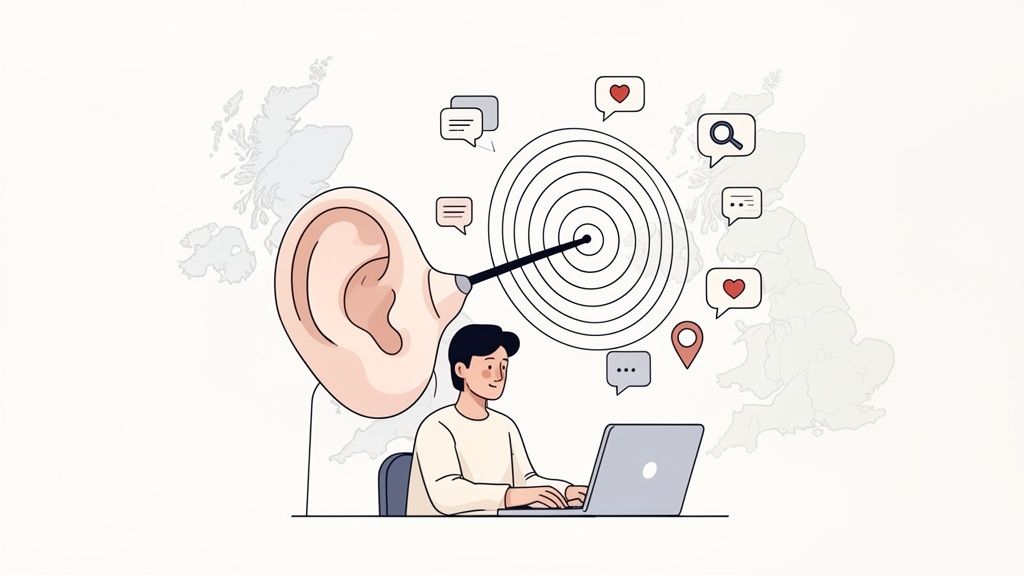
If your business is a ship on the vast ocean of the internet, then social media monitoring is your radar. It’s the tool that spots everything from hidden treasure (like new sales opportunities) to dangerous icebergs (like a looming PR crisis) long before you see them with your own eyes. This isn't just about counting likes; it's about turning unstructured chatter into structured business intelligence.
At its core, monitoring involves actively keeping tabs on specific keywords, hashtags, and mentions of your brand across a whole host of platforms. We're talking about the big players like Facebook and X (formerly Twitter), but also crucial community hubs like Reddit and niche industry forums. The goal is to collect the raw data—the "what" of the conversation.
Why Monitoring Is a Business Necessity
In the UK, the sheer volume of online chatter makes monitoring a non-negotiable part of any serious business strategy. As of January 2025, there are 54.8 million active social media users in the United Kingdom, which is a staggering 79.0 percent of the entire population. A huge chunk of your customers are online right now, sharing opinions and experiences. Are you listening?
Getting monitoring right delivers some serious advantages:
- Early Crisis Detection: It’s your early warning system. You can spot a sudden spike in negative comments or complaints and jump on it before it spirals into a disaster.
- Direct Customer Feedback: You get raw, unfiltered opinions on what people love (and hate) about your products. This is a direct pipeline to making real improvements.
- Competitive Intelligence: By keeping an eye on your competitors, you can see where they’re slipping up, spot gaps in the market they’ve missed, and learn from their wins.
- Lead Generation: People are constantly asking for recommendations online. Monitoring for phrases like "can anyone suggest a..." lets you find potential customers who are actively looking for a solution you offer.
The 'What' Versus the 'Why'
It’s easy to get monitoring mixed up with its strategic cousin, social listening. They're related, for sure, but they do different jobs. Monitoring is about collecting the data in the moment, while listening is about stepping back to analyse that data to understand the bigger picture.
To make this distinction crystal clear, here’s a quick breakdown of how they differ.
Social Monitoring vs Social Listening at a Glance
| Aspect | Social Monitoring (The 'What') | Social Listening (The 'Why') |
|---|---|---|
| Primary Goal | Reacting to individual mentions and conversations in real time. | Analysing trends and sentiment to inform long-term strategy. |
| Scope | Tactical and immediate. Focuses on specific keywords and brand names. | Strategic and forward-looking. Examines the broader market and audience. |
| Key Actions | Responding to customer queries, flagging negative feedback, engaging with users. | Identifying market gaps, tracking brand health over time, refining campaigns. |
| Analogy | A firefighter putting out individual fires as they pop up. | A fire chief analysing data to prevent future fires from starting. |
This table shows that while both are valuable, they serve different purposes. Monitoring is the foundation, and it's what we'll be focused on building here.
Social media monitoring is the reactive process of gathering mentions and responding to individual conversations. Social listening is the proactive process of analysing the data behind those conversations to guide your business strategy.
Think of it like this: monitoring is the firefighter rushing to an alarm—it’s immediate and tactical. Listening is the fire chief studying incident reports to spot patterns and prevent future fires. You need both for a complete safety strategy, but this guide will focus on building a rock-solid monitoring framework first.
How Monitoring Drives Real Business Value
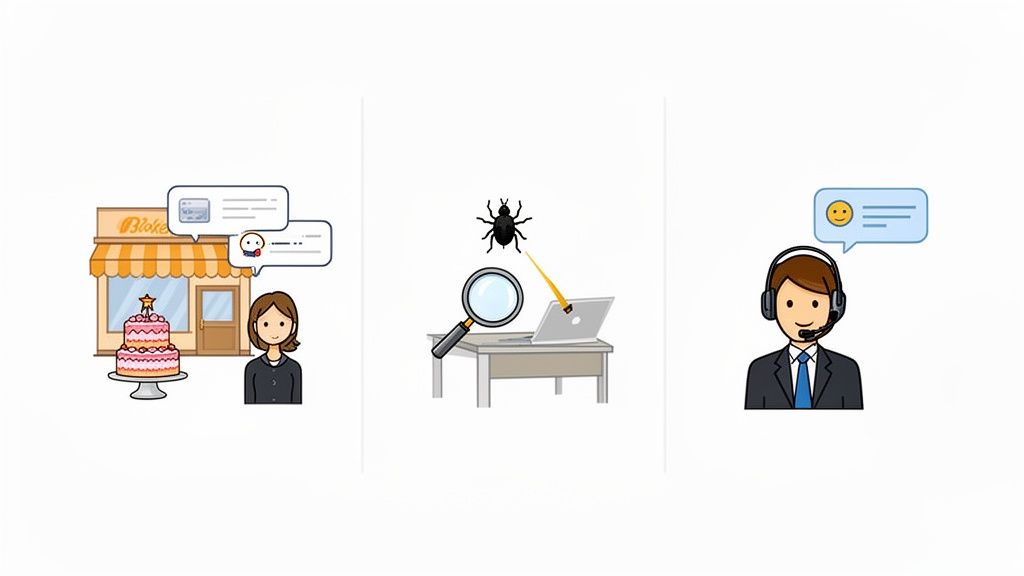
Let's move from concept to cashflow. Here are four core ways monitoring delivers real, practical value, connecting online discussions directly to your bottom line.
Track and Improve Your Brand Health
Your brand's health is simply what the public thinks of you, and those perceptions are shaped every single day in online conversations. Monitoring is your real-time brand health check-up, letting you measure sentiment around your company, products, and services. You get to see what people love and, maybe more importantly, what drives them nuts.
A sudden dip in positive sentiment can be the canary in the coal mine—the first warning of a product flaw or a breakdown in customer service. Catching it early means you can fix the root problem before it snowballs into a reputation crisis. Tracking these trends consistently helps you make smarter moves to strengthen how customers see you.
Gain a Competitive Intelligence Advantage
Your competitors' customers are an absolute goldmine of information, and they’re talking openly on social media. By listening in on mentions of your rivals, you can spot their weaknesses, identify gaps in the market, and learn from their mistakes without having to make them yourself.
Imagine a software startup that starts monitoring its main competitor. They might find a steady stream of complaints about a buggy feature or an unpopular price hike. That intelligence is priceless.
- For Sales: The team can now tailor their pitches, pointing out how their product solves the exact issues people are griping about.
- For Product Development: The product team gets a direct line into market demand, helping them prioritise features that will pull in unhappy customers from the competition.
- For Marketing: The marketing team can build campaigns that hit those specific pain points, making their messaging far more potent.
Suddenly, monitoring isn't a passive task anymore. It’s an active strategy for snatching up market share.
Generate High-Quality Leads
People are constantly asking for recommendations on social media, signalling direct buying intent. If you monitor these conversations, you can find potential customers at the exact moment they’re looking for a solution. It's one of the most direct ways to find warm leads.
A local bakery, for example, could set up a search for phrases like "cake recommendation" or "best birthday cake" within a 10-mile radius of their shop. When someone posts asking for ideas, the bakery can jump in with a helpful, non-pushy reply, turning a simple conversation into a sale.
This works so well because you're adding value at the precise moment it’s needed, building goodwill and driving business at the same time.
Deliver Proactive Customer Service
In today’s world, customers often head to social media to vent before they even think about sending an email or picking up the phone. In fact, studies show 47% of consumers have used social media to complain about a company's customer service. Monitoring helps you find these support requests and complaints, even when your brand isn't tagged.
When you find a post from a frustrated customer who just mentions your product by name, you can step in and offer a solution publicly. This kind of proactive support doesn't just solve one person's problem; it shows everyone else watching that you actually care. It turns a potential negative into a powerful showcase of your commitment to great service.
Building Your Social Monitoring Framework
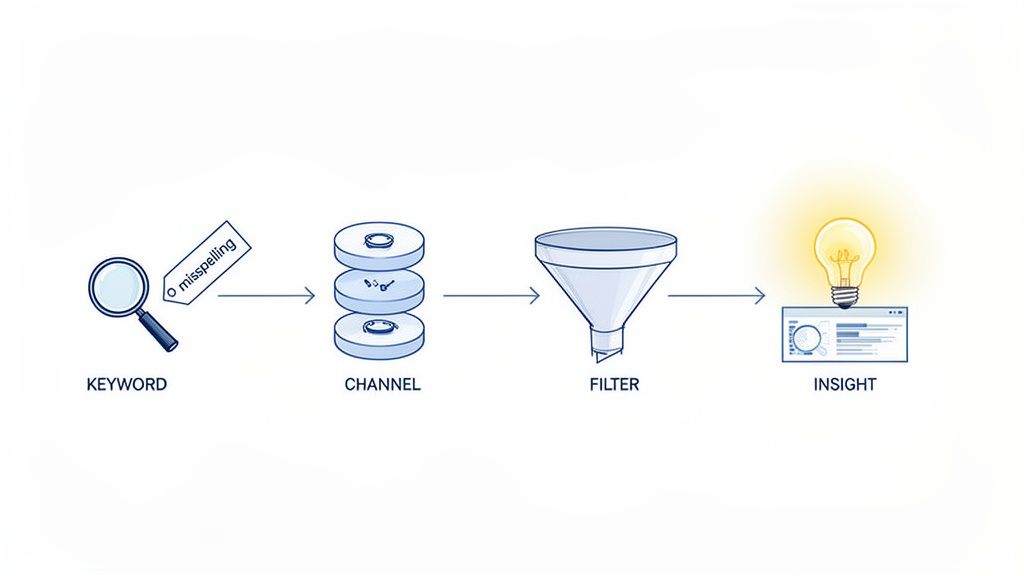
Think of it like building a custom water filtration system for your business. The raw social media landscape is a muddy river, full of everything from valuable minerals (customer insights) to random debris (spam and irrelevant chatter). Your framework is the series of pipes and filters designed to capture only what you need, delivering clean, actionable intelligence. This process ensures you never miss the conversations that actually matter.
Step 1: Define Your Core Objectives
Before you track a single keyword, you have to know why you're monitoring in the first place. Your goals will dictate every other decision you make, from the keywords you choose to the platforms you watch. Vague goals like "find mentions" just lead to vague, useless results.
Instead, get specific. Are you trying to find unhappy customers of a competitor? Do you want to discover people asking for product recommendations in your local area? Is your main goal to catch negative feedback about your brand before it snowballs? Each objective requires a totally different setup.
Common objectives for social media monitoring include: * Brand Health Tracking: Understanding public perception and sentiment towards your brand. * Competitive Intelligence: Identifying competitor weaknesses and gaps in the market. * Lead Generation: Finding users who are showing purchase intent or asking for recommendations. * Customer Support: Proactively finding and resolving customer issues, even when they don't tag you.
Your framework's success hinges on clarity. A well-defined goal acts as a compass, ensuring every search query and filter you create is pulling you in the right direction.
Step 2: Choose Your Keywords and Phrases
With your objectives locked in, it's time to choose the keywords that will act as your listening posts. This goes way beyond just your brand name. A comprehensive keyword list is the heart of your monitoring setup, making sure you capture the full scope of relevant conversations.
Your list should be organised into distinct categories. This strategic approach keeps your alerts from becoming a jumbled mess and makes the analysis much easier down the line.
Essential Keyword Categories 1. Brand Terms: Your full company name, product names, and any common abbreviations or acronyms people use. 2. Common Misspellings: Don't assume everyone spells your name correctly. Always include frequent typos (e.g., "ForumScut" instead of "ForumScout"). 3. Competitor Terms: List your top competitors' brand and product names. This is absolutely vital for competitive intelligence and spotting opportunities. 4. Industry and Problem-Based Terms: Track phrases related to the problems your product solves, like "social listening tool for startups" or "how to find reddit mentions."
Step 3: Identify Your Key Channels
You can't be everywhere at once, and you shouldn't even try. Focus your efforts on the platforms where your target audience is most active and where the conversations relevant to your goals are actually happening. Monitoring Facebook for developer feedback is probably a waste of time if they're all discussing issues on Reddit and Hacker News.
A B2B software company might prioritise LinkedIn and X (formerly Twitter) for industry trends. On the other hand, a D2C brand selling fashion accessories would get far more value from Instagram and TikTok, where visual trends dominate. The key is to match the channel to your audience and your goals.
Step 4: Construct Your Search Queries
This is where you bring your keywords and channels together to create powerful search queries. You can start simple, but don't be afraid to get more precise using filtering logic. Most modern monitoring tools let you move beyond basic keyword tracking by using operators to refine your search.
This is often done with Boolean logic, which uses simple operators like AND, OR, and NOT to create highly specific rules.
- AND narrows your search (e.g.,
BrandXANDreview). - OR broadens your search (e.g.,
BrandXORProductY). - NOT excludes terms (e.g.,
BrandXNOTjob opening).
For example, a query like ("competitor name" OR "competitor product") AND ("complaint" OR "issue" OR "broken") is incredibly effective for pinpointing customer frustration with a rival. This level of precision is what separates a professional monitoring framework from a simple keyword alert, guaranteeing you get high-signal, low-noise results every time.
Tracking the Metrics That Actually Matter
Collecting data is the easy part. Where most people get stuck is turning that mountain of mentions, likes, and shares into something genuinely useful. Piles of numbers mean nothing without a clear story of what they mean for your business.
Think of it like a doctor reading a patient's chart. A single number, like a slightly elevated heart rate, isn't cause for panic on its own. But when you look at it alongside blood pressure, patient feedback, and other tests, you get the full picture. Your social monitoring metrics work the same way—they need context to reveal the true health of your brand online.
Volume Metrics: The Foundation of Your Analysis
Volume metrics are your starting point. They're the most straightforward, telling you how much conversation is happening around your brand. This gives you a baseline for everything else you measure.
- Mention Volume: This is simply the total number of times your brand, products, or competitors are mentioned online over a set period. A sudden spike is your first clue that something is up—it could be a new campaign taking off, a viral post, or the start of a PR headache.
- Reach: This metric estimates the potential number of people who could have seen a mention. It’s the difference between a complaint seen by ten people and one seen by ten thousand, helping you understand the real visibility of a conversation.
These numbers set the stage, but they don't tell the whole story. A high volume of mentions is only great if the conversation is a positive one.
Engagement Metrics: Gauging Audience Interaction
Engagement metrics tell you if people actually care. They measure how your audience is interacting with the conversation, moving beyond just passive views to active participation. This is where you find out if your brand's story is compelling enough for people to get involved.
Key engagement metrics are things like shares, comments, likes, and clicks. A post with tons of shares but few comments might be informative but not conversational. On the other hand, high comment volume signals a topic that’s really hitting a nerve. Digging into these interactions is essential for fine-tuning your content. For a deeper dive, check out our detailed guide on how to calculate your engagement rate.
High engagement shows that your message isn't just being heard—it's actively resonating with your audience. It's the moment passive viewers turn into active participants in your brand's story.
Qualitative Metrics: Understanding the "Why"
This is where the real magic happens. Qualitative metrics give you the context, tone, and feeling behind the numbers, turning raw data into genuine business intelligence.
- Sentiment Analysis: This is your most critical early-warning system. It automatically sorts mentions into positive, negative, or neutral categories. A sudden surge in mentions is only a crisis if it's paired with a sharp drop in sentiment.
- Share of Voice (SOV): This metric compares your brand's mention volume to your direct competitors. It directly answers the question, "How much of the industry conversation are we actually owning?" A growing SOV is a clear sign your marketing efforts are capturing more attention than the competition.
The importance of this kind of detailed analysis is backed up by what's happening in the UK market. The social media industry in the UK is projected to pull in £12.5 billion in revenue in 2025. Even more telling, a massive 48.6% of adult internet users—that's nearly 24 million people—use these platforms to research brands before they buy. It’s clear why so many businesses are finally getting serious about monitoring.
To give you a clearer picture, here’s a quick breakdown of the most important metrics and what they really tell you about your business.
Key Social Monitoring Metrics and Their Business Meaning
| Metric | What It Measures | Business Question It Answers |
|---|---|---|
| Mention Volume | The total number of times your brand is mentioned. | How much are people talking about us? |
| Reach | The potential audience size for your mentions. | How visible is the conversation about our brand? |
| Engagement Rate | The percentage of your audience interacting with content. | Is our content resonating with our audience? |
| Sentiment Score | The ratio of positive, negative, and neutral mentions. | How do people generally feel about our brand? |
| Share of Voice (SOV) | Your brand's conversation volume vs. competitors. | Are we leading the conversation in our industry? |
| Click-Through Rate (CTR) | The percentage of people who click a link in your post. | Is our content driving action and traffic? |
Tracking these metrics together provides a complete, actionable view of your brand's performance. It’s not about watching every single number, but about focusing on the ones that connect directly to your business goals.
Finding Better Insights with AI and Boolean Logic
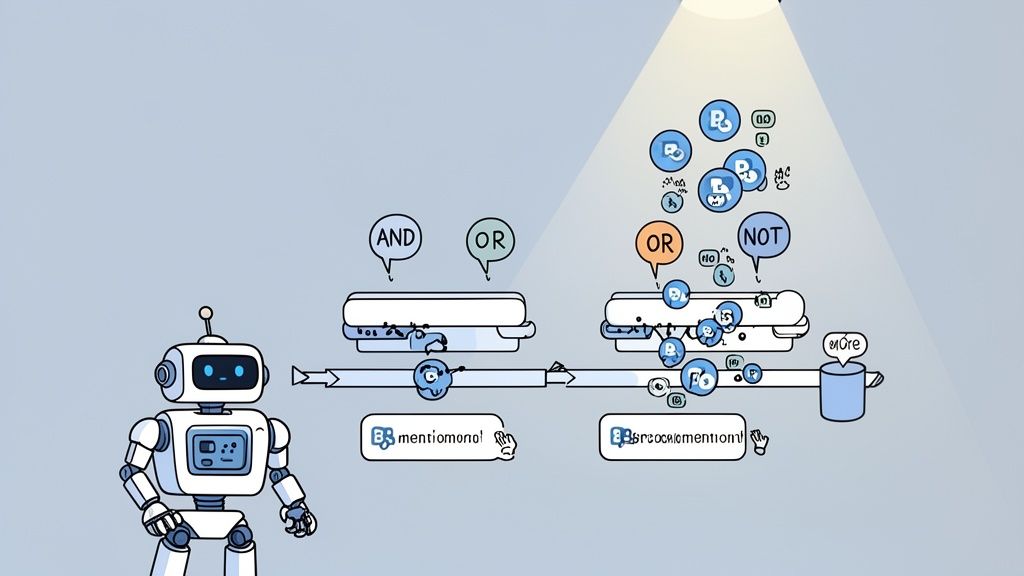
Think of it like fishing. A simple keyword alert is like casting a massive net that catches everything—the fish you want, but also old boots, seaweed, and rubbish. Boolean logic helps you design a smarter net, one with specific openings to catch only the right type of fish. AI then acts like a sophisticated sonar, showing you exactly where the most valuable fish are swimming.
Mastering Precision with Boolean Logic
Boolean logic is a simple but incredibly effective way to refine your search queries. It uses three basic operators—AND, OR, NOT—to create specific rules for what your monitoring tool should find and what it should ignore.
Getting these operators right allows you to slice through the clutter and zero in on conversations that actually matter.
- AND narrows your search by requiring all your keywords to be in the same mention.
- Example:
"my brand" AND "review"will only show you posts that contain both your brand name and the word “review.” Simple.
- Example:
- OR broadens your search by finding mentions that contain at least one of your specified terms.
- Example:
"complaint" OR "issue"is a lifesaver for customer support, catching mentions of either keyword.
- Example:
- NOT excludes mentions that contain a specific word you don’t want.
- Example:
"my brand" NOT "job opening"filters out all the recruitment chatter, letting you focus on customer conversations.
- Example:
By combining these, you can build some seriously sophisticated queries. A search for
"competitor name" AND ("price" OR "cost") NOT "discount"instantly finds people talking about your competitor's pricing—a goldmine for any sales team.
This level of control ensures your alerts are packed with relevant insights, not random noise. It’s the first real step to making your monitoring efforts truly effective.
Amplifying Your Efforts with AI
While Boolean logic refines what you search for, AI takes things a step further by understanding the context and intent behind the words. This is where modern monitoring gets really powerful, especially when you need to analyze social media comments with AI to uncover sentiment and emerging topics. The best tools are moving beyond just matching keywords to actually interpreting meaning.
For example, a platform like ForumScout uses AI to let you filter mentions with plain English commands. Instead of wrestling with a complex Boolean string, you just tell the system what you’re looking for.
AI-Powered Filtering in Action
* Goal: Find potential customers who are unhappy with a competitor's pricing.
* Plain English Command: 'find people complaining about our competitor's price'
* What AI Does: The system doesn't just look for keywords like "price." It analyses the sentiment, context, and emotion of each mention, scoring it for relevance and surfacing only the most promising leads.
This automates the most soul-destroying part of monitoring: manually sifting through hundreds of posts just to find the one or two that matter. To see how this works in practice, check out our guide on the top AI social listening tools available today. AI turns your monitoring setup from a passive data collector into a proactive intelligence engine, freeing up your team to focus on strategy, not endless filtering.
How to Choose the Right Monitoring Tool
Picking the right tool can make or break your entire social media monitoring strategy. Think of it like this: you wouldn't take a city car on a rugged, cross-country trek. It might get you started, but it’ll fall apart on rough terrain and struggle on the motorway. A basic monitoring tool is the same—it might catch a few obvious brand mentions but will leave you completely blind to crucial conversations happening across the wider web.
Your goal is to find the all-terrain vehicle of monitoring platforms. Something powerful enough to navigate the whole social web, precise enough to keep you on track, and affordable enough that it doesn’t blow your budget. For most businesses, this is all about balancing robust features with scalable pricing.
Core Criteria for Evaluating Tools
When you start comparing options, zoom in on three non-negotiable criteria. Get these right, and the tool will deliver real value. Get them wrong, and it’ll just become another subscription you barely use.
-
Comprehensive Channel Coverage: Does the tool actually monitor where your audience talks? The UK's social landscape isn't just one big platform; adult internet users here spend an average of 1 hour and 37 minutes on social media every single day, but where they spend that time varies wildly. For instance, TikTok users are on the platform for an average of 42 hours per month, while Facebook still pulls in a massive 58.4 million users. A tool that only watches X (formerly Twitter) is missing enormous chunks of the conversation. You need a platform that covers the majors but also digs into vital community hubs like Reddit and forums. Check out the latest UK digital trends for more insights.
-
Powerful Filtering and Alerting: A great tool doesn't just find mentions; it helps you find the right ones. Can you easily cut through the noise with Boolean logic or, even better, AI? The best platforms let you create smart alerts that only ping you when a genuinely relevant conversation happens, saving you from drowning in useless data.
-
Scalable and Transparent Pricing: Steer clear of tools with confusing enterprise pricing that feels designed to trip you up. Look for clear, tiered plans that can grow with your business. A startup shouldn't have to pay for features only a massive corporation would ever need.
Making the Right Choice for Your Business
To see how this works in practice, let's look at a tool like ForumScout. Its plans are built specifically for growing businesses.
- It offers broad coverage, tracking everything from LinkedIn to Reddit, making sure you don't miss out on key insights from niche communities.
- Its innovative AI filtering lets you write criteria in plain English (like, 'find people unhappy with our competitor'), which automatically brings the most relevant leads to the surface.
- The pricing is completely transparent. The Growth plan starts at just $19/month, making powerful, professional-grade monitoring genuinely accessible.
The right tool isn't the one with the most features. It's the one that delivers the specific insights you need, from the channels that matter most, at a price that makes sense for your business right now.
By using this simple checklist, you can confidently weigh up your options and pick a platform that fits your budget and truly empowers your team. For a deeper dive, check out our guide to the best social media monitoring tools available.
Frequently Asked Questions
Getting started with social media monitoring always brings up a few good questions. Here are some straightforward answers to the ones we hear most often, designed to help you set up your strategy and start turning conversations into valuable insights.
How Often Should I Be Monitoring Social Media?
Honestly, it depends entirely on your goals. If you're using monitoring for time-sensitive tasks like customer support or crisis management, you need to be on it constantly. Think real-time or hourly check-ins to catch problems before they snowball.
But for bigger-picture goals like tracking brand health or keeping an eye on competitors, a daily or weekly review is usually plenty. The trick is to find a rhythm that keeps you informed without drowning you in data.
What Is the Difference Between a Keyword and a Mention?
Getting this right is crucial, especially when you're looking at tool subscriptions. It's simpler than it sounds:
- A keyword is the specific word or phrase you tell your tool to look for. It could be your brand name ("BrandX"), a competitor, or an industry term like "best CRM for startups."
- A mention is a single result the tool finds that contains your keyword. So, if someone posts, "I love my new BrandX trainers!", that counts as one single mention.
When a plan says it includes 5,000 mentions per month, it means the tool will collect up to 5,000 individual posts containing your keywords.
Can Social Media Monitoring Really Help a Small Business?
Absolutely. In fact, it's one of the most powerful, cost-effective ways for a small business to gather proper market intelligence. It completely levels the playing field, giving you access to the kind of insights that used to be reserved for huge corporations with massive research budgets.
With the right setup, you can find people actively looking for what you sell, spot weaknesses in your competitors' offerings, and get raw, unfiltered feedback on your products—all without paying for a single expensive survey.
For a small business, social media monitoring isn't an expense. It's a direct investment in understanding your customers, gaining a competitive edge, and driving real growth.
How Should I Handle Negative Mentions?
The golden rule here is to respond quickly, publicly, and professionally. A fast, calm reply shows everyone watching that you take feedback seriously and genuinely want to make things right.
Start by acknowledging their frustration and offer a sincere apology for their experience. Then, invite them into a private channel—like a direct message—to sort out the specific details. This approach contains the problem while demonstrating top-notch customer service. Whatever you do, never delete negative comments unless they are obvious spam or abusive. Doing so can destroy trust in an instant.
Ready to turn conversations into customers? ForumScout gives you the power to monitor mentions across Reddit, X, LinkedIn, and more, with AI-powered filtering to find the insights that matter. Start your free 7-day trial and see what you've been missing at https://forumscout.app.