
- 22 min read

Your Guide to Reputation Management for Businesses
When we talk about reputation management for businesses, we're not just talking about some fluffy marketing term. It’s the hands-on process of watching, influencing, and ultimately controlling how the public sees your brand. This means keeping an eye on online conversations, jumping in to respond to customer feedback, and actively shaping the story people tell about you.
Put simply, it's taking the reins of your own narrative.
Why Your Reputation Is Your Most Valuable Asset
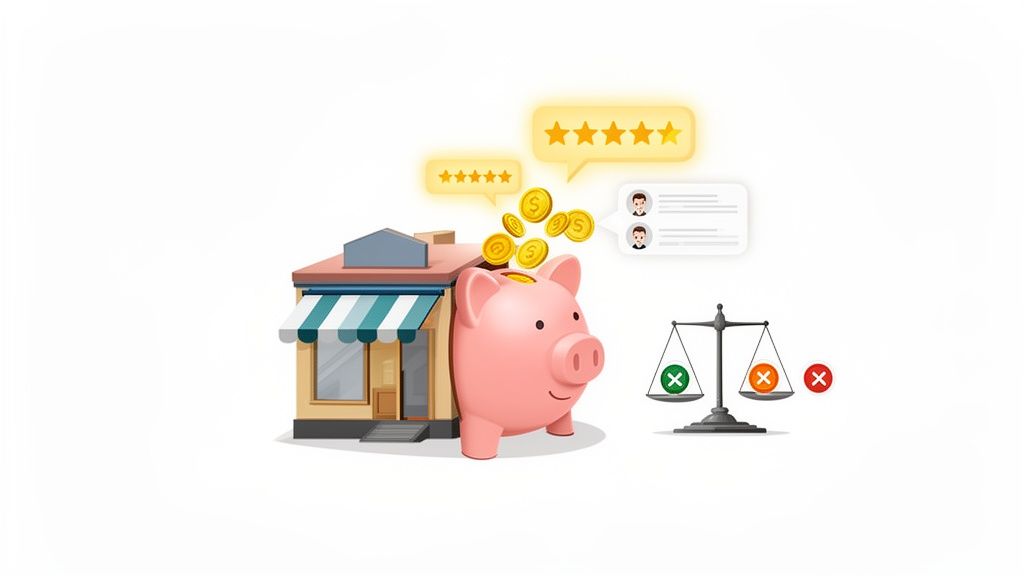
It helps to think of your reputation as your most critical financial asset, not just a vague concept. A great analogy is to see it as a bank account. Every glowing review, happy customer interaction, and bit of positive press is a deposit, steadily building your balance of goodwill and trust.
On the flip side, every negative comment, ignored complaint, or public blunder is a withdrawal. A few small withdrawals might not cause much of a stir, but a major one—or a constant drip of minor ones—can drain your account fast, leaving your brand exposed and vulnerable. A solid reputation acts as a much-needed buffer against the unexpected.
The Never-Ending Conversation
Whether you like it or not, conversations about your brand are happening all the time. They’re unfolding across a huge web of platforms, from Google reviews and social media threads to niche forums and news articles. Pretending this dialogue isn't happening doesn't make it stop; it just means you've given up your seat at the table.
This is where effective reputation management for businesses comes in. It’s your ticket to turning a potential minefield into a massive growth opportunity. It’s about switching from being a passive observer to an active participant in your own story.
By actively managing this asset, you're not just doing damage control. You're building a resilient brand that customers trust, champion, and stick with. This flips reputation from a defensive chore into a core part of your business strategy.
Turning Risks into Opportunities
This guide is your roadmap to taking back control of your brand’s narrative. We’ll walk you through exactly how to listen to what people are saying, engage with them constructively, and build a digital footprint that truly reflects your company's value. By the end, you'll see why this isn't just a "nice-to-have" but a non-negotiable for any modern business.
Proactive management helps you:
- Build Customer Trust: A transparent and responsive brand is one people feel good about spending their money with.
- Increase Profitability: A strong reputation directly impacts sales. In fact, studies show that a staggering 86% of people will think twice before buying from a business with negative online reviews.
- Attract Top Talent: A great reputation doesn’t just attract customers; it makes your company a magnet for skilled professionals who want to work for a winner.
Understanding Modern Reputation Management

Let's get one thing straight: modern reputation management for businesses isn't about damage control anymore. The old-school approach was like being a firefighter—you only showed up when a crisis was already raging.
Today, it's more like being a gardener. It's a continuous, hands-on process of planting positive seeds, nurturing growth, and weeding out problems before they take over. This proactive work cultivates a healthy, resilient brand that can weather any storm.
This whole effort really boils down to three core pillars. When they work together, they don't just protect your brand; they actively help it grow.
The Three Pillars of Reputation Management
Good reputation management isn’t a one-off task. It’s a cycle of three interconnected jobs that feed into each other, creating a powerful system for shaping how people see you.
- Monitoring: First, you have to listen. This means actively tracking what’s being said about your brand across the entire digital world—the good, the bad, and the neutral.
- Responding: Once you hear the conversation, you have to join in. That means replying to feedback, both glowing and critical, in a way that’s helpful and human.
- Building: Finally, you have to create your own story. This is about proactively putting out positive content that builds a strong, compelling narrative around your business.
Think of the internet as one giant, sprawling town square where everyone—customers, competitors, and random commentators—has a megaphone. If you’re not actively participating, your brand’s story is being told by everyone but you.
The Battlegrounds Where Reputation Is Forged
Your brand’s reputation isn’t built in a boardroom. It’s shaped every single day across a huge range of digital platforms. Each one is a critical battleground where public opinion is won or lost.
Here are the key places you need to be watching:
- Review Sites: Platforms like Google, Trustpilot, and Yelp are often the first stop for customers looking for proof that you’re the real deal.
- Social Media: Conversations on X (formerly Twitter), Facebook, Instagram, and LinkedIn can take a spark of sentiment and turn it into a wildfire in minutes.
- Industry Forums and Communities: Niche spots like Reddit or specialised industry forums are home to some of the most influential—and brutally honest—discussions out there.
- News and Media Outlets: A single article, good or bad, can dramatically shift how thousands of people perceive your business overnight.
Ignoring any of these channels is like leaving a flank completely unguarded. The consequences can hit your bottom line hard, especially when negative comments pile up. Consider this: research shows 86% of people will think twice before buying from a business with negative online reviews. And 63% of consumers say they’d lose trust if they saw mostly negative feedback. You can explore more data on the impact of negative press.
The goal of modern reputation management isn't to silence criticism. It's to become an active, respected participant in the conversation, demonstrating transparency, responsiveness, and a genuine commitment to customer satisfaction.
Connecting Reputation to Real Business Outcomes
At the end of the day, this isn't just a PR exercise. A strong, well-managed reputation translates directly into tangible business results. It builds customer trust, which is the bedrock of loyalty and repeat sales.
It also makes your company a magnet for top talent, giving you an edge in a competitive hiring market. By taking control of your narrative, you aren't just protecting your brand from harm. You are building a powerful asset that pays dividends in customer loyalty, revenue, and long-term, sustainable growth.
The Five Pillars of a Powerful Reputation Strategy
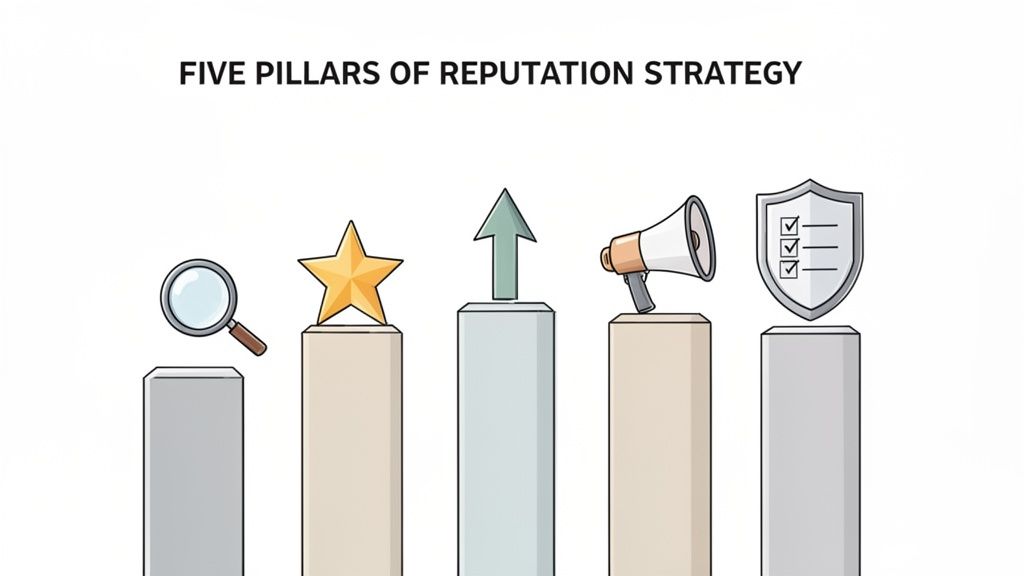
A great reputation isn't built on luck. It's the result of a deliberate, well-organised strategy. Think of it like a building – without strong pillars holding it up, it’s only a matter of time before things start to wobble. Your brand's reputation needs that same sturdy structure to grow and weather any storms.
This isn’t a "set it and forget it" task. Solid reputation management for businesses is a continuous process. So, let's break down the five essential pillars that form the foundation of a resilient brand. Each one tackles a different angle of how your business is seen, and together, they create a powerful system for both defence and growth.
Pillar 1: Digital Monitoring and Social Listening
You can't manage what you don’t measure. Simple as that. The first pillar is all about awareness—knowing exactly what’s being said about your brand, your competitors, and your industry across the entire web. This is your intelligence-gathering hub.
It involves using tools to automatically track brand mentions where real, unfiltered conversations happen, like Reddit, X (formerly Twitter), and niche industry forums. If you're not listening in, you're flying blind, completely unaware of a brewing customer issue or a golden opportunity to connect with someone ready to buy.
Think of social listening as your brand's early-warning system. It’s the smoke detector that alerts you to a smouldering customer complaint long before it erupts into a public wildfire.
Pillar 2: Active Review Management
Reviews are the new word-of-mouth, and they pack a serious punch. In fact, a whopping 93% of consumers say online reviews have influenced their buying decisions. This pillar is about getting hands-on with that feedback loop on crucial sites like Google, Yelp, and Trustpilot.
Active management really comes down to two things:
- Encouraging the Good Stuff: Systematically asking happy customers to share their experience helps you build up a bank of positive social proof. This creates a cushion of goodwill that can easily absorb the impact of the odd negative review.
- Responding to Everything: A prompt and professional response to all feedback is non-negotiable. Thanking a happy customer makes them feel valued. Properly addressing a complaint shows you’re listening and can often turn a disgruntled customer into a loyal advocate.
Showcasing powerful testimonials is one of the most direct ways to build trust and prove your reputation is well-earned.
Pillar 3: Search Engine Reputation Management
For most people, the first page of Google is your brand. What shows up there shapes their entire perception of your business. Search Engine Reputation Management (SERM) is a special kind of SEO that focuses on controlling this incredibly valuable digital real estate. The goal is simple: when someone Googles your brand, they should see positive, accurate, and brand-owned content first.
How do you do it? By creating and promoting high-quality content that you control, such as:
- Optimised blog posts
- Positive press releases and media coverage
- Your official social media profiles
- Customer success stories and case studies
By pushing this good content to the top of the search results, you naturally push any negative or irrelevant stuff further down, where almost nobody looks. It’s about owning your story where it matters most.
Pillar 4: Proactive Content and Public Relations
This is where you switch from defence to offence. Instead of just reacting to conversations, you start them. Proactive PR is about creating a steady stream of valuable content that establishes your brand as a helpful, trusted authority in your field.
This isn't about bragging. It’s about adding real value to your community through thought leadership articles, useful guides, engaging social media, and getting involved in industry discussions. When you consistently put out positive and helpful content, you build a strong digital footprint that defines your brand on your terms. All that positive noise makes it much harder for any negative chatter to gain traction.
Many businesses start with a reactive mindset, only scrambling to fix their reputation when a crisis hits. A proactive strategy, however, builds resilience long before trouble ever starts.
Here’s a quick comparison of the two approaches:
Proactive vs Reactive Reputation Management Approaches
| Aspect | Proactive Approach (Strategic) | Reactive Approach (Crisis-Driven) |
|---|---|---|
| Mindset | "Let's build a strong reputation now." | "Oh no, we have a problem. Fix it!" |
| Timing | Continuous, ongoing effort. | Triggered by negative events. |
| Actions | Building positive assets, monitoring, engaging. | Damage control, apologies, firefighting. |
| Focus | Long-term brand health and trust. | Short-term problem mitigation. |
| Tools | Social listening, SEO, content creation. | PR statements, legal teams, customer service scripts. |
| Outcome | Brand resilience, stronger customer loyalty. | Potential for lasting brand damage, loss of trust. |
Ultimately, a proactive stance gives you control over your narrative, while a reactive one forces you to play defence on someone else's terms.
Pillar 5: Crisis Response Planning
Even with the best strategy in the world, things can still go wrong. This final pillar is about being ready for the worst-case scenario. A crisis response plan is your pre-approved playbook that details exactly how your team will respond when a major reputational threat emerges.
A solid plan defines roles, communication channels, and key messages before a crisis hits. This preparation ensures you can act swiftly, calmly, and cohesively when tensions are high. Having that plan ready can be the difference between a quick recovery and a full-blown disaster that erodes customer trust and hits your bottom line hard.
How Social Listening Transforms Reputation Management

In a world buzzing with constant digital chatter, trying to keep track of every mention of your brand manually is a losing game. It’s like trying to listen to every single conversation in a packed stadium. This is where technology steps in as your most valuable ally, and social listening platforms are the engine that drives effective reputation management for businesses.
These tools are so much more than simple keyword alerts. Think of them as a sophisticated radar, continuously scanning social media, forums, news sites, and blogs for any conversation that matters to you. This real-time intelligence is the difference between proactively shaping your own narrative and just reacting to crises after the damage is already done.
From Raw Data to Actionable Insights
Modern platforms don’t just find mentions; they make sense of them. They use a combination of keyword tracking and AI-powered filters to sift through all the noise, delivering only the conversations you actually need to see. This lets you focus your energy where it has the most impact, instead of drowning in a sea of irrelevant data.
One of the most powerful features is sentiment analysis. With just a glance, you can get an instant pulse check on how the public feels about you. Is the chatter around your latest product launch positive, negative, or just neutral? Tracking this over time reveals trends and shows you whether your reputation efforts are actually working.
This data-driven approach takes the guesswork out of the equation. You can make strategic decisions based on what your audience is really saying and feeling, turning the chaotic web of online conversations into a clear dashboard for your brand's health. You can find out more about what social listening entails and how it provides this crucial layer of intelligence.
A Scenario Unfolding in Real-Time
Imagine this all-too-common situation: a customer has a bad experience with your product and posts a detailed complaint on a niche industry forum. Without a monitoring tool, that comment could sit there for weeks, festering and collecting agreement from other users. By the time it finally hits your radar, it's a full-blown community issue that has already hurt your credibility.
Now, let's replay that with a social listening tool in place.
- Instant Alert: The moment the negative comment goes live, your platform detects the keywords and the negative tone, triggering an instant notification for your team.
- Swift Response: Instead of silence, the customer gets a prompt, helpful reply directly on the forum within hours. You acknowledge their problem and publicly offer a solution.
- Positive Outcome: Other forum members see your proactive and professional response. The situation is de-escalated, and what could have become a crisis is now a public display of excellent customer care.
This quick intervention doesn't just solve the immediate problem; it builds serious trust and loyalty. It shows the entire community that you're listening and that you care, turning a detractor into a potential advocate. To learn more about how this works in practice, check out our detailed guide on what is social listening.
Uncovering Hidden Opportunities
Great reputation management for businesses isn’t just about putting out fires. Social listening tools are also incredible for spotting opportunities. By keeping an eye on competitors, you can identify their weaknesses and unhappy customers you could win over. You might discover a recurring feature request that inspires your next product update, or find an influential voice in your industry to partner with.
Social listening gives you the power to be proactive. It’s not just about defending your reputation; it’s about actively building it by finding and seizing opportunities to engage, innovate, and delight your audience.
By turning the firehose of online conversation into a structured stream of insights, these platforms allow you to manage your reputation with precision and foresight. They're an essential part of any modern business toolkit, enabling you to protect your brand, connect with customers, and drive sustainable growth.
Navigating Common Pitfalls and Real-World Recoveries
One of the smartest things you can do in business is learn from other people's mistakes. Even with the best intentions, reputation management is tricky, and it’s easy to stumble. Knowing the common blunders helps you sidestep them, while seeing how other brands bounce back gives you a powerful playbook for when things inevitably go sideways.
Mistakes happen. It’s unavoidable. But a thoughtful, well-executed recovery can actually build more trust than if the crisis never happened at all. It’s your chance to turn a negative moment into a showcase of your company's character and commitment to its customers.
Common Reputation Blunders to Avoid
So many businesses fall into the same traps when trying to manage their online image. Just being aware of these pitfalls is the first step toward avoiding them completely.
- Ignoring Negative Comments: The absolute worst thing you can do is nothing. When you ignore a bad review or a snarky social media comment, it sends a clear message: you don't care. This only fuels the customer's frustration and encourages them to shout even louder.
- Engaging in Public Arguments: You should always respond, but you must never, ever argue. Getting dragged into a defensive, back-and-forth battle online is a fight you simply can't win. It makes your brand look petty and unprofessional, alienating not just the original complainer but everyone else watching from the sidelines.
- Being Unprepared for a Crisis: A tiny spark can turn into a raging inferno in minutes online. Without a crisis plan, teams panic. Responses are slow, disjointed, or contradictory, and public trust evaporates. Having a clear protocol is the only way to ensure a calm, effective reaction. Our guide on communications crisis management gives you a solid framework for getting prepared.
The Anatomy of a Successful Recovery
When a brand faces a public mess and comes out stronger, it's rarely down to luck. Successful recoveries almost always share a few key ingredients that transform a potential disaster into a moment of genuine connection.
Think of the classic story of a popular food delivery service. A customer's post about a late, cold meal went viral. The company could have just offered a refund and called it a day. Instead, the CEO issued a public apology, transparently explained the logistical breakdown, and announced a new training programme for all their delivery partners. The response turned a simple complaint into a public commitment to do better.
The key takeaway is that recovery isn't just about saying sorry. It’s about taking ownership, demonstrating transparency, and showing a clear path to preventing the issue from happening again.
From Feedback to Innovation: A Case Study
Another powerful recovery story comes from a software company that kept getting hammered with feedback about its clunky user interface. Instead of getting defensive, the product team leaned into the criticism. They started a dedicated forum thread, invited their most vocal critics into a private beta group, and used their direct feedback to drive a total redesign.
When the new version launched, they publicly thanked the community for their "brutally honest but invaluable" input. The result?
- A vastly improved product that customers actually loved.
- The original critics turned into some of their biggest fans.
- A powerful brand story about a company that genuinely listens.
This approach teaches a crucial lesson in reputation management for businesses: negative feedback isn't just a threat to be managed. It's a free source of priceless market research that can fuel real innovation and growth.
Measuring the ROI of Your Reputation Efforts
So, how do you actually prove that all this reputation management work is worth the investment? It's easy to get caught up in vanity metrics like follower counts, but that won't convince your finance team. The real value comes from tracking specific Key Performance Indicators (KPIs) that tie directly to your bottom line.
A clear framework is essential for translating your activities into measurable results. Think of reputation management not as a cost centre, but as a strategic investment that actively protects and grows revenue. This means we need to focus on the numbers that really move the needle.
Tracking Perception Metrics
This first bucket of metrics is all about gauging how your audience feels about your brand. These give you a high-level snapshot of your brand's health and tell you if your messaging is hitting the mark.
- Sentiment Score: This is the pulse check of your brand. It measures the overall tone—positive, negative, or neutral—of conversations about you. A rising positive sentiment score is a solid sign your efforts are resonating.
- Share of Voice (SoV): This KPI shows how much of the conversation in your industry is about your brand compared to your competitors. A growing SoV means you're not just part of the conversation; you're starting to lead it. You can learn more about how to start share of voice measurement in our detailed guide.
Connecting to Performance Metrics
Next, we need to connect those warm, fuzzy feelings to cold, hard action. Performance metrics track how a good reputation influences what customers actually do—and whether it drives them closer to making a purchase.
Here are the key ones to watch:
- Referral Traffic: Keep an eye on how many people land on your website from places like review sites, positive news articles, or glowing social media mentions. A steady increase here shows your good name is actively sending qualified leads your way.
- Conversion Rates: Dig a little deeper. Analyse the conversion rates of traffic coming from that positive press or a top-rated review platform. This draws a direct line from a strong reputation to actual sales.
Proving ROI is absolutely critical for getting continued buy-in for your strategy. Research from Ipsos confirms there's a direct link between a company's reputation and its business efficiency. For UK businesses, the data is even more compelling: a positive online reputation can generate 6.9 times more leads, and companies that actively manage it see a 93% boost in customer satisfaction. You can discover more insights about the impact of reputation on business growth on electroiq.com.
Focusing on Financial Metrics
Finally, let's bring it all back to the money. Financial metrics are the ultimate proof of ROI, showing exactly how your reputation work contributes to the company's financial health.
Track customer lifetime value (CLV) to see if customers who came from positive channels stick around longer and spend more. You can also quantify the leads generated from positive mentions to put a direct monetary value on your brand’s glowing image.
Your Reputation Management Questions Answered
Diving into the world of reputation management can feel like opening a can of worms. Let's tackle some of the most common questions with straightforward, practical answers to give you a bit more clarity.
How Quickly Should I Respond to a Negative Review?
The golden rule is within 24 hours. A speedy reply shows the unhappy customer—and everyone else watching—that you're paying attention and you genuinely care about feedback.
Letting a negative comment sit for too long makes it look like you don't care, which just lets the bad feeling simmer and attract more eyeballs. Even if you don't have a perfect solution right away, a quick, "Thanks for letting us know, we're looking into this right now" can cool things down and buys you time while making the customer feel heard.
Can I Legally Remove a False Negative Review?
This is a tricky one. You can't just delete a review because you don't like it. But if a review is provably false, defamatory, full of hate speech, or breaks the platform's rules (like on Google or Trustpilot), you've got a case for getting it removed.
The process involves flagging the review directly on the platform and showing them exactly why it violates their policies. Be warned, it's often a slow-moving process and success isn't guaranteed. Your best bet is always to respond professionally and drown out the bad with a flood of good reviews.
What Is the First Step in Creating a Crisis Management Plan?
Before you can plan a response, you need to know what you might be responding to. The very first step is to identify potential risks and nightmare scenarios. Get a small team together and brainstorm all the things that could realistically go wrong for your specific business.
Think about things like:
- A faulty product that needs to be recalled.
- A customer complaint that goes viral on TikTok or X.
- An unflattering story in the local news.
- An employee saying something they shouldn't online.
Once you’ve listed out the most likely threats, you can start building a clear plan for each one, starting with what’s most probable.
How Much Should a Small Business Budget for Reputation Management?
There's no magic number here. Your budget really depends on your industry, size, and how much heat you're likely to face. The easiest way to think about it is in two buckets: technology and time.
For tech, a good social listening tool is a must-have. These can range from affordable plans perfect for startups to more powerful enterprise platforms. The other big cost is time—either your own or a team member's—spent monitoring conversations, responding to customers, and putting out positive content. A little proactive spending here often saves you a fortune down the road by stopping a full-blown crisis before it starts.
Ready to take control of your brand's story? ForumScout gives you the real-time social listening and sentiment analysis you need to guard your reputation and spot growth opportunities. Start your free 7-day trial today at https://forumscout.app.