
- 21 min read
A Guide to Sentiment Analysis for Social Media in 2026
Think about the last time you launched a campaign or product. You probably held your breath, waiting to see what people would say. That flood of comments, tweets, and posts is a goldmine of feedback, but trying to read it all manually is impossible.
This is where sentiment analysis comes in. It's the tech that automatically sifts through millions of online conversations to figure out the emotional tone behind them. In short, it sorts all that chatter into simple buckets: positive, negative, or neutral.
Understanding Social Media Sentiment Analysis
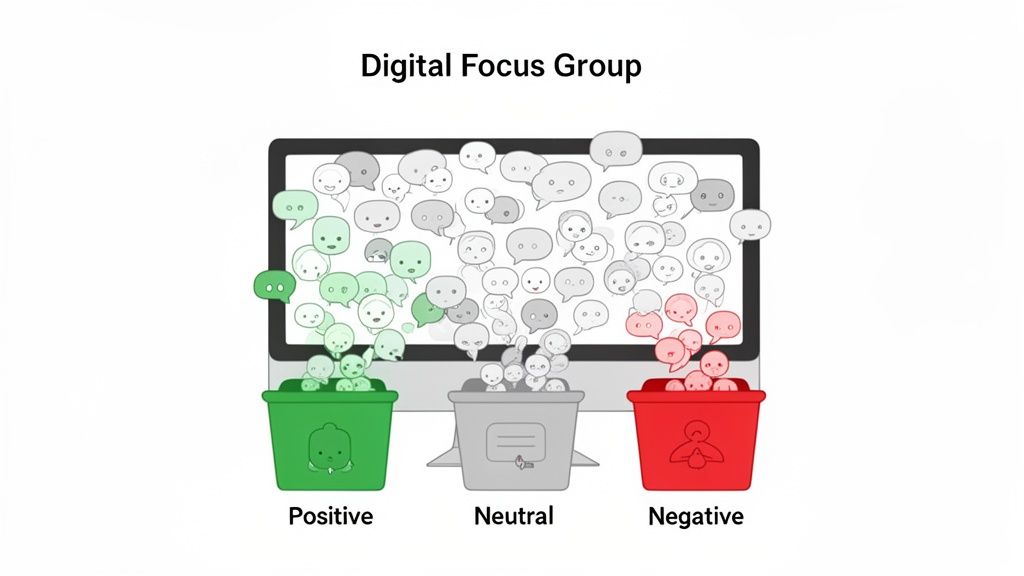
Imagine a digital focus group that works 24/7 at a massive scale. That’s sentiment analysis. It goes way beyond just counting keywords; it digs into the context and feeling of what people are actually saying about you online.
This gives you an organised, bird's-eye view of public perception in real time. By putting a number on feelings, you can track your brand's health, see how a new campaign is landing, or spot a PR crisis before it blows up.
To give you a clearer picture, here’s a quick breakdown of what social media sentiment analysis really means for your business.
Sentiment Analysis at a Glance
| Component | Description |
|---|---|
| What | The automated process of sorting social media text into positive, negative, or neutral categories. |
| Why | To get a real-time pulse on public opinion, track brand health, and make smarter strategic decisions. |
| How | By using Natural Language Processing (NLP) and AI to analyse the emotional tone and context of conversations. |
This table shows how simple the core idea is, but its application is what truly makes the difference.
From Data Points to Strategic Direction
The real magic of sentiment analysis is turning all that messy online chatter into clear, actionable insights.
Let’s say you launch a new feature and suddenly see a spike in negative sentiment. That’s a red flag for your product team to jump on a potential bug. On the flip side, a wave of positive comments after a marketing campaign is solid proof that your messaging hit the mark. This is a crucial part of any good reputation monitoring service, as it helps you protect and grow your brand’s image.
Ultimately, this isn’t just about data; it’s about connecting with your customers on an emotional level. It lets you celebrate with them when they’re happy and step in to help when they’re frustrated, building the kind of loyalty that lasts.
How Sentiment Analysis Technology Works
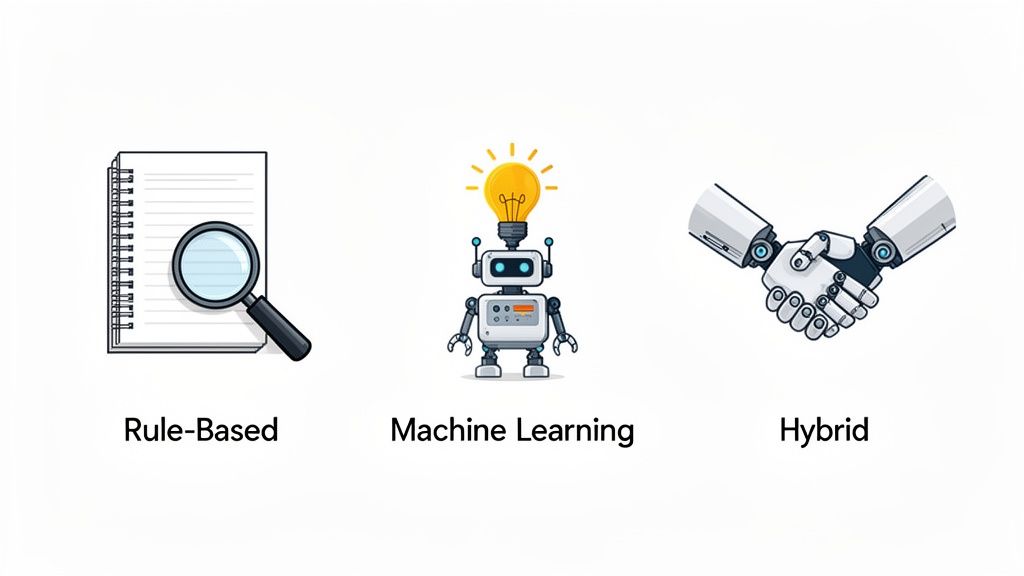
Different tools use different methods to get there, and each one comes with its own trade-offs in speed, accuracy, and the ability to handle tricky language. Let's lift the bonnet and look at the three main engines that power modern sentiment analysis.
Rule-Based Systems: The Digital Grammarian
The most straightforward approach is the rule-based system. Think of this model as a very literal, by-the-book grammarian armed with a massive dictionary. It works by following a set of manually created rules and lexicons—basically, huge lists of words pre-sorted into positive and negative buckets.
For example, a lexicon would tag words like “love,” “amazing,” and “excellent” with a positive score. On the other hand, words like “hate,” “awful,” and “disappointed” get a negative score. When it scans a sentence, the system just tallies up the scores to decide the overall sentiment.
It’s fast and predictable, but this black-and-white approach can be rigid. It often gets tripped up by nuances like sarcasm or context, where its strict rules just don’t apply.
Machine Learning: The Smart Apprentice
Next up is the machine learning (ML) approach. This one is less like a grammarian and more like a smart apprentice who learns from experience. Instead of being fed a list of rules, an ML model is trained on a massive dataset of text that has already been labelled by humans as positive, negative, or neutral.
The algorithm sifts through thousands, or even millions, of real social media posts, learning the subtle patterns and connections between certain words, phrases, and the feelings behind them. With enough practice, it starts making its own accurate predictions on brand-new text it’s never seen before.
The Power of Learning from Data: ML models are brilliant at catching the subtleties that rule-based systems miss. Because they learn from actual human chatter, they’re much better at understanding complex sentences and picking up on implied sentiment.
This adaptability makes ML the go-to choice for most modern sentiment analysis tools, though it does need a lot of data and computing power to get up and running.
Hybrid Models: The Seasoned Expert
Finally, we have the hybrid model, which blends the best of both worlds. This approach is like a seasoned expert who combines textbook knowledge (the rules) with years of real-world experience (the machine learning). It leverages the precision of a lexicon while tapping into the contextual smarts of an ML model.
A hybrid system might use simple rules to quickly flag obvious keywords, then pass more ambiguous sentences to the ML model for a deeper look. This is where it can figure out if “sick” means “awesome” or “unwell,” something a purely rule-based system would almost always get wrong.
This layered analysis almost always delivers the highest accuracy, giving you a far more robust and nuanced understanding of what people are really saying.
Comparing Sentiment Analysis Techniques
So, which method is best? It really depends on the job. Each one has its own strengths and is suited for different tasks. The table below breaks down the key differences to help you see where each one shines.
| Approach | How It Works (Analogy) | Pros | Cons | Best For |
|---|---|---|---|---|
| Rule-Based | The Digital Grammarian | Transparent, fast, and highly predictable. No training data needed. | Brittle, struggles with nuance, and requires constant manual updates. | Simple, well-defined domains like product reviews with straightforward language. |
| Machine Learning | The Smart Apprentice | Adaptable, learns context, and achieves higher accuracy on complex text. | Requires large labelled datasets and can be a "black box," making it hard to interpret. | Dynamic environments like social media where language evolves quickly. |
| Hybrid | The Seasoned Expert | Combines the accuracy of ML with the transparency of rules for the best of both worlds. | Can be complex to develop and maintain, requiring expertise in both approaches. | Enterprise-level applications demanding the highest possible accuracy and reliability. |
Ultimately, understanding these methods helps you appreciate what's going on inside your social listening tool and why some are better than others at capturing the true voice of your customers.
The Big Hurdles in Social Media Sentiment Analysis
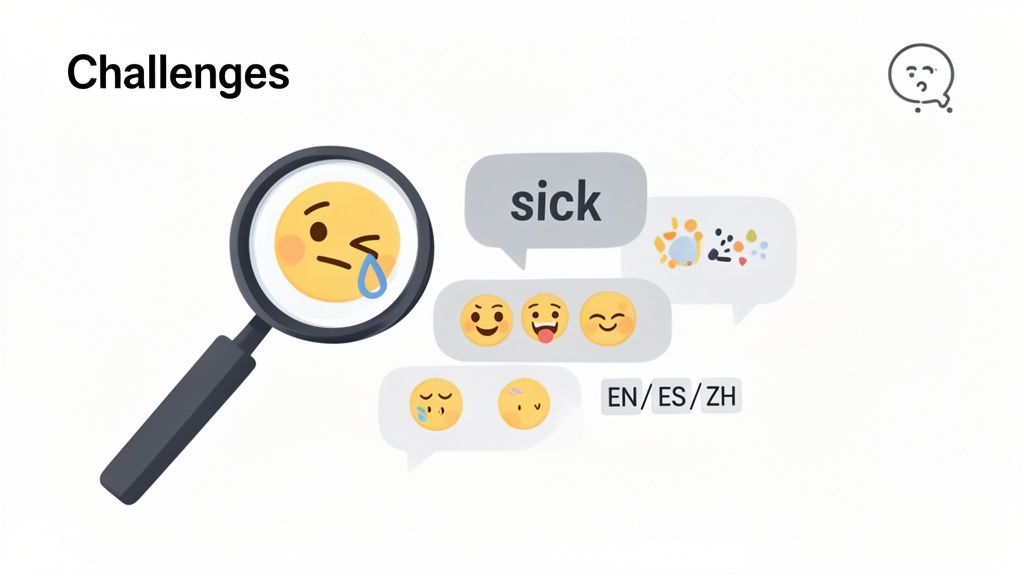
While the tech behind sentiment analysis is impressive, applying it to the wild, messy world of social media is another story entirely. This isn't some neat-and-tidy lab environment with perfect grammar; it's a chaotic mash-up of slang, memes, inside jokes, and typos. That unpredictability throws up some serious roadblocks for any analysis tool.
Just slapping a "positive" or "negative" label on a post often misses the whole point. A truly effective sentiment analysis for social media strategy hinges on using tools that can actually navigate this chaos. Without that, you're just guessing, making big decisions based on dodgy data.
Decoding Sarcasm and Irony
One of the toughest nuts for any AI to crack is figuring out when people don't mean what they say. Sarcasm and irony are the lifeblood of online chat, where the real meaning is the polar opposite of the words on the screen.
Think about a comment like, "Just love waiting on hold for 45 minutes. Best customer service ever." A basic, rule-based system sees "love" and "best" and instantly flags it as positive feedback. That single mistake could cause a brand to completely overlook a glaring customer service problem.
This is where advanced AI models come in. They’re trained on colossal datasets of real human conversations, learning to pick up on the subtle patterns. They spot the clash between positive words and a negative context, allowing them to correctly identify sarcasm and assign the right negative sentiment.
Without that level of smarts, your sentiment data gets polluted with false positives, burying the very issues you need to fix. This is exactly why you need sophisticated analysis to get a real read on what your customers are thinking.
Understanding Slang, Emojis, and Short Text
Social media language moves at a ridiculous pace. New slang, abbreviations, and emoji combos pop up every day, creating a constantly shifting dialect that sentiment models have to keep up with.
Take a word like "sick." It can mean amazing or awful, all depending on context. The skull emoji (💀) usually means you’re laughing your head off, not that something is morbid. Traditional, dictionary-style approaches just can't keep up with these fluid meanings.
This gets even harder with the short-form content on platforms like X (formerly Twitter). A single tweet might just be a few words and an emoji, leaving the AI with almost zero context to work with.
- "This update is 🔥" – That’s a positive. It means something is excellent.
- "My laptop is on fire 🔥" – That’s a negative. It’s a literal, very bad problem.
- "Everything is fine 🔥" – That’s sarcasm. It’s a meme used to mean the exact opposite.
To be worth anything, sentiment analysis tools need to be constantly updated and retrained. They have to understand this ever-changing digital language and the tiny clues hidden in short-form text.
Navigating Multilingual Conversations
In a global market, people are talking about your brand in hundreds of different languages and dialects. A tool built only for English is going to miss a massive chunk of the conversation.
But the challenge isn't just about direct translation. Word-for-word translation often butchers cultural nuances, idioms, and context. A phrase that's perfectly neutral in one language could come across as hugely negative in another when translated literally.
For instance, the English idiom "it's not rocket science" just means something is easy. A direct translation into another language would probably just be confusing and lose its meaning entirely.
Proper multilingual sentiment analysis for social media needs models trained specifically on native-language data. These systems don't just translate; they understand the sentiment as it's actually expressed within that culture. This is how you get accurate insights from every market you're in, and it's what separates basic tools from platforms that deliver intelligence you can actually act on.
Practical Applications of Sentiment Analysis
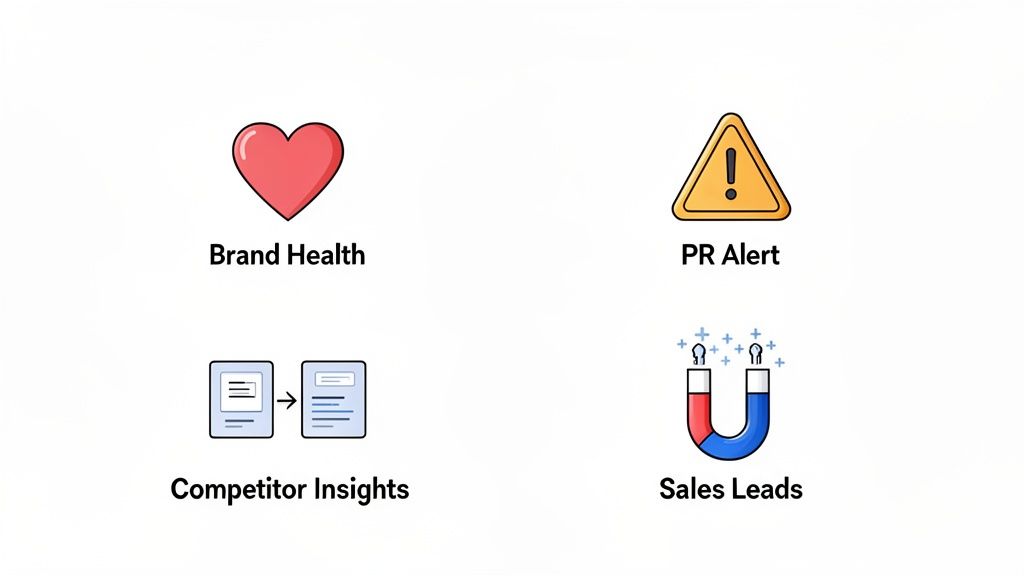
Knowing the theory is one thing, but putting it to work to get real results is another game entirely. Sentiment analysis isn't just some abstract data exercise; it's a powerful strategic tool that smart brands use to make faster, better-informed decisions. It turns messy, raw online chatter into a clear dashboard of public opinion.
This is where the real value kicks in. When you move beyond simple metrics like likes and shares, you start to measure the emotional current running through conversations. Suddenly, you have a direct line into what your audience genuinely thinks and feels. Let's dig into how this actually drives business outcomes.
Monitor and Protect Your Brand Health
Your brand's health is directly tied to how people feel about it. Think of sentiment analysis as a real-time EKG, constantly monitoring the pulse of public perception. It gives you an immediate, unfiltered look at how your marketing campaigns, product launches, or policy changes are landing with your audience.
Imagine you've just launched a new ad campaign. Instead of waiting weeks for survey results, you can track sentiment by the hour. A sudden dip in positive mentions or a spike in negative comments acts as an early warning that your messaging might have missed the mark, giving you a chance to pivot before any real damage is done.
The Bottom Line: Consistent monitoring lets you measure the emotional impact of every single action your brand takes. This data-driven feedback loop is essential for maintaining a positive reputation and building long-term customer trust.
Detect and Manage a Brewing Crisis
On social media, a single negative post can snowball into a full-blown PR crisis in a matter of hours. Early detection is everything. Sentiment analysis tools are your digital smoke detector, alerting you to sudden, sharp shifts in negative sentiment the moment they happen.
A platform like ForumScout, which offers hourly monitoring, can spot a surge in angry comments about a service outage or a faulty product. This allows your team to respond proactively—often before the story even hits the mainstream news. That speed is your greatest asset in crisis management.
By catching these issues early, you can: * Isolate the problem: Quickly understand what's driving the negative feedback. * Deploy your response team: Route the issue to the right people, whether that's customer support or PR. * Control the narrative: Address the concern publicly and transparently, mitigating any harm to your reputation.
Uncover Competitive Intelligence and Market Gaps
Your audience isn't just talking about you; they're also talking about your competitors. Analysing the sentiment around rival brands offers a goldmine of strategic insights. You can pinpoint their weaknesses and identify golden opportunities to highlight your own strengths.
For example, if you notice a wave of negative sentiment around a competitor’s recent price hike or a poorly received feature update, that’s your cue. You can tailor your marketing messages to showcase your brand as the more customer-friendly or innovative alternative. It’s all about listening to their customers' pain points and positioning your product as the obvious solution. Learning about different AI social listening tools can reveal which platforms are best suited for this kind of intelligence gathering.
Generate High-Quality Sales Leads
Sentiment analysis can also be a surprisingly effective tool for lead generation. By monitoring conversations for positive sentiment related to industry pain points, you can identify people or businesses actively looking for a solution just like yours.
Someone tweeting, "I wish there was a project management tool that actually integrated with our accounting software," is basically raising their hand and expressing a clear need. If your product does exactly that, your sales team has a warm, qualified lead ready to engage. It’s a highly targeted approach that focuses on solving an existing problem, leading to far more meaningful sales conversations.
And the sheer volume of these opportunities is huge. The social media analytics market in the UK alone generated USD 729.0 million in 2024, a number expected to soar to USD 2,485.9 million by 2030. You can explore further market trends in the full research on Grand View Research.
How to Measure Sentiment Analysis Accuracy
So, you’ve got a sentiment analysis tool up and running. But how much can you actually trust what it’s telling you? Just because an AI slaps a “negative” label on a comment doesn’t automatically make it so. You need to know if the data is reliable, especially if you’re using it to make strategic decisions.
Think of it like sorting a huge bin of apples. You want to separate the good ones (positive sentiment) from the bad ones (negative sentiment). But how good are you really at spotting the rotten ones? To figure that out, we use a few key metrics.
These aren't just for data scientists; they're practical concepts that help anyone understand how reliable their tool’s insights are. Let's break down the most important ones using our apple-sorting analogy.
Key Metrics for Accuracy
Getting a handle on these will empower you to ask the right questions when you’re sizing up different sentiment analysis platforms.
-
Precision: This tells you how many of the apples you labelled as bad were actually bad. If you put 10 apples in the "bad" pile but only 9 of them were genuinely rotten, your precision is 90%. High precision means your tool is trustworthy and isn't crying wolf with false alarms.
-
Recall: This measures how many of the actual bad apples in the entire bin you managed to find. If there were 12 rotten apples in total and you only found 9 of them, your recall is 75%. High recall means your tool is thorough and isn't missing important negative feedback that needs your attention.
-
F1-Score: This is just a balanced score that combines both precision and recall into a single number. It’s useful because you often have to trade one for the other. A high F1-Score means you’ve struck a healthy balance between being accurate and being comprehensive.
For instance, a system with high precision but low recall might be great at correctly identifying negative posts, but it misses a lot of them. On the flip side, high recall with low precision finds most negative posts but also incorrectly flags a bunch of neutral or positive ones. The F1-Score helps you find that sweet spot.
The Human-in-the-Loop Advantage
No automated system is perfect. That’s why the most effective way to guarantee long-term accuracy involves a human-in-the-loop process. All this means is having a real person periodically check a sample of the AI's work to spot errors.
This feedback is then fed back into the AI model to retrain and fine-tune it. This makes it smarter and more attuned to the specific nuances of your brand’s conversations online. It helps the system learn your industry's slang, get better at recognising sarcasm, and adapt to how language evolves. This continuous improvement cycle is vital for maintaining high-quality, reliable data.
Ultimately, sentiment analysis is a must-have tool for learning how to measure social media success because it takes you beyond vanity metrics to assess what your audience genuinely thinks. By understanding metrics like precision and recall and embracing human validation, you can be confident that the insights you’re gathering are not just interesting, but genuinely accurate and actionable.
Putting Sentiment Analysis to Work in Your Strategy
Turning a pile of sentiment data from an interesting report into something that actually drives your business forward needs a clear plan. Just collecting data is pointless. The real goal is to build a workflow where insights automatically trigger specific, coordinated actions across your company. This is about moving from passively watching conversations to actively weaving sentiment analysis into how you work every day.
It all starts with deciding what you’re trying to accomplish. Are you trying to slash customer support response times, figure out if your latest campaign landed well, or just gather honest product feedback? Setting clear, measurable goals is the first, most important step. It will guide every decision you make, from the platform you choose to how you build your reports.
Define Your Business Goals
Before you even think about tools and data, you need to connect your sentiment analysis efforts to real business objectives. Without clear goals, you’ll just end up drowning in a sea of irrelevant chatter. Start by asking yourself: what problems are we trying to solve, or what opportunities are we missing?
Your objectives will shape everything that follows. For instance:
- Customer Support: Maybe the goal is to cut response times for negative mentions by 25%. That means you need a tool with real-time alerts that can automatically flag urgent issues and send them straight to the support team.
- Marketing Campaigns: You might aim for an 80% positive sentiment score for a new product launch. This requires you to closely track campaign-specific hashtags and keywords to see what people are saying.
- Product Development: Perhaps your goal is to identify the top three most requested features each quarter. This involves setting up filters to analyse sentiment around user pain points and suggestions.
When you tie your strategy to specific KPIs, sentiment analysis stops being a simple listening exercise. It becomes a measurable tool for boosting performance, justifying the investment, and proving its value to the rest of the company.
Choose the Right Tools and Integrate Data
Once you know your goals, the next step is picking a platform that actually fits your needs. The market is flooded with different customer sentiment analysis tools, but it's crucial to find one that aligns with your specific objectives and budget. Look for a solution that doesn't just give you an accurate sentiment score but also has features that support your day-to-day workflow.
For example, a platform like ForumScout offers hourly monitoring, which is perfect for the real-time crisis detection a support team needs. Its AI-powered filters let you create rules in plain English, so you can automatically sort and categorise mentions without any manual work. This ensures the right information gets to the right people, instantly.
After choosing your tool, it’s time to hook up your social media data sources. This just means connecting the accounts and platforms where your audience is most active. A solid platform will pull data from the big social networks, but also from forums, blogs, and news sites, giving you the complete picture. If you want to get into the technical weeds of how this works, you can explore a social listening API to see how the data gets pulled and organised.
Establish Your Reporting and Action Framework
The final piece of the puzzle is building a system for reporting what you find and—most importantly—acting on it. Data is useless if it just sits on a dashboard. You need a clear framework that turns insights into coordinated action across your organisation.
Start by setting up automated reports designed for different teams. The marketing team might want a weekly summary of campaign sentiment, while the product team could use a monthly breakdown of feature requests. Keep these reports short, visual, and focused on the metrics that each department actually cares about.
This is where AI-powered sorting really changes the game. An intelligent system can automatically:
- Spot Urgent Issues: Mentions with strong negative sentiment combined with keywords like "broken" or "outage" can be flagged and sent straight to the customer support queue.
- Highlight Positive Feedback: Glowing reviews and happy comments can be funnelled to the marketing team to be used as testimonials or user-generated content.
- Find Sales Leads: Conversations showing someone is ready to buy or is fed up with a competitor can be routed directly to the sales team for a follow-up.
For brands in the UK, home to 54.8 million social media users, weaving AI into sentiment analysis is no longer a luxury—it’s a necessity. Brands using AI-optimised platforms for real-time analysis have seen a 14% bump in engagement. With social ad spend hitting £9.02 billion in 2025, tools that provide real-time dashboards are essential for turning massive amounts of raw data into cultural wins and a higher ROI. This creates a smooth, efficient loop that takes you from listening to action.
Got Questions? We've Got Answers
What's the Difference Between Sentiment Analysis and Social Listening Anyway?
It’s a common mix-up, but the two are quite different. Think of social listening as casting a huge net across the internet to catch every mention of your brand, your competitors, or key industry terms. It’s the what—collecting all the chatter happening in one place.
Sentiment analysis is what you do with that catch. It’s the specialised engine that sorts through everything you’ve gathered and figures out the emotional tone behind it—is it positive, negative, or just neutral? In short, social listening finds the conversation; sentiment analysis tells you how people feel about it.
How Accurate is This Stuff, Really?
It's surprisingly good. The best AI-powered tools hit around 80-90% accuracy, but let's be honest, it's not perfect. Language is messy. Things like sarcasm, inside jokes, and regional slang can easily trip up an algorithm. Anyone who tells you their tool is 100% accurate isn't being straight with you.
That’s why the most reliable platforms have a "human-in-the-loop" process. This basically means there's an option for a real person to check and correct the AI's work. This not only fixes errors but also helps train the model, making it smarter and more accurate over time for your specific brand.
Can Sentiment Analysis Go Beyond Just Text?
Yes, and this is where things get really interesting. The latest evolution is called multimodal sentiment analysis, and it’s a game-changer for understanding platforms like Instagram, TikTok, and YouTube. It doesn't just read the caption; it analyses the whole post.
Think about it: a picture or a video clip often says more than a paragraph of text ever could. This tech can interpret facial expressions in a photo, pick up on the tone of voice in a video, or even understand the context of a meme. It gives you a much richer, more complete picture of how your audience truly feels.
Ready to stop guessing and start knowing? With ForumScout, you get hourly monitoring, smart AI filtering, and the kind of deep sentiment and emotion analytics that turn social chatter into real business intelligence. Start your free 7-day trial of ForumScout today and see what you've been missing.