- 17 min read
A Guide to Using a Reputation Monitoring Service
A reputation monitoring service is your brand's 24/7 digital watchtower. It constantly scans everything from social media and news sites to niche forums and review platforms for mentions of your business. In an age where a single negative comment can go viral overnight, this is no longer a luxury—it's an essential tool for any business that cares about its public image.
Why Your Brand Needs a Reputation Monitoring Service

Think of your brand's reputation as its digital immune system. When it’s healthy, you attract customers, talent, and opportunities with ease. But when it’s weakened by a wave of negative chatter, your entire business becomes vulnerable. A reputation monitoring service is the diagnostic tool that keeps this system in check, listening to the millions of unstructured conversations happening online every day.
Without it, you’re flying blind. You could be missing a storm of customer complaints brewing on a niche forum, an inaccurate news story gaining traction on Twitter, or even a competitor launching a sneaky campaign that targets your known weaknesses. By the time this stuff reaches you through the grapevine, the damage is often already done.
The Real-World Cost of a Bad Reputation
A strong reputation isn't just a feel-good metric; it's a hard financial asset. We're not just talking about a few lost sales, either. In the UK, corporate reputation now accounts for a massive 29% of the total market value of the FTSE 350 index. That’s equivalent to a staggering £730 billion. It's clear proof that what people say and feel about your brand directly impacts your bottom line.
Proactive monitoring gives you a serious edge in several ways.
To help you see the value more clearly, here's a quick breakdown of what a monitoring service brings to the table.
Key Benefits of Reputation Monitoring at a Glance
| Benefit | Impact on Your Business |
|---|---|
| Early Crisis Detection | Spot potential PR fires before they become infernos, giving you time to respond thoughtfully. |
| Honest Customer Insight | Uncover unfiltered feedback on your products and services that you'd never get from a survey. |
| Competitive Intelligence | Track what people are saying about your rivals to find their weaknesses and your opportunities. |
| New Lead Generation | Find potential customers who are unhappy with a competitor or are actively asking for solutions like yours. |
These benefits come together to transform your strategy from reactive damage control to proactive brand building.
A reputation monitoring service empowers you to stop reacting to conversations and start shaping them. It’s the difference between hearing about a problem and solving it before anyone else knows it exists.
Ultimately, investing in a monitoring tool is about taking control of your brand's narrative. If you want to dig deeper into how your digital presence drives business results, check out this guide on the importance of online reputation management.
What’s Actually Under the Hood? Key Features of Monitoring Tools

To really get what a reputation monitoring service does, we need to pop the bonnet and look at the engine. These platforms aren't just glorified search bars; they’re complex systems built on a few core technologies that work in concert. Think of it less like a single instrument and more like a full orchestra, with each part playing a crucial role.
The absolute foundation of any good service is its ability to find conversations about you. This is where comprehensive mention tracking comes in. It casts a much wider net than a simple Google search, scanning a vast network of online sources in almost real time.
- Social Media: Platforms like X (formerly Twitter), Reddit, Instagram, and LinkedIn.
- News and Blogs: Major media outlets and tiny niche industry publications.
- Forums and Communities: Specialised discussion boards where your real customers hang out.
- Review Sites: Absolutely critical platforms like Trustpilot, Google Reviews, and industry-specific sites.
This broad sweep ensures you're seeing the whole picture, not just the easy-to-find bits. For a deeper look at the tech behind this, this overview of brand tracking software is a great place to start.
Deciphering the Emotion Behind the Words
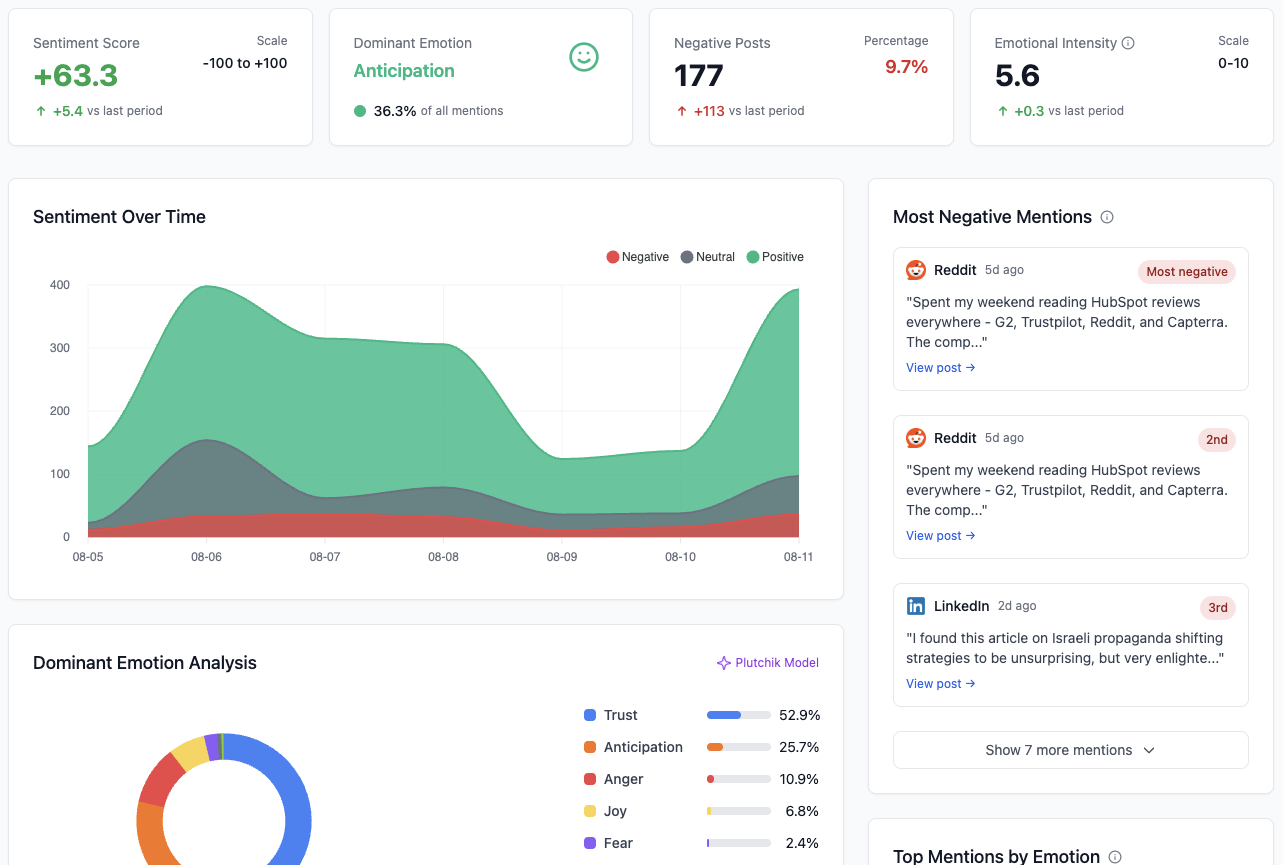
Just finding mentions is step one. Knowing someone mentioned your brand is useful, but knowing how they feel is a total game-changer. This is where sentiment and emotion analysis steps in. Using natural language processing (NLP), the service analyses the text to figure out its emotional tone.
It sorts each mention into positive, negative, or neutral. The smarter tools can even pinpoint specific emotions like joy, anger, or frustration, giving you a much richer read on the customer's state of mind. This lets you prioritise your responses, jumping on an angry customer's comment before it spirals out of control.
Filtering the Signal from the Noise
Let's be honest, the internet is incredibly noisy. A wide-ranging search can pull in thousands of totally irrelevant mentions, from spam accounts to conversations that just happen to use your brand name out of context. Without a way to manage this chaos, you'd spend all day sifting through digital junk.
This is why AI-driven filtering is so important. It acts as an intelligent gatekeeper, learning what’s actually relevant to your business and what isn't. You can set up rules to exclude certain keywords, sources, or languages, making sure your team only sees the conversations that genuinely matter.
A powerful reputation monitoring service doesn’t just show you more data; it shows you the right data. It turns an overwhelming flood of information into a clear, manageable stream of insights.
Turning Insights into Immediate Action
Finally, a great monitoring platform bridges the gap between insight and action with two key features: alerts and integrations. Real-time alerts ping you the moment a critical mention appears—like a post from a major influencer or a sudden spike in angry comments—so you can respond instantly.
Integrations let the service talk to the other tools your team already relies on. For instance, a negative mention could automatically create a support ticket in your helpdesk software, while a potential sales lead could be pushed straight into your CRM. This seamless connection turns monitoring from a passive, look-and-see activity into an active driver of your business.
How Monitoring Drives Real Business Growth

It’s one thing to know what a reputation monitoring service does, but it’s another to see how it directly impacts your bottom line. This is where monitoring stops being a defensive chore and becomes a serious engine for growth. It’s all about turning the endless stream of online chatter into clear, measurable business wins.
For marketing teams, this is an absolute goldmine. By keeping an eye on competitor mentions, you can spot the exact pain points your rivals are failing to solve. This is your chance to swoop in. Imagine finding a Reddit thread where users are tearing their hair out over a competitor’s terrible customer support. That’s a perfect opening to launch a campaign highlighting your own responsive, helpful team.
Monitoring also unearths a constant supply of user-generated content (UGC). Finding authentic customer photos or glowing reviews on social media gives you powerful, trustworthy assets for your campaigns—often far more compelling than polished corporate ads.
Proactive Support and Smarter Products
For your customer support team, reputation monitoring is the ultimate early-warning system. A single frustrated tweet can easily snowball into a public relations nightmare if it’s ignored. With proactive monitoring, your team can jump on that complaint in minutes, turning a potential disaster into a public display of fantastic customer service.
Product teams get a huge leg up from these unfiltered conversations, too. Sure, surveys give you structured feedback, but forums and reviews are where people share their brutally honest opinions. A local cafe, for instance, might notice a pattern in Google reviews—customers love the coffee but complain about the lacklustre pastry selection. That’s invaluable, direct feedback telling them exactly what to do next: partner with a local bakery.
By listening to what customers are already saying, you get a direct line into their needs. It helps you guide product development, improve your service, and make smarter business decisions across the board.
Turning Trust into Revenue
Ultimately, all these moving parts work together to drive real growth. The UK online reputation management market is booming for a simple reason: trust is now built online. A recent report found that 89% of UK consumers read reviews before making a purchase, proving the undeniable link between a positive online presence and sales. You can learn more about the online reputation management market growth and its impact.
When you actively manage your online story, you’re building the social proof needed to turn curious visitors into loyal customers. Every positive review you acknowledge and every problem you solve publicly reinforces your brand’s commitment to quality. A good reputation isn't just a nice-to-have; it's a core driver of revenue.
How to Choose the Right Monitoring Service
Picking the right reputation monitoring service feels a lot like choosing a new car. They all promise to get you where you’re going, but the ride, features, and price tag can be worlds apart. To find the perfect fit, you have to look past the shiny brochures and see what’s really under the bonnet. The goal is simple: find a solution that lines up perfectly with your budget, team size, and what you actually need to accomplish.
First things first, make yourself a practical buyer's checklist. This isn’t about chasing the tool with the longest feature list; it’s about finding the one with the right features for you. Start by asking some hard questions that tie directly into your day-to-day workflow and long-term goals.
- Source Coverage: Does it actually monitor the places where your customers hang out? If your audience lives on niche forums or Reddit, a tool that only cares about the big social networks is going to miss the most important conversations.
- Analytics Quality: How deep do the insights really go? You should be looking for a service that moves beyond basic sentiment analysis to offer things like trend tracking and a clear picture of your competitive share-of-voice.
- Scalability: Can this thing grow with you? Check the limits on keywords and the number of monthly mentions. You don’t want to hit a wall the moment your brand’s conversation volume starts to pick up.
- User Experience (UX): Is the platform actually easy to use? A clunky, confusing interface will just gather digital dust, making even the most powerful features totally useless because nobody on your team wants to log in.
Evaluating Your Core Needs
Before you even think about booking a demo, get a crystal-clear picture of what you want to achieve. Are you a small business owner who just needs to keep an eye on local reviews, or are you a marketing manager who needs to benchmark performance against three major competitors? Nailing down your use case is the single most important step in this whole process.
A startup, for instance, might be focused on digging up sales leads and getting raw product feedback. For them, AI-powered filtering and real-time alerts are non-negotiable. An established enterprise, on the other hand, might need heavy-duty reporting features to justify ROI to the higher-ups. Don’t get talked into paying for enterprise-level bells and whistles if all you need is a simple, effective monitoring tool.
Choosing a reputation monitoring service is a balancing act between power, price, and practicality. The best tool isn't the most expensive one; it's the one that becomes an indispensable part of your team's routine.
Comparing Different Monitoring Approaches
To make your decision a bit easier, most solutions fall into one of three buckets. Each approach is built for a different type of business with its own unique resources and goals. Getting your head around these differences is key to making a smart choice. For an even more detailed breakdown, checking out a list of powerful Talkwalker alternatives can give you some great context on what different platforms bring to the table.
Here's a quick comparison to help you figure out which path makes the most sense for you.
Comparing Reputation Monitoring Approaches
| Approach | Best For | Pros | Cons |
|---|---|---|---|
| DIY Tools | Solopreneurs and tiny businesses on a shoestring budget. | Low cost or free (think Google Alerts). Dead simple to set up for basic keyword tracking. | Limited sources, zero analytics, no sentiment analysis, and it's a very manual process. |
| Dedicated Platforms | SMBs and marketing teams who need actionable insights and efficiency. | Covers a huge range of sources, offers advanced analytics, real-time alerts, and team features. | Comes with a monthly subscription cost. Can have a learning curve to get the most out of it. |
| Full-Service Agencies | Big corporations or businesses without an in-house team to handle reputation. | It’s all managed by experts who provide strategic advice and crisis management. | The most expensive option by a mile, and you have less direct, hands-on control. |
At the end of the day, the right reputation monitoring service will feel like a natural extension of your team—one that works tirelessly behind the scenes to bring you the insights you need to protect your brand and fuel your growth.
Implementing a Practical Monitoring Workflow

This is where the rubber meets the road. Turning theory into action is how you get real value from a reputation monitoring service. A solid workflow makes sure insights don’t just get stuck in a dashboard; they flow right into your day-to-day operations.
This isn't about making things complicated. It's about building a clear, repeatable process that lets your team act fast and with confidence.
The trick is to start with a system that fits your current resources. If you're a small business, a massive, multi-departmental workflow is just overkill. You need something lean and focused that delivers an impact without bogging down your team.
On the other hand, a larger corporate team needs a much more structured process to juggle a higher volume of mentions and coordinate responses across different departments. Let’s break down what these workflows actually look like.
A Lean Workflow for Small Businesses
For small and medium-sized businesses (SMBs), it’s all about efficiency. The aim is to keep an eye on the most important channels without needing a full-time reputation manager. This workflow is built on simplicity and quick action.
Focus on High-Impact Channels: Don't boil the ocean. Zero in on the platforms that actually matter to your business. This usually means Google Reviews, your main social media page (like Facebook or Instagram), and maybe one or two key industry-specific review sites.
Use Simple, Effective Tools: You don’t need a pricey enterprise platform. A mix of a cost-effective monitoring tool and free resources works great. Setting up basic keyword tracking is a fantastic start. If you’re new to this, our guide on how to set up Google Alerts gives you a perfect foundation to build on.
Assign Clear Ownership: Pick one person—maybe the business owner or a marketing assistant—to be the point person. Their job is to check mentions daily and either respond directly or flag them for the right team member.
The core idea for an SMB workflow is simple: Listen where it counts, act immediately, and don't overcomplicate it. This way, you catch critical feedback without burning through your limited time and money.
An Advanced Workflow for Corporate Teams
Corporate environments need a more sophisticated workflow to manage brand reputation at scale. This is less about simple monitoring and more about strategic intelligence—routing information, setting up tiered alerts, and creating insightful reports for leadership.
This advanced process includes:
- Setting Up Tiered Alerts: Configure your monitoring service to send instant alerts for high-priority keywords like "crisis," "outage," or any mentions from major news outlets. Less urgent mentions can be bundled into a daily digest.
- Creating a Routing System: Have a clear protocol for where each mention goes. A negative product review could automatically generate a ticket for the customer support team, while a glowing mention from an influencer gets routed straight to marketing for amplification.
- Generating Monthly Insight Reports: The workflow should wrap up with a monthly report that does more than just count mentions. This report needs to track sentiment trends over time, benchmark your share of voice against competitors, and pull out key customer insights that show a clear ROI to leadership.
The Future of Reputation Intelligence
The world of brand protection is shifting gears. It’s no longer enough to just keep an eye on what people are saying about you; the future is all about predictive reputation intelligence. Think of it as moving from reacting to online chatter to proactively shaping it before it even starts.
This evolution is powered by smarter AI that doesn't just count mentions. Instead, it digs deeper to understand the complex emotions and values driving public perception. This means you can finally get ahead of the conversation.
We’re also seeing a move away from just tracking customer reviews and towards a much broader stakeholder intelligence approach. This means tuning into conversations happening among your employees, investors, regulators, and even local communities. It’s about getting a complete, 360-degree view of your brand’s health.
This holistic understanding is crucial for building resilience. When a company has an excellent reputation, consumers are 2.1 times more likely to give them the benefit of the doubt during a crisis.
This trend is completely reshaping what businesses expect from a reputation monitoring service. According to a recent study by The Harris Poll UK, this high level of consumer trust has prompted many UK firms to seek out advanced platforms that can track sentiment across all stakeholder groups. You can dive deeper into these corporate reputation findings from The Harris Poll UK to see where the industry is headed.
Frequently Asked Questions
Got questions about how reputation monitoring services work? You're not alone. Here are some clear, straightforward answers to the questions we hear most often.
How Is It Different From Google Alerts?
This is a big one. While Google Alerts is a decent, free way to get started, comparing it to a dedicated monitoring service is like comparing a fishing rod to a deep-sea trawler with sonar. They’re in completely different leagues.
A proper monitoring platform scans a much, much wider ocean of sources—think Reddit, niche forums, and countless review sites that free tools simply can’t see. But the real difference isn't just what it finds, it's the intelligence it gives you.
- Sentiment Analysis: It tells you the feeling behind a mention—is it happy, angry, or just neutral?
- Detailed Analytics: You get dashboards to spot trends, measure how people feel over time, and see where the conversations are happening.
- Real-time Alerts: This lets you jump on critical mentions the moment they appear, so you can respond strategically instead of playing catch-up.
Can A Monitoring Service Remove Negative Reviews?
No, a monitoring service can't directly remove online content. Its job is to be your eyes and ears online, finding and analysing mentions for you. Think of it as your early-warning system that spots negative feedback the second it hits the web.
And that speed is everything.
When you see a bad review instantly, you have a chance to engage with the customer and resolve their issue before it snowballs. If a review is fake or breaks a platform's rules, the service gives you the evidence you need to report it effectively. It empowers your response, but taking action is a separate step.
How Much Does A Reputation Monitoring Service Cost?
The cost really depends on what you need. For a small business just starting out, you can find simple tools from around £30–£80 per month.
If you're a mid-sized company needing deeper analytics and wider coverage, you're more likely looking at £300 to £800 monthly. For large enterprises that need global monitoring and advanced AI, the investment can easily climb into the thousands each month. The trick is to figure out what features you’ll actually use and find a plan that delivers a clear return without paying for things you don’t need.
Ready to turn online chatter into real growth opportunities? ForumScout gives you the power to monitor mentions, analyse sentiment, and find leads—all without the enterprise price tag. Start your free 7-day trial and see what people are really saying about your brand.