
- 20 min read

How to Measure Brand Recall in 2026
Let's be honest—brand recall can feel like a fluffy, academic concept. It often gets pushed aside for harder metrics like conversion rates or click-throughs. But in a ridiculously crowded market, it's the invisible force that drives customer choice and builds long-term loyalty.
Measuring brand recall isn't just about collecting data for a fancy report. It’s a strategic move that should inform everything from where you put your marketing budget to how you handle a crisis. It connects the dots between your campaigns and your bottom line.
Why Brand Recall Is Your Most Underrated Metric
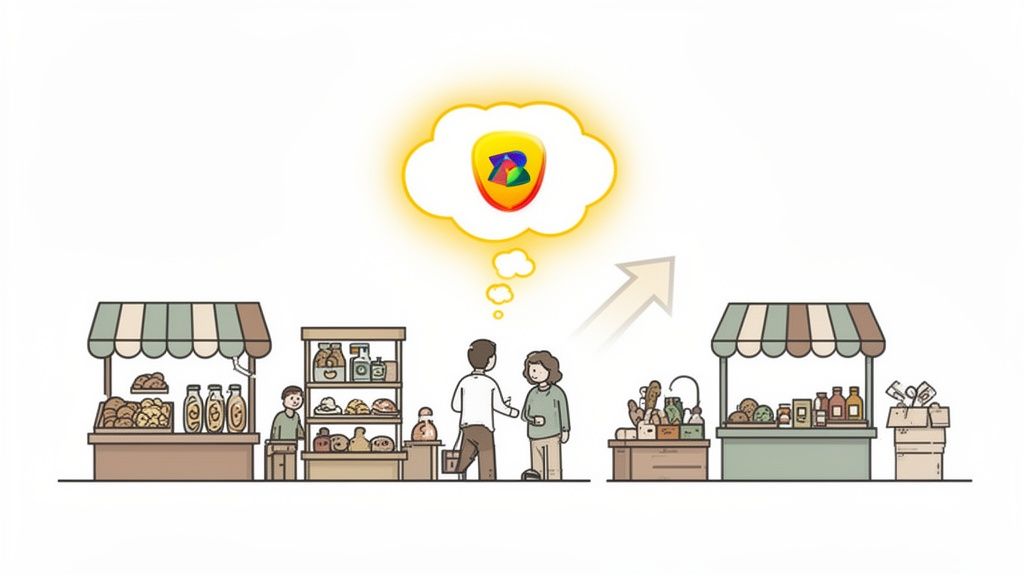
So, what exactly is brand recall? It’s a measure of your brand’s mental real estate. Think surveys, social listening, and direct traffic analysis to see if people remember you without a prompt. It’s the clearest indicator of your top-of-mind awareness and whether your marketing is actually sticking.
Moving Beyond Vanity Metrics
Too many businesses get hung up on vanity metrics like social media likes or follower counts. While these give you a surface-level glimpse of engagement, they don't tell you if your brand has genuinely lodged itself in your audience's mind.
Brand recall, on the other hand, is a concrete measure of your mental market share.
Think of it this way: a customer scrolling through their feed might 'like' dozens of posts a day. But when they're in a shop and need to make a choice, which brand pops into their head first? That’s the power of recall, and it directly influences buying decisions when it counts.
Strong brand recall acts as a protective buffer for your business. It's the reason loyal customers will wait for a restock instead of immediately switching to a competitor. This resilience is built long before a crisis hits, through consistent and memorable brand experiences.
Building Your Brand Recall Measurement Playbook
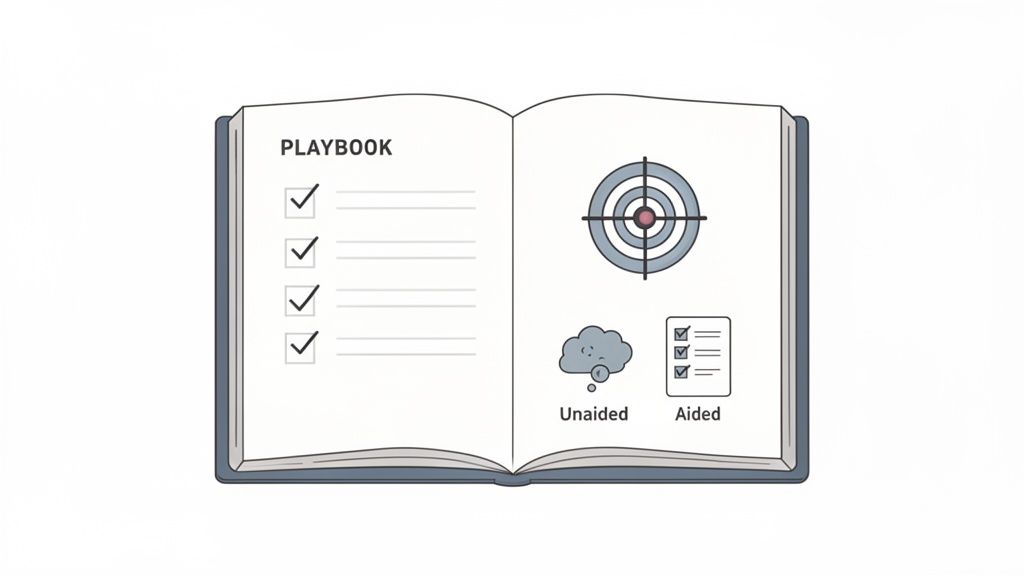
Before you even think about launching a survey or digging through social media chatter, you need a solid game plan. A well-structured playbook makes sure your efforts are focused, your data is meaningful, and the insights you get are actually useful. It’s the blueprint for measuring brand recall the right way.
This all starts by getting specific. Vague ambitions won't cut it; you need concrete, measurable objectives. What are you really trying to achieve? Your goal will dictate the methods you use and the metrics you track.
For example, a new startup might aim to hit 15% unaided recall with its core demographic in the next six months. An established brand, on the other hand, might want to see how a new TV advert shifted recall in a specific region. Clear goals stop you from collecting data that just sits there gathering dust in a spreadsheet.
Defining Your Measurement Objectives
Without clear goals, you’re flying blind. Your objectives need to be specific, measurable, and tied directly to your bigger business strategy. They are the "why" behind every piece of data you collect.
Here are a few practical examples of what strong objectives look like:
- Campaign Impact: Measure the uplift in aided recall among UK adults aged 25-40 following our three-month digital marketing campaign.
- Competitive Benchmarking: Establish a baseline for our unaided recall compared to our top three competitors in the sustainable fashion market.
- Market Entry: Assess initial brand recall levels in a new geographical market (e.g., Scotland) three months after launch.
See how precise those are? They lock in the audience, the metric, and the timeframe, which makes designing your study and judging its success much, much easier down the line.
Aided vs. Unaided Recall: When to Use Each
Getting your head around the difference between aided and unaided recall is fundamental. They measure two completely different levels of brand memory and serve very different strategic purposes. Nailing this choice is crucial for gathering relevant insights.
Unaided recall is the gold standard for measuring top-of-mind awareness. It tells you how many people can name your brand without any prompts. The classic survey question is something like, "When you think of electric cars, which brands come to mind?" If you're mentioned first, that’s a powerful sign of market leadership.
Aided recall, on the other hand, is all about brand recognition. For this, you’d give respondents a list of brands and simply ask which ones they’ve heard of. This is great for gauging general familiarity and seeing if your campaigns are actually boosting visibility, even if you aren’t the first name that pops into people’s heads.
Your choice between aided and unaided recall isn't an either/or decision. A truly robust measurement playbook uses both to paint a complete picture. Unaided recall tells you who owns the mental real estate, while aided recall reveals the broader landscape of familiarity.
So, when should you pick one over the other? It really depends on your specific goals and what you’re trying to learn. This table breaks down the core differences to help you decide.
Choosing Between Aided and Unaided Recall
| Aspect | Unaided Recall (Top-of-Mind Awareness) | Aided Recall (Brand Recognition) |
|---|---|---|
| Primary Goal | To measure brand strength and market leadership. | To assess brand familiarity and campaign reach. |
| Best For | Established brands tracking their top-of-mind status. | New brands or products entering a market. |
| Typical Question | "Which brands of coffee can you name?" | "Which of these coffee brands have you heard of?" |
| Strategic Insight | Reveals your brand's position in the consumer's mind. | Shows the effectiveness of visibility-focused marketing. |
Ultimately, a mix of both gives you the richest data. Unaided tells you where you stand in the hierarchy, while aided shows you if you're even in the game.
Establishing a Baseline and Audience
You can’t track progress if you don’t know where you started. Your very first measurement is your baseline. Every future result gets compared against this initial data point to show whether your recall is growing, shrinking, or staying flat.
Think of the baseline as your anchor. If your initial unaided recall is 8%, your goal might be to push it to 12% next quarter. Without that 8% figure, you’re just guessing.
Defining your audience is just as important. Are you measuring recall among existing customers, a specific demographic, or the general population? A B2B software company has a wildly different audience than a snack brand. Get specific here, because it ensures your insights are relevant and helps you understand your share of voice within the conversations that matter.
By setting clear objectives, choosing the right recall method, and establishing a solid baseline for a defined audience, you create a powerful playbook. This organised approach turns measurement from a simple task into a strategic tool for growth.
Crafting Surveys That People Actually Answer
Let’s be honest: the most sophisticated measurement playbook in the world is useless if your data is garbage. Getting genuine brand recall insights comes down to asking the right questions in the right way. This means designing surveys that people don't just start, but actually finish thoughtfully. It's an art that blends a bit of psychology with precise wording.
The biggest hurdle is survey fatigue. Your audience gets bombarded with feedback requests all day long, so your survey needs to be sharp, respectful of their time, and structured to avoid accidentally nudging them toward an answer. A single poorly phrased question can skew your results, leading you to make big decisions based on bad information.
Designing Unbiased Questions
The foundation of any good survey is neutrality. Your questions have to be worded carefully to avoid steering respondents. Even subtle cues can influence a reply, contaminating the very data you’re working so hard to collect.
Leading questions are the most common trap. For instance, asking, "How much did you enjoy our latest innovative advert?" assumes the person saw it and enjoyed it. A much better approach is to break it down: "Have you seen our latest advert?" and if they say yes, follow up with, "How would you describe your reaction to it?"
Here are a few proven question templates for both unaided and aided recall:
- Unaided Recall (Top-of-Mind): "When you think of [product category, e.g., eco-friendly cleaning products], which brands are the first that come to mind?" This open-ended format is pure gold for measuring spontaneous recall.
- Aided Recall (Recognition): "Which of the following brands of [product category] have you heard of?" Here, you’ll present a list including your brand, key competitors, and maybe even a fake brand (a "red herring") to see if people are just ticking boxes without paying attention.
A critical pro tip is to always ask your unaided recall questions before any aided ones. The moment you show someone your brand name in a list, you've lost the chance to get a clean, unprompted measure of their spontaneous awareness.
Structuring Your Survey for Engagement
A long, monotonous survey is a guaranteed recipe for high drop-off rates and lazy, rushed answers. To keep people engaged, you need to think like a user experience designer. The flow and format are just as important as the questions themselves.
Kick things off with broader, easier questions to warm up the respondent before diving into more specific ones. And keep it short. Seriously. Aim for a completion time of no more than 5-7 minutes. If a question isn't absolutely essential, cut it. Every extra click increases the odds someone will give up.
For a deeper dive into survey design and other methodologies, you can explore different types of market research to expand your toolkit.
Getting It in Front of the Right People
Once your survey is polished, the final piece is distribution. The method you choose directly impacts the quality and representativeness of your sample. You need to get your questions in front of an audience that actually reflects your target market, not just a convenient sample of your existing followers.
Here’s a quick breakdown of common channels and where they fit best:
- Email Lists: Perfect for surveying your existing customer base. This gives you great insights into recall among people who already know you, but it won't tell you much about awareness among non-customers.
- Social Media Polls: Quick and dirty. Great for a simple aided recall test or gauging immediate sentiment. While not statistically rigorous, polls on platforms like X or Instagram can offer a useful, real-time pulse check.
- Website Pop-ups: You can use tools to trigger a survey pop-up for your website visitors. This is a solid way to capture feedback from an engaged audience, but it can be annoying if you don't implement it carefully.
- Targeted Panels: For the most accurate and unbiased data, using a third-party panel provider is the gold standard. These services let you survey a pre-screened group of people who match your specific demographic and psychographic criteria, ensuring your results are truly representative.
Choosing the right channel really depends on your goals and budget. For a quick, directional vibe check, social media might be enough. But for a robust baseline measurement that will inform a major marketing spend, investing in a targeted panel is almost always worth it.
Using Social Listening to Hear What Customers Really Think
While structured surveys are a solid way to benchmark recall, they only tell you what people think when you’re asking the questions. What about the millions of unprompted, unfiltered conversations happening online every single day?
That's where social listening becomes your secret weapon. It gives you a real-time pulse on your brand’s mental footprint, capturing recall in its most natural state. Think of it as the ultimate measure of unaided recall—it reveals which brands people bring up on their own when talking about their problems, needs, and recommendations.
Tapping Into Unfiltered Online Conversations
Platforms like Reddit, X (formerly Twitter), and countless niche forums are absolute goldmines for honest consumer opinions. People aren't filling out a form; they're chatting with peers, which makes these mentions incredibly authentic. Trying to track all this manually is impossible, which is why a good social listening tool is essential.
For instance, if you sell vegan protein powder, you shouldn't just track your brand name. You should be listening for phrases like "best plant-based protein" or "recommend a dairy-free supplement." Every time your brand pops up in those threads without any prompting, you've just captured a direct signal of strong recall.
This goes way beyond simple brand monitoring. Instead of just reacting to mentions, you’re proactively finding conversations that show you exactly where you stand in the market. It’s a strategic shift, and you can learn more about what social listening is and why it's a game-changer.
Analysing Share of Voice and Competitive Mentions
One of the most powerful metrics you can pull from social listening is Share of Voice (SoV). In simple terms, it tells you what percentage of the entire industry conversation features your brand versus your competitors. It's a direct reflection of how much space your brand occupies in the public's mind.
SoV adds crucial context that a simple mention count can't. Getting 500 mentions a month might sound great on its own, but if your main competitor is pulling in 5,000, your brand's recall is actually pretty weak in comparison.
Here’s how to put it into practice: * Define your competitors: List out your top three to five direct rivals. * Track all brand names: Set up your social listening tool to monitor mentions of your brand and all the competitors you listed. * Calculate SoV: The formula is straightforward: (Your Brand Mentions / Total Industry Mentions) x 100. Most tools, including ForumScout, handle this calculation for you automatically.
Tracking Share of Voice over time lets you directly connect your marketing efforts to brand salience. Did your SoV spike after you launched that new ad campaign? Did a competitor's PR blunder create an opening for you? This data makes your recall measurement dynamic and instantly actionable.
Going Beyond Mentions to Understand Sentiment
Just knowing that people are talking about you is only half the picture. To really get a grip on brand recall, you need to know how they're talking about you. This is where sentiment and emotion analysis come into play.
Modern social listening tools automatically tag each mention with a sentiment—positive, negative, or neutral. This qualitative layer adds incredible depth. A high volume of mentions is fantastic, but not if they're all about customer service complaints.
This becomes especially critical during a crisis, like a product recall. A Sedgwick report noted over 3,500 EU/UK product recall incidents in a single quarter. For UK businesses, this is a huge deal. A YouGov poll found that while 38% of Britons would stick with a recalled dairy brand, another 33% become hesitant, often due to fears over quality.
By analysing the sentiment of online chatter during an event like that, you can see in real-time whether your brand's recall is helping or hurting your recovery.
When you combine mention volume with sentiment analysis, you get a much richer, more accurate view of your brand's health. You move from just counting mentions to truly understanding the nature of your reputation in the wild.
Turning Your Recall Data Into Actionable Insights
Collecting brand recall data is just the first step. Honestly, it’s the easy part. The real work begins when you need to turn that raw data into a story that actually drives smart business decisions. A spreadsheet full of percentages is just noise until you find the patterns and connect them to real-world outcomes.
This is where you move from just measuring recall to using it as a powerful tool for growth. It’s all about translating percentages into a concrete plan.
From Raw Numbers to Clear Metrics
Before you can spot any trends, you need to get your hands dirty with a few core calculations. These formulas are simple but form the bedrock of your analysis, giving you a consistent way to track performance over time.
Here are the two calculations you absolutely need to start with:
- Brand Recall Rate: This is your headline figure. You get it by taking the (Number of respondents who mentioned your brand / Total number of respondents) x 100. This gives you a clear percentage for both aided and unaided recall.
- Top-of-Mind Awareness (TOMA): This one’s a big deal. TOMA is a powerful indicator of market leadership and is calculated as (Number of respondents who mentioned your brand first / Total number of respondents) x 100. A high TOMA score is a massive competitive advantage.
Once you have these baseline figures, you can start digging deeper. For a broader perspective on using these kinds of results, it's worth exploring a guide to mastering advertising effectiveness measurement.
Segmenting Your Data to Uncover Opportunities
An overall recall score is a good start, but the real magic happens when you start slicing up your data. Looking at how recall differs across various groups can reveal hidden strengths, weaknesses, and untapped opportunities you’d otherwise miss completely.
Don’t just settle for the total percentage. Break it down by:
- Demographics: How does recall vary between age groups, genders, or locations? You might discover your brand is a huge hit with young adults but is practically invisible to older audiences.
- Customer vs. Non-Customer: Is your recall sky-high among existing customers but dead flat with everyone else? This could point to a loyalty bubble and a serious need for broader awareness campaigns.
- Journey Stage: Compare recall among prospects who just discovered you versus those who have been in your funnel for months. This helps you understand if your marketing touches are actually building memory over time.
For instance, you might find your unaided recall is 25% among customers but a dismal 5% among non-customers in London. That immediately tells you that while your product is memorable, your brand message just isn't reaching new audiences in a key market.
The goal of segmentation isn't just to create more charts. It's to find the 'why' behind the numbers. A single, well-chosen segment can reveal a strategic blind spot and give you a clear, actionable direction for your next campaign.
Building a Compelling Report for Stakeholders
All your hard work collecting and analysing data means nothing if you can’t communicate your findings to the people who make decisions. A great report tells a story with data, highlighting progress, diagnosing problems, and recommending clear next steps.
When you're putting your report together, focus on clarity and context. Ditch the jargon and use visuals to make your points land.
A strong reporting dashboard should always include benchmarking. Comparing your current performance to past quarters and key competitors is what turns your data from a simple score into a powerful competitive analysis. Below is a sample layout that helps frame the conversation around performance and action.
Sample Brand Recall Reporting Dashboard
| Metric | Current Quarter (%) | Previous Quarter (%) | Key Competitor (%) | Insight & Action |
|---|---|---|---|---|
| Unaided Recall | 12% | 9% | 18% | Our recall is growing but still lags behind Competitor X. Action: Increase top-of-funnel ad spend in our key growth regions. |
| Aided Recall | 45% | 42% | 55% | Steady growth, but a significant gap remains. Action: Launch a targeted social media campaign to boost brand recognition. |
| TOMA | 8% | 6% | 15% | We are not the first brand that comes to mind. Action: Focus creative on a single, memorable value proposition. |
| Sentiment | 78% Positive | 75% Positive | 72% Positive | Our positive sentiment is a key advantage. Action: Leverage customer testimonials in upcoming marketing materials. |
This kind of reporting makes it easy for anyone to grasp the current situation and understand the recommended path forward. It moves the conversation from "what happened?" to "what are we going to do about it?".
Your Brand Recall Questions Answered
Diving into brand recall can feel like opening a can of worms. One minute you're setting up a survey, the next you're swamped with questions about frequency, benchmarks, and budgets. It's totally normal.
Getting these details right is what separates a one-off data point from a strategic measurement programme. Think of this section as your quick-reference guide. We’ve tackled the most common hurdles businesses hit when they start measuring recall to help you move forward with confidence.
How Often Should We Measure Brand Recall?
For most businesses, running a brand recall survey quarterly is the sweet spot. This rhythm is frequent enough to spot meaningful trends and see if your marketing is actually working, but not so often that you’re annoying your audience. A quarterly check-in gives you a regular, reliable pulse on your brand's health.
That said, this isn't a hard-and-fast rule. You’ll also want to plan for extra, event-triggered measurements to isolate the impact of specific activities.
- Before and after a big campaign: Did that massive Black Friday promotion or new product launch actually move the needle? A dedicated pre- and post-campaign survey will give you a clear-cut answer.
- Following a major PR event: Whether it’s amazing press or a crisis you’re managing, measuring recall straight after can show you exactly how public perception has shifted.
For the day-to-day picture, layering in social listening is a game-changer. It fills in the gaps between your quarterly deep dives with a constant stream of real-world data.
What Is a Good Brand Recall Score?
Ah, the million-dollar question. The honest answer is: there is no magic number.
A "good" score is completely relative. It depends on your industry, your competitors, and how long you’ve been on the scene. A niche B2B software firm is going to have a wildly different benchmark than a national snack brand that’s been around for 50 years.
Instead of chasing an arbitrary percentage, your main goal should be to set your own baseline and focus on consistent, quarter-over-quarter improvement. Growth against your own history is a much more powerful success metric than trying to match a competitor in a totally different situation.
A far more insightful KPI is often your Share of Voice, which you can pull from social listening. This metric inherently benchmarks you against the direct competitors your customers are talking about right now, giving you a dynamic and context-rich measure of your mental market share.
Can I Measure Brand Recall with a Small Budget?
Absolutely. A tight budget doesn't mean you have to fly blind. You can get started with free and low-cost tools that provide valuable directional data, even if they aren't as statistically perfect as a formal panel study.
A great starting point is using a tool like Google Forms to survey your existing email list and social media followers. No, it won't capture what non-customers think, but it’s a brilliant, cost-free way to understand recall among the people who already know you.
If you want the most bang for your buck, social listening is your best friend. It gives you direct access to unprompted brand mentions—a powerful and seriously cost-effective proxy for real-world brand recall.
Ready to tap into those unfiltered conversations? With ForumScout, you can track brand mentions, analyse sentiment, and monitor your Share of Voice in real-time. Start your free 7-day trial and turn online chatter into actionable insights.