
- 16 min read
Our Guide to Reputation Management for Business Success in 2026
Reputation management for a business isn't a passive activity; it's the active process of monitoring and influencing how the public sees your company. It involves keeping a close eye on online conversations, handling reviews, and actively shaping your brand's story to build trust and credibility. Think of it as the digital version of your shop front—it needs constant care to keep customers coming through the door.
Why Your Business Reputation Is a Tangible Asset
Back in the day, a company’s reputation was built on word-of-mouth and what you read in the papers. Now, it’s forged in the fires of online reviews, social media posts, and forum discussions. Every single digital interaction adds up, creating a public perception that directly hits your bottom line. Just hoping for a good reputation simply isn't a strategy anymore.
Your reputation isn't just some vague idea; it's a measurable asset that drives real-world results. A strong, positive image acts like a magnet for new customers and top talent, making it one of your most powerful competitive advantages. To get it right, it's vital to understand actionable online reputation management tips that work in today's digital world.
The Financial Impact of a Strong Reputation
The link between a good name and a healthy bank balance is undeniable. In the UK, corporate reputation now accounts for an incredible 29% of the total market value of FTSE 350 companies. That adds up to a staggering £730 billion in value, proving that reputation isn't fluff—it's a hard asset that boosts investor confidence and makes a business more resilient.
A great reputation doesn't just protect you from crises; it actively fuels growth. It's the silent force that convinces a potential customer to choose you over a competitor and encourages existing clients to become loyal advocates for your brand.
Key Benefits of Proactive Management
Actively managing your online presence pays off in several ways, all of which contribute to sustainable growth and stability. A well-executed strategy helps you:
- Build Trust and Credibility: A consistent and positive online presence tells customers they’re making the right choice.
- Increase Sales and Revenue: With over 90% of consumers reading online reviews before visiting a business, a better reputation leads directly to more sales. It’s that simple.
- Attract Top Talent: The best people research companies online before they even think about applying. A positive reputation makes your business a place where they want to work.
- Mitigate Risks: By listening to conversations, you can spot potential problems and sort them out before they explode into a full-blown crisis.
The Four Pillars of a Winning Reputation Strategy
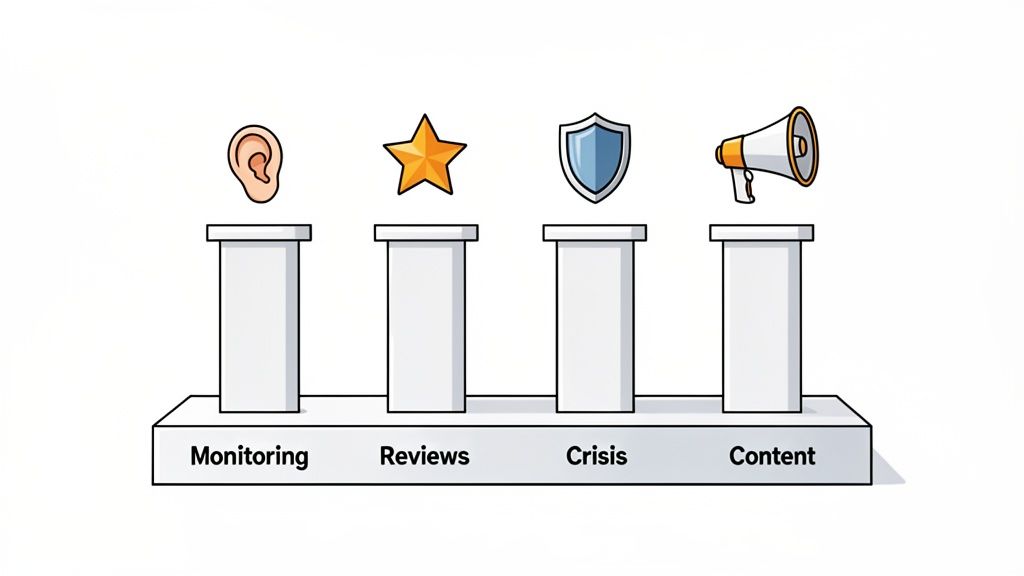
Great reputation management isn’t about one-off fixes. It’s a steady, organised effort built on a solid framework, not just guesswork. By breaking it all down into four core pillars, any business can build a repeatable system for shaping how the public sees them and taking control of their brand story.
These four pillars—Monitoring, Reviews, Crisis Planning, and Content—all work together. Think of them as a strong defence and a powerful engine for growth, all rolled into one.
Pillar 1: Proactive Monitoring and Listening
You can’t manage what you don’t measure. This is the foundation. It’s where you actively listen to what people are saying about your brand, your rivals, and your industry across the entire web. And no, this isn't just about checking your social media notifications.
It means keeping tabs on mentions everywhere—from forums like Reddit to news sites, blogs, and review platforms. The goal is to get a real-time pulse on public feeling and catch small issues before they blow up. To get a better handle on this, check out our guide on what social listening is and how it benefits your business.
- What to Track: Brand names, product names, key executives, and your main competitors.
- Why It Matters: Spotting negative chatter or false information early lets you respond fast, putting out sparks before they turn into fires.
Pillar 2: Strategic Review Management
Online reviews are a direct line to your customers and a massive driver of sales. In fact, research shows 87% of consumers read them before buying. Managing reviews isn't just about damage control; it's about turning feedback into your biggest asset.
This means encouraging your happy customers to leave reviews, which builds trust and boosts your local search rankings. It also means responding to all feedback—good and bad—professionally and quickly. A thoughtful reply to a negative review can often win back an unhappy customer and shows everyone else you’re serious about service.
Pillar 3: Robust Crisis Preparedness
A crisis can hit any business, at any time. The line between a small hiccup and a brand-destroying disaster is often just one thing: preparation. This pillar is all about creating a clear communication plan before you actually need it.
A crisis management plan is your company's emergency playbook. It maps out who does what, how you communicate, and provides pre-approved messages so you can give a calm, organised, and effective response when the pressure is on.
Your plan should name a crisis team, set up a chain of command, and have template statements ready to go. Having this framework in place means you can act decisively, stay transparent, and protect customer trust when things get tough.
Pillar 4: Positive Content Amplification
The final pillar is all about playing offence. Instead of just defending your reputation, you actively build it by creating and sharing content that reinforces the image you want people to see. This creates a "protective shield" of positive information that pushes any negativity down in search results.
This can include things like: * Publishing customer success stories and detailed case studies. * Sharing positive press and media shout-outs. * Creating genuinely helpful, keyword-rich blog posts that show off your expertise.
By consistently putting valuable, positive content out there, you make it much harder for a few negative comments or an old bad article to define your brand online.
What Happens When You Ignore Your Online Reputation

Ignoring your online reputation is a bit like leaving your shop front open for anyone to graffiti. It’s not a question of if someone will cause damage, but when. The consequences go way beyond a few lost sales from bad reviews; they can quietly poison your entire business from the inside out.
An unmanaged online presence quickly becomes a breeding ground for negativity. When you’re not tuned in to what’s being said, you miss every chance to correct misinformation, address genuine customer complaints, or even just thank loyal fans. That silence is often mistaken for indifference, and it eats away at the trust your business needs to survive.
The Ripple Effect on Your Team and Talent
A tarnished reputation creates huge internal problems that many business owners don't see coming. The best candidates for any job will Google your company before they even think about applying. A search results page full of negative reviews or unanswered complaints is a massive red flag. Good luck attracting top talent with that hanging over your head.
It’s not just about hiring, either. Existing employee morale can take a nosedive. Nobody enjoys working for a company that's constantly getting slated online. This negativity often leads to lower productivity and higher staff turnover as your best people start looking for employers with a stronger, more positive public image.
The pressure to protect a fragile reputation can even lead to overly cautious leadership. When executives are constantly worried about public backlash, they may avoid making bold, innovative decisions that are necessary for growth.
This defensive mindset completely stifles creativity and progress, trapping the business in a cycle of playing it safe. In fact, these pressures are so intense that UK businesses are feeling the strain. Recent research found that 20% of leaders admitted to choosing 'safer' options over what was best for the business, purely to shield their company's image. You can explore more of these findings on business risks facing UK companies.
From Small Sparks to Raging Fires
In today’s world, a single negative social media post, a misleading news article, or a false rumour can spiral out of control within hours. Ignoring these small sparks is a gamble you just can't afford to take. Without an early warning system, you’re left scrambling to put out a full-blown crisis rather than proactively managing a minor issue.
This is where proactive reputation management for business really proves its worth. By having a plan, you can get a handle on these situations before they explode.
Here are a few key vulnerabilities of an unmonitored reputation: * Viral Misinformation: False claims or rumours can spread like wildfire without any official word from you to set the record straight. * Unchecked Customer Complaints: A single unresolved issue can attract dozens of similar complaints, creating a snowball of negativity. * Competitor Sabotage: Unscrupulous rivals can easily exploit an unmanaged online space with fake negative reviews.
Ultimately, ignoring your reputation means you’re handing over control of your brand's story to the loudest voices online—whether they’re right or not. This builds a foundation of risk that undermines everything else you’re trying to achieve. For a deeper look into handling these situations, read our guide on developing a communications crisis management plan.
How a Stellar Reputation Fuels Sustainable Growth
Effective reputation management isn't just about playing defence; it's one of the most powerful offensive strategies you can have. While a weak reputation means you're constantly putting out fires, a stellar one acts like a magnet, actively pulling customers, top-tier talent, and new opportunities towards your brand. It becomes a self-sustaining engine for growth.
Think of trust as a currency. When customers trust you, they don’t just buy from you once. They’re far more likely to come back, tell their friends about you on social media, and even forgive the occasional mistake. This deep well of trust directly boosts customer lifetime value and builds a loyal community that money can't buy.
Turning Trust into Tangible Returns
The link between public perception and your bottom line is direct and measurable. Companies with excellent reputations consistently leave their competitors in the dust. This isn't a fluke; it's what happens when sustained trust translates into investor confidence and customer loyalty, creating an unshakeable competitive edge.
Over a 25-year period, analysis revealed that companies with strong reputations delivered stock growth 2.7 times higher than the Dow Jones and 2.1 times higher than the S&P 500. This data shows that reputation is a high-yield investment, not just another expense.
This performance is welded to the customer experience (CX). In fact, there's a razor-sharp 0.79 correlation between CX and reputation. A better customer experience builds a stronger reputation, which in turn amplifies positive CX through word-of-mouth. You can dig into more insights on how reputation impacts financial performance here.
To truly fuel sustainable growth, understanding and continuously working to improve customer satisfaction scores is non-negotiable.
The Halo Effect in Action
A strong reputation creates a "halo effect" that makes everything you do a little easier. It's the reason a well-regarded brand can launch a new product to instant excitement, while a lesser-known competitor struggles to even get noticed. This positive perception gives you a leg up in so many ways:
- Higher Price Tolerance: Customers are often willing to pay more for products or services from a brand they trust and admire.
- Increased Resilience: A deep reservoir of goodwill means your business can weather a crisis or bounce back from a misstep much faster.
- Better Partnerships: Other businesses are more eager to partner with and be associated with a brand that has a sterling reputation.
This screenshot shows how a platform like ForumScout visualises brand health, tracking mentions and sentiment over time.
By monitoring these trends, you can see exactly how your reputation-building efforts are impacting public perception, turning abstract concepts like "trust" into data you can actually use.
Putting Your Reputation Strategy into Action
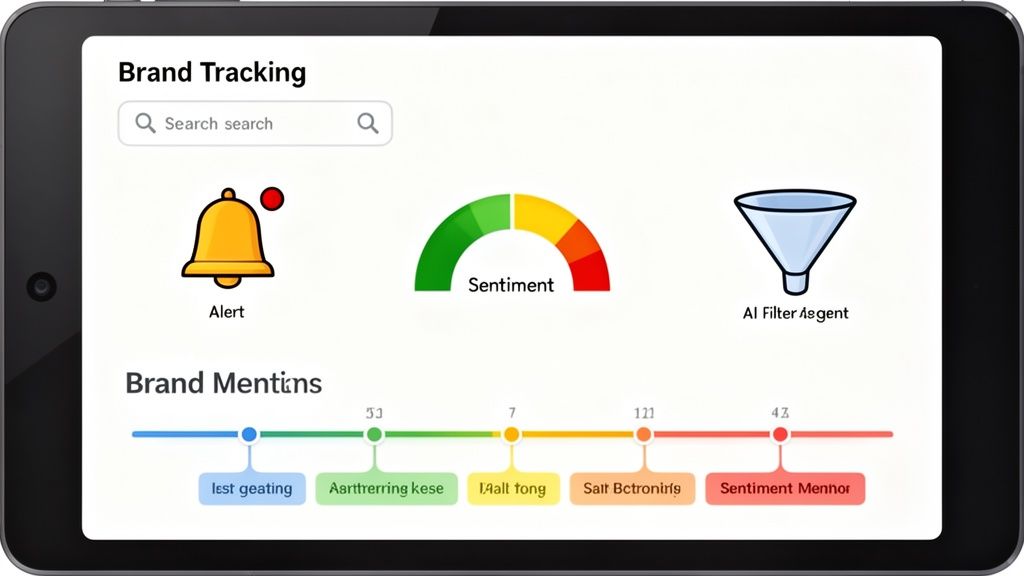
Okay, let's move from theory to reality. This is where a reputation management strategy really comes alive. Building a modern, effective workflow is much simpler than it sounds, especially with tools designed to do the heavy lifting for you. This isn’t about endlessly Googling your own company name; it’s about building an intelligent system that brings the conversations that matter directly to you.
Let's walk through a practical workflow using a social listening platform like ForumScout as an example. This approach gives you a clear, repeatable process that any business can follow to get a handle on its online story.
Step 1: Set Up Your Monitoring Keywords
First things first, you need to tell your system what to listen for. This goes way beyond just your brand name. A solid setup ensures you get the complete picture of your market and where you fit into it.
Think of it like casting a net. A wider net catches more fish, but you need the right size mesh to filter out the junk.
Start by tracking these core keyword groups: * Your Brand: This includes your company name, product names, and any common typos or variations people might use. * Your Competitors: Keep tabs on your top 2-3 rivals to see what their customers are saying. This is a goldmine for spotting their weaknesses and finding opportunities to win over their unhappy clients. * Key Topics and Problems: Monitor terms related to the problems your product actually solves. This helps you find potential customers who are actively looking for a solution just like yours.
Step 2: Fine-Tune with AI Filtering
Once your keywords are live, the raw data will start pouring in. Now the challenge is to separate the important signals from all the background noise. This is where AI-powered filtering becomes an absolute game-changer for any effective reputation management for business.
Instead of manually digging through thousands of mentions, you can set up smart rules. For instance, you could tell an AI filter to flag any mentions that show someone is ready to buy, expresses frustration, or directly compares you to a competitor.
This intelligent filtering is the difference between being buried in data and getting actionable insights. It makes sure you only see the conversations that truly matter, saving you hours of grunt work every single week.
Step 3: Analyse Sentiment and Emotion
With a clean, relevant feed of mentions, the next job is to understand the feeling behind the words. AI-powered sentiment analysis does this automatically, labelling each mention as positive, negative, or neutral. This gives you a quick, at-a-glance dashboard of public perception.
This lets you spot shifts in customer mood almost instantly. A sudden spike in negative comments could be the first warning sign of a product bug or a service issue, letting you jump on it before it snowballs. This level of insight is a core benefit of a modern reputation monitoring service.
Step 4: Create Smart Notifications and Integrations
Finally, your system needs to get these insights to the right people so they can act on them. The goal is to weave reputation monitoring directly into your team's daily groove.
Set up smart notifications to alert the right people in real time: 1. Negative Mentions: Ping your customer support team's Slack channel or email the second a negative comment appears. 2. Sales Leads: When a mention shows strong buying intent, use a webhook to automatically pop a new lead into your CRM. 3. Competitor Complaints: Forward mentions of competitor problems to your sales and marketing teams so they can chime in and help potential new customers.
This kind of automated workflow transforms reputation management from a reactive, time-sucking chore into a proactive engine for better customer service, more leads, and real business growth.
Got Questions About Reputation Management?
Even with a solid plan, getting started with reputation management can feel a bit daunting. Let's tackle some of the most common questions that pop up for businesses, with straightforward answers to help you get going with confidence.
How Much Time Does This Actually Take?
Probably less than you think, especially with modern tools. The biggest time-suck used to be monitoring, but that’s now almost entirely automated.
Instead of losing hours manually digging for mentions, a good platform sends smart alerts straight to you. A great starting point is setting aside 20-30 minutes each day to check these notifications and jump into conversations where it makes sense. This steady, proactive habit is way more effective than spending days cleaning up a mess that's already gone viral.
Can a Small Business Really Afford This?
Absolutely. You don't need a massive budget or a pricey agency anymore. Smart reputation management is scalable, and today’s software makes it incredibly affordable for businesses of any size.
Think of it like this: a powerful social listening tool might only cost a few pounds a month. When you weigh that against the thousands you could lose from a single negative review or a viral complaint, that small monthly fee is some of the cheapest business insurance you can buy.
Isn’t This Just Social Media Management?
It’s easy to mix them up, but they play very different roles. Social media management is all about what you broadcast on your own channels—your company’s Facebook page, your LinkedIn profile, and so on. It’s an active, outbound function.
Reputation management is much, much broader. It’s about listening to what people are saying about you everywhere else online. That includes social media, but also Reddit threads, niche forums, news sites, and review platforms. The focus is on understanding and shaping the entire public conversation about your brand, not just curating your own posts.
How Should I Handle a Negative Review?
The golden rule here is to respond quickly, stay professional, and do it publicly before taking the conversation offline if you need to. That transparency is a huge trust signal for any business.
Here’s a simple but effective game plan: 1. Acknowledge their frustration right away. It shows you’re listening. 2. Apologise for their bad experience, even if you don't think you were at fault. 3. Offer a real solution or a direct line to fix it (like an email or phone number).
A calm, helpful public reply shows every potential customer watching that you genuinely care and are committed to making things right. It's a simple act that can easily turn a bad situation into a win for your reputation.
Ready to take control of your online story? ForumScout handles the hard work of monitoring, so you can focus on building relationships and growing your business. Find out what people are saying about your brand right now. Start your free 7-day trial of ForumScout.