- 21 min read
Guide to share of voice calculation: measure, benchmark, and optimize
Calculating your Share of Voice (SOV) is all about figuring out your brand's visibility compared to your competitors. Think of it as your slice of the conversation pie within your market, shown as a simple percentage. It’s a vital sign that reveals just how much of the online chatter your brand actually owns.
Why Share of Voice Is Your Marketing Compass

Too many businesses write off Share of Voice as a vanity metric, something only corporate giants need to worry about. But in reality, running a regular share of voice calculation is one of the most practical things you can do to guide your marketing strategy, no matter how big or small your company is. It gives you a clear, unbiased benchmark of your market presence.
Honestly, it’s the ultimate competitive intelligence metric. Are your marketing campaigns actually making a dent? Are you gaining ground, or are your rivals drowning you out? SOV gives you the real answers.
From Vague Feelings to Hard Data
Without SOV, you're flying blind. You're just going off gut feelings about how your brand is doing. Calculating it turns those abstract ideas about "brand awareness" into concrete numbers you can track, analyse, and actually do something with.
It allows you to:
- Benchmark Your Position: Know exactly where you stand in the market right now.
- Identify Strategic Gaps: Find channels or topics where your competitors are winning and you’re basically invisible.
- Measure Campaign Impact: See a direct link between your marketing efforts and your visibility.
- Spot Emerging Rivals: Detect new players joining the conversation before they become a major threat.
A great real-world example of this is the fiercely competitive UK supermarket sector. A study that tracked over 3.5 million online mentions in the first half of 2023 showed Tesco leading with an 18% SOV. But it also revealed Co-op grabbing a strong second place at 13%. They didn't do it through sheer size; they did it by owning conversations around ethical sourcing and community values. These are the kinds of insights that show you which messages are truly cutting through the noise. You can explore more about the UK supermarket analysis and its findings.
Putting SOV into Practice
The applications here are incredibly valuable and diverse. A new SaaS startup, for instance, can use SOV to track its growing presence on tech forums like Reddit and Hacker News against the established leaders. This isn't just about counting mentions; it's about seeing if their product launches and feature updates are sparking genuine discussion.
On a smaller scale, a local coffee shop can monitor its social media buzz compared to the Starbucks down the street. A sudden spike in their competitor's SOV might reveal a successful new drink promotion—something they can learn from and counter.
Key Takeaway: Share of Voice isn't just a number. It's a narrative about your brand's journey in the marketplace, highlighting your strengths, exposing weaknesses, and pointing the way toward strategic growth.
Ultimately, understanding your SOV is the critical first step toward strategically expanding your influence. It helps you focus your budget and energy where they’ll have the biggest impact, ensuring you’re not just shouting into the void but actively capturing a larger share of your audience’s attention.
Choosing the Right SOV Calculation Method

There’s no single, universal formula for a share of voice calculation. Honestly, anyone who tells you otherwise is selling something. The best method for your business comes down to your goals, the channels you’re active on, and the data you can actually get your hands on.
Picking the right approach from the start is crucial because it shapes the insights you get. Think of it like choosing the right lens to view your market—each one reveals a different part of the story. We can break down the main methods into three categories, each offering a different level of depth.
The Classic Mentions-Based Formula
The most straightforward way to calculate SOV is to simply count the conversations. This is the mentions-based approach, and it’s a fantastic starting point for any business wanting a quick pulse check on its market presence.
The logic is simple: you count every time your brand is mentioned and divide that by the total mentions for all the brands you're tracking (including your own) over a set period.
Your Brand Mentions / Total Market Mentions = Your SOV (%)
This method is perfect for getting a baseline understanding of who’s generating the most chatter. If you're a new startup, for example, tracking mentions on Reddit and X (formerly Twitter) can quickly show if your launch is making any noise compared to established players. It’s direct, and it answers one key question: "How often are we being talked about?"
Gauging Potential Audience with Impressions-Based SOV
While mention volume is useful, we all know not all mentions are created equal. A single shout-out in a major online publication can reach more people than a hundred tweets from accounts with ten followers. This is where an impressions-based share of voice calculation gives you a much more nuanced view.
This model shifts the focus from how many mentions you get to how many people could have seen them.
Key Takeaway: An impressions-based SOV measures potential reach, not just conversation volume. It helps you understand your visibility in terms of audience size, which is vital for assessing brand awareness campaigns.
To calculate it, you'll need data on the potential impressions for each mention—often an estimate based on a site's readership or a social media account's follower count. The formula looks familiar:
Your Brand's Total Impressions / Total Market Impressions = Your SOV (%)
Using this method helps you appreciate the true impact of high-authority placements. For instance, a feature on a popular industry blog might only count as one mention, but its 500,000 potential impressions give it far more weight than a handful of social media comments. If you're looking to dive deeper into this metric, our guide on how to measure reach provides some valuable context.
The Weighted Formula for True Impact
For the most sophisticated and accurate picture, a weighted formula is the gold standard. This method acknowledges that the quality of a mention is just as important as its volume or reach. It adds layers like sentiment, source authority, and even engagement to provide a truly comprehensive score.
A weighted share of voice calculation doesn't have one fixed formula; you create it by assigning scores to factors based on what matters to your brand. For instance:
- Sentiment: Positive mentions might get a score of +2, neutral +1, and negative -1.
- Source Authority: A mention from a major news outlet could be worth 10 points, while a mention on a small forum might be worth 1 point.
- Engagement: You could add points for every like, share, or comment a mention receives.
A global brand would find this essential. A headline in a national newspaper carries significantly more weight than a random angry tweet, and a weighted model reflects that reality. This approach moves beyond simple visibility to measure genuine influence and reputation, giving you insights that are far more actionable.
Share of Voice Calculation Methods
Here’s a quick breakdown to help you decide which formula makes the most sense for your team right now.
| Formula Type | Calculation | Best For | Data Required |
|---|---|---|---|
| Mentions-Based | Your Mentions / Total Mentions |
Quick, high-level view of conversation volume and market chatter. | Raw mention counts for your brand and competitors. |
| Impressions-Based | Your Impressions / Total Impressions |
Measuring potential audience size and brand awareness campaign impact. | Estimated impressions or reach data for each mention. |
| Weighted | Your Weighted Score / Total Weighted Score |
Gaining a deep, nuanced understanding of brand reputation and influence. | Mentions, reach, sentiment, source authority, engagement data. |
Ultimately, the best method is the one that aligns with your goals and resources. Don't feel pressured to start with a complex weighted formula if a simple mentions count will give you the answers you need today.
Your Playbook for Calculating Share of Voice

Alright, this is where the theory behind the share of voice calculation gets real. Knowing the formulas is one thing, but actually putting them to work is what gives you repeatable, valuable insights.
We're going to walk through a practical process you can lift and shift directly into your own marketing reporting. The goal here isn't just to get a number; it's to build a system that consistently tells you where you stand.
Pinpoint Your True Competitors
Before you can figure out your slice of the pie, you need to know who else is at the table. The first step is always defining a realistic competitive landscape. It’s tempting to just list your top three direct rivals, but the online conversation is almost always bigger than that.
You’re competing for attention, not just for sales. Think broader:
- Direct Competitors: The obvious ones. They sell similar stuff to the same people.
- Indirect Competitors: These brands solve the same problem but with a different solution. If you sell project management software, a simple to-do list app is an indirect competitor.
- Aspirational Competitors: The big players you look up to. Including them gives you a benchmark for what success really looks like in your space.
- Content Competitors: Industry blogs, publications, or influencers who own the keywords and topics you’re after, even if they don't sell a competing product.
Getting this list right is foundational. Too narrow, and you'll get a falsely inflated SOV that makes you feel good but tells you nothing. Too broad, and you'll look insignificant.
Define the Scope of the Conversation
With your competitor list locked in, it's time to draw some boundaries around the conversation you want to measure. This means picking the keywords, topics, and channels that actually matter. Trying to track everything, everywhere is a fast track to data overload and useless results.
Get focused by setting clear parameters.
- Brand Keywords: This is your baseline. Track your brand name, product names, and any common misspellings. Do the same for every single competitor on your list.
- Topical Keywords: Now, go beyond brand names. Think about non-branded industry terms, product categories, or the "problem" keywords your audience is searching for. If you sell eco-friendly cleaning supplies, you'd want to track things like "sustainable household products" or "non-toxic cleaner."
- Relevant Channels: Where are these conversations actually happening? Zero in on the specific social media platforms, forums (like Reddit), news sites, and blogs where your target audience hangs out.
Key Takeaway: Your share of voice calculation is only as good as the data you feed it. By carefully curating your competitors and keywords, you ensure the final number actually reflects the market reality that matters to your goals.
This tight focus stops your analysis from getting watered down by irrelevant noise and keeps your insights sharp.
Set Your Timeframe and Gather the Data
Consistency is everything in measurement. You need to pick a specific timeframe for your analysis and stick to it. A monthly calculation is a solid starting point for most businesses—it’s frequent enough to spot trends but not so frequent that it becomes a chore. For a specific campaign, you might zoom in on a week or two.
Once your timeframe is set, it's go-time for data collection. This is where a social listening tool is a massive help, but you can do it manually if you have the patience. You need to collect the total number of mentions for your brand and each competitor across all your chosen keywords and channels within that period.
A simple spreadsheet is your best friend here. Create columns for each brand, rows for each keyword or channel, and start tallying up the mentions.
Execute the Calculation and Analyse the Results
You've got your data neatly organised, so the last step is the easiest part: the calculation. Let's stick with our hypothetical e-commerce brand, "GreenClean," which is up against "EcoShine" and "PureHome."
Let’s say that over the last month, you collected this data:
- GreenClean (Your Brand): 450 mentions
- EcoShine: 800 mentions
- PureHome: 250 mentions
First, get the Total Market Mentions by adding everything up:
450 (GreenClean) + 800 (EcoShine) + 250 (PureHome) = 1,500 total mentions
Now, just plug your brand's numbers into the SOV formula:
(Your Brand Mentions / Total Market Mentions) x 100 = Your SOV %
(450 / 1,500) x 100 = 30%
Boom. In this market, GreenClean has a 30% Share of Voice. You'd then do the same for the others to see the full picture: EcoShine is dominating with a 53.3% SOV, while PureHome trails with 16.7%.
This one number gives you a clear, quantitative benchmark. From here, you can start digging into the why behind the numbers and figure out your next move.
Automating Your SOV Calculation with ForumScout

Manually pulling data for a share of voice calculation is a noble effort, but let’s be honest—it’s a massive time sink. Sifting through Reddit threads, X feeds, and niche forums is tedious work that becomes outdated the moment you finish and is notoriously prone to human error.
This is where automation becomes your secret weapon. Using a dedicated social listening platform like ForumScout removes the manual grind, giving you a continuous, real-time pulse on your market position without you having to lift a finger.
Setting Up Your Automated Monitoring
The real magic of automation lies in its "set it and forget it" nature. Instead of repeatedly searching for mentions, you just tell the platform what to look for once. Getting this sorted in the ForumScout dashboard is incredibly straightforward.
You kick things off by creating projects for your brand and each of your key competitors. For each project, you simply define the keywords you want to track.
- Brand Keywords: Your company name, product names, and key people.
- Competitor Keywords: The same set of terms for each of your rivals.
- Topic Keywords: Non-branded industry terms that signal relevant conversations worth tracking.
Once that’s saved, ForumScout’s crawlers get to work, automatically pulling in every relevant mention from sources like Reddit, LinkedIn, X, and countless online forums. This data feeds directly into your dashboard, updating hourly to provide a live look at the conversation.
Key Takeaway: Automation transforms your share of voice calculation from a static, retrospective report into a dynamic, live dashboard. This shift lets you spot trends as they happen, not weeks after the fact.
This immediate access to data is a game-changer. You can see the impact of a press release or a competitor's misstep within hours, allowing for agile and responsive marketing. For businesses in the SaaS sector, specialised platforms offer even more advanced methods for AI Brand Tracking for SaaS Companies, which can seriously streamline your SOV measurement.
Visualising Trends and Competitive Intelligence
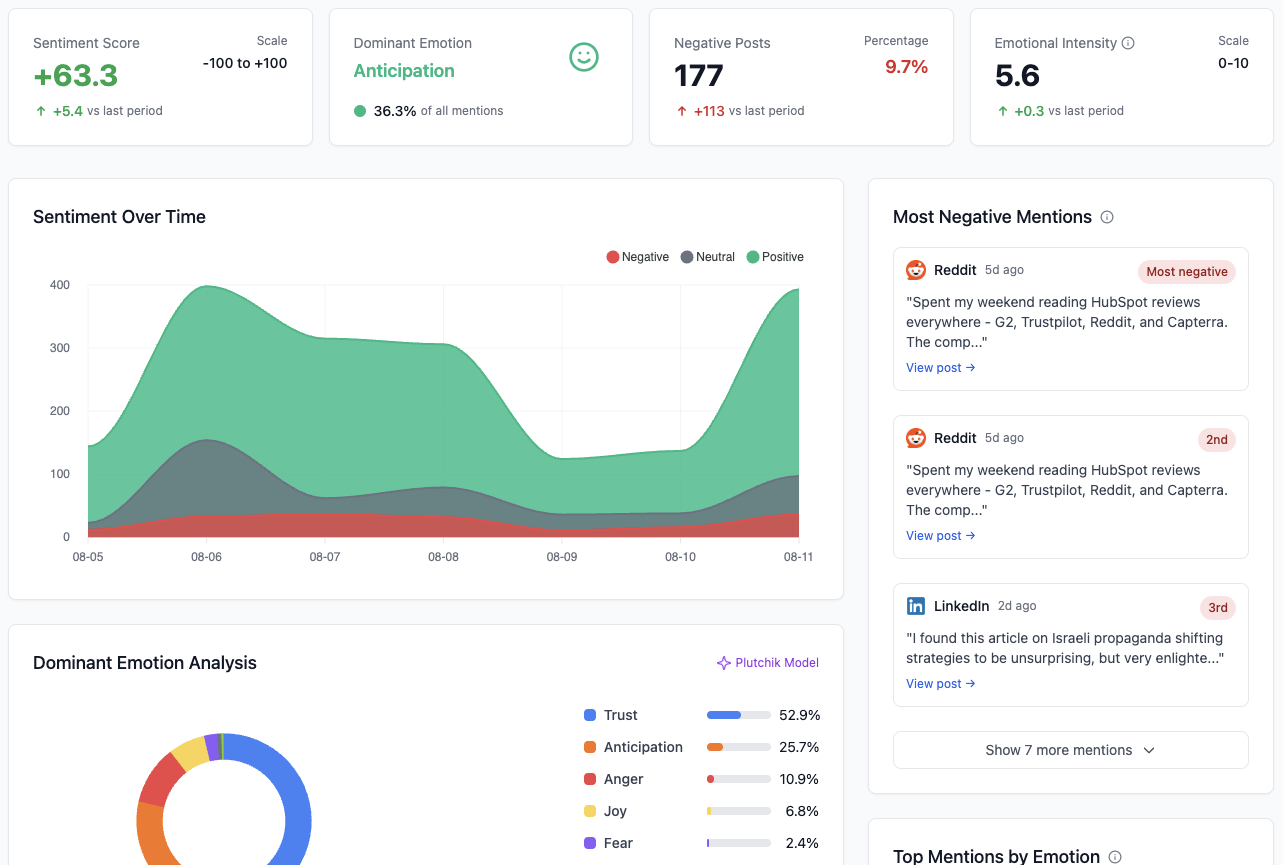
Raw data is just one piece of the puzzle. The real value comes from making sense of it all quickly. ForumScout automates the analysis by instantly visualising your share of voice calculation through its built-in competitive intelligence features.
You can instantly see SOV trend lines that show your market position over time. Are you gaining ground or losing momentum? The answer is right there in a simple graph, comparing your brand's mention volume directly against your competitors. This completely removes all the guesswork and spreadsheet wrangling.
This visual approach makes it simple to:
- Identify SOV Spikes: Pinpoint the exact moments and conversations that caused a surge in mentions for you or a competitor.
- Analyse Sentiment: See if your share of voice is driven by positive praise or negative feedback.
- Discover Untapped Channels: Find out where your competitors are being discussed that you aren't.
This level of automation turns a complex analytical task into a simple check-in, freeing up your team to focus on strategy instead of data entry.
Integrating SOV Data into Your Workflow
Actionable insights are only useful if they get to the right people and systems. Manually exporting data is clunky, but modern tools allow for seamless integration, turning your SOV metrics into a core part of your business intelligence.
ForumScout offers a few ways to connect your data to the tools you already use. You can set up an automated export to Google Sheets, which can serve as a central data source for custom dashboards or reports.
For more advanced workflows, you can connect ForumScout to thousands of other apps using webhooks and tools like Zapier or Make. Imagine automatically sending high-priority negative mentions to a Slack channel or logging potential leads discovered through social listening directly into your CRM. By exploring the platform's capabilities, you can build a powerful system for turning conversations into revenue. You can learn more about this in the ForumScout API and webhook documentation. This truly bridges the gap between monitoring and action.
Turning Your SOV Data into Smarter Strategies
Knowing your Share of Voice percentage is a bit like getting a score back on a test. It tells you how you did, but it doesn't tell you how to get a better grade next time. The real magic of any share of voice calculation isn't in the number itself, but in what you do with it.
Turning that raw data into a smart, actionable marketing strategy is what separates brands that grow from those just going through the motions.
A single SOV number is just a snapshot. But when you track it over time, that snapshot turns into a story. Are you slowly gaining ground, or did a competitor’s latest launch just wipe out last quarter's progress? By plotting your SOV monthly or quarterly, you can see your brand's trajectory and connect the dots between spikes, dips, and your own marketing efforts.
Look Beyond the Numbers: Are the Mentions Actually Good?
Chasing a higher SOV without context is a classic mistake. A huge spike in mentions isn't automatically a win. Was that surge from a successful product launch, or was it a customer service meltdown going viral on X?
This is exactly why you need to layer your SOV data with sentiment analysis. It's non-negotiable.
A healthy SOV is driven by positive or neutral conversations. If your share of voice is growing but your sentiment score is plummeting, you've got a reputation crisis on your hands, not a visibility win. You have to understand the quality of your mentions to get the real story.
Find the Gaps in Your Competitors' Armour
Your competitors' SOV data is a treasure map showing you exactly where their weaknesses are. Don't just glance at their overall score. Dig deeper. Break it down by channel, topic, and sentiment to find strategic openings for your own brand.
For instance, you might find things like:
- A Channel Gap: Your biggest rival owns the conversation on X, but they're practically invisible on relevant Reddit communities. That's your cue to go in and dominate that channel.
- A Content Weakness: A competitor has a high SOV for their brand name but almost none for critical, problem-solving keywords in your niche. This is a golden opportunity to become the go-to resource with targeted content.
- Negative Sentiment: If a competitor's SOV is high but riddled with complaints about a specific feature, you can tailor your messaging to highlight how your product solves that exact problem.
Key Takeaway: A proper competitor analysis isn't just about seeing who's shouting the loudest. It's about listening for the quiet spots where your brand can step in and lead the conversation.
This process turns their report card into your strategic playbook. To get even more out of this, check out our guide on benchmarking with competitors to really sharpen your approach.
The Power of "Extra" Share of Voice (ESoV)
Investing in SOV isn't just about fuzzy brand-building; it has a direct, proven impact on market growth. This is especially true for UK brands trying to navigate a tough economy.
The Extra Share of Voice (ESoV) principle is simple: brands that achieve an SOV higher than their current Share of Market (SOM) tend to grow. Recent findings show that boosting ESoV by just 10 percentage points reliably drives a 0.7% increase in market share, not to mention higher profits and customer loyalty.
Connect SOV to Your Bottom Line
Your share of voice calculation should never exist in a silo. It’s a vital sign that informs your entire marketing ecosystem, helping you measure brand awareness, competitive positioning, and message effectiveness.
Understanding your SOV gives context to your other efforts, including measuring content marketing ROI. A rising SOV, especially one with positive sentiment, should lead to improvements in other key metrics like website traffic, leads, and sales.
When you can draw a clear line from a higher share of voice to real business outcomes, you've successfully turned a simple calculation into a powerful tool for growth.
Got Questions About Share of Voice? We’ve Got Answers
Even with the best formulas, calculating your share of voice can get a little tricky in practice. When you move from theory to your actual spreadsheet, some common questions always seem to pop up. Let’s walk through a few of the hurdles marketers run into most often.
How Often Should I Calculate Share of Voice?
There's no single right answer here—it really depends on how fast your market moves and what you’re trying to achieve. That said, for most businesses, a monthly check-in is the perfect sweet spot.
It’s frequent enough to catch important trends and see if your latest campaign made a dent, but not so frequent that you get lost in meaningless daily fluctuations. If you’re in a super competitive space or in the middle of a big launch, you might want to ramp that up to a weekly calculation to keep a closer pulse on things.
What If My SOV Is Zero or Really Low?
First off, don't panic. A low (or even zero) Share of Voice is a totally normal starting line, especially for new brands or companies stepping into a crowded market. Think of it less as a failure and more as a clean slate—a clear benchmark you can only go up from.
A low score is actually a fantastic diagnostic tool. It tells you exactly where to focus:
- Find untouched channels: Where are your competitors not showing up? A low overall SOV could be hiding a golden opportunity to become the dominant voice in a specific niche forum or social platform.
- Own a smaller pond first: Instead of trying to shout louder than everyone everywhere, pick a specific topic or keyword and own it. Build momentum there before you try to take on the entire ocean.
- Learn from the winners: A competitor’s high SOV is basically a free roadmap. Dig into their most successful content and engagement tactics to see what’s working with your target audience.
A low SOV isn't a dead end. It’s a starting point that gives your marketing strategy a clear, data-backed direction.
Should I Include My Own Paid Ads in the Calculation?
This is a great question, and it trips a lot of people up. The answer really depends on what you want to measure.
If your goal is to understand your brand’s organic pull and how much people are talking about you naturally, then you should absolutely exclude your own paid ads. This gives you a pure, unfiltered look at your earned media presence.
However, if you're after the complete picture of your total market visibility—both what you've earned and what you've paid for—then it makes sense to include them. Many teams I've worked with actually calculate both. They track an "organic SOV" and a "total SOV" side-by-side to understand how much of their visibility is being bought versus earned.
Ready to stop guessing and start measuring? ForumScout automates the entire share of voice calculation process, giving you real-time insights from Reddit, X, forums, and more. Start your free 7-day trial and see where you stand.