
- 16 min read
How to Measure Brand Awareness
Measuring brand awareness isn't some dark art. It’s simply about tracking how familiar your target audience is with your brand, and you do it by looking at a mix of direct feedback and indirect signals. The best way to get a real, honest picture is by blending the hard numbers, like branded search volume, with the softer, more human insights you get from surveys and social listening.
Beyond Vanity Metrics: What Is Brand Awareness, Really?
Let's cut through the noise. Brand awareness isn’t about chasing impressions or racking up followers. Those are just numbers on a screen. True awareness is about whether your audience recognises you and—this is the important part—thinks of you when they actually need something you offer. It’s the groundwork that turns people who just scroll past your content into people who actively seek you out.
This whole concept really boils down to two key things:
- Brand Recognition: This is what we call prompted awareness. If someone sees your logo or hears your name, do they actually know who you are? It’s that "Oh yeah, I've heard of them" moment.
- Brand Recall: This is the unprompted stuff, sometimes called top-of-mind awareness. When a customer thinks about a product or service in your field, is your brand one of the first names that pops into their head? That’s the real goal.
Relying on old-school metrics just doesn’t cut it anymore for businesses that want to grow. Staring at follower counts or website hits gives you an incomplete, and often misleading, picture of your brand's actual health.
Moving from Guessing to Knowing
To truly get a handle on where your brand stands, you need a modern framework—one that mixes what you can ask people directly with what you can observe from their behaviour. Before getting into the weeds, it's worth checking out a comprehensive guide to Brand Awareness Measurement, which really drives home the point of tracking what actually matters for growth.
This approach is all about combining quantitative data from your analytics with qualitative feedback from real people. It’s about connecting the dots, like seeing a spike in direct website traffic right after a big PR push, or noticing that positive sentiment on social media went up just after you launched a new feature.
When you do this, you stop guessing about your impact and start measuring it with confidence. And that means you can finally prove the value of your marketing efforts with solid evidence.
Choosing the Right Brand Awareness Metrics to Track
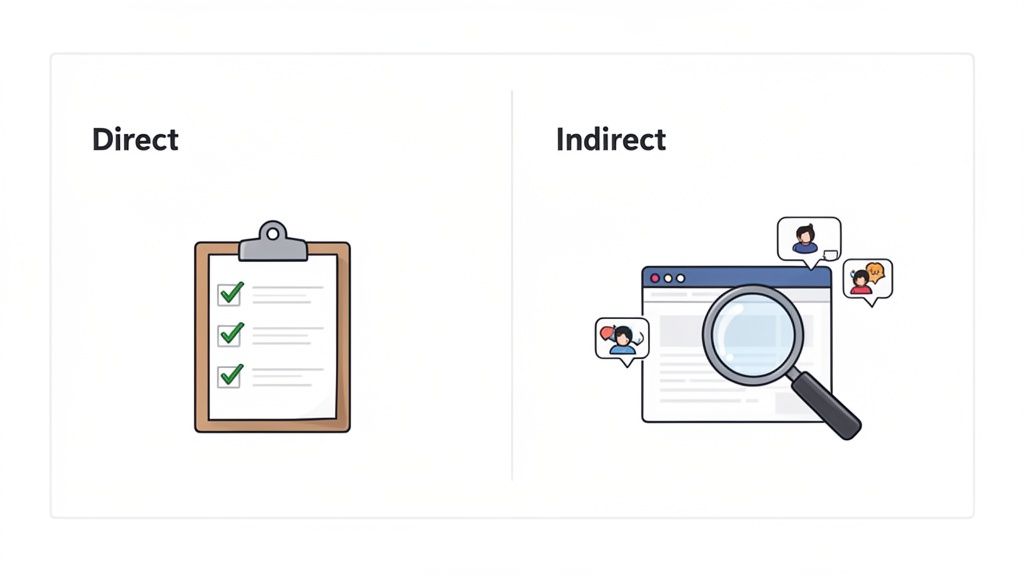
To get a real sense of your brand awareness, you need a balanced toolkit. Just looking at one number can give you a completely skewed picture. It’s far better to combine metrics that show you both direct feedback from your audience and the indirect signals they leave behind in their online behaviour.
Think of it like this: direct feedback is what people tell you, while indirect signals are what they do. The first involves actively asking your audience about your brand to get clear, intentional data. The second involves observing the digital breadcrumbs they leave across the web.
When you blend both, you get a much richer, more reliable view of where your brand truly stands.
Gauging Awareness with Direct Feedback
The most straightforward way to find out if people know who you are is simply to ask them. Surveys are your best friend here, and they're perfect for measuring two distinct types of awareness.
-
Unaided Awareness: This is the gold standard of brand recall. You’d ask a question like, "When you think of project management software, which brands pop into your head first?" If people name your brand without any prompting, you know you’re memorable.
-
Aided Awareness: This one’s all about recognition. You show people a list of brands—yours, plus a few competitors—and ask, "Which of these have you heard of before?" This tells you how familiar your brand is, even if it isn't the first one they think of.
Here in the UK, brand recall surveys are a common way to quantify this stuff. YouGov BrandIndex, for example, tracks daily Ad Awareness by asking adults which brands they’ve seen advertised in the last two weeks. Back in June 2023, Robinsons soft drinks saw its score jump by 8.3 percentage points after launching a new campaign, while Morrisons supermarkets gained 7.5 points just by bringing back a classic slogan. It shows how targeted tracking can nail down the uplift from specific campaigns.
Uncovering Clues in Indirect Signals
Indirect signals are the behavioural footprints your audience leaves online. They aren’t as direct as a survey answer, but they provide powerful, real-time insights into how your brand is being discovered and perceived in the wild.
One of the strongest indicators is Direct Website Traffic. When someone types your URL straight into their browser, it’s a massive sign of strong brand recall. They didn't need Google; they knew exactly where they wanted to go. That’s a loyal, aware user.
Another huge one is Branded Search Volume. This is simply the number of people typing your brand name into a search engine. A steady increase here is a crystal-clear sign that awareness is growing and people are actively looking for you.
Finally, you’ve got social media metrics. Go beyond vanity numbers like follower counts and look at reach, engagement, and especially brand mentions. For a deeper look at what to track, a good guide to Twitter account analytics can help you make sense of the data that actually matters for awareness.
Key Takeaway: A healthy mix of metrics is non-negotiable. Direct traffic shows intent, social listening reveals sentiment, and surveys confirm recall. No single metric tells the whole story, but together, they create a clear and actionable view of your brand's health.
This naturally leads us to a crucial competitive metric: Share of Voice (SoV). This measures how much of the conversation in your industry is about your brand compared to your competitors. By tracking mentions across social media, forums, and news sites, SoV gives you a clear picture of your market presence. To really get to grips with it, check out our guide on how to https://forumscout.app/blog/share-of-voice-measurement.
Gathering and Analysing Your Brand Data
Alright, you've picked your metrics. Now it’s time to get your hands dirty and actually start collecting the data. This is where we move from planning to doing, setting up the systems that will feed you the insights you need.
The aim here isn't a one-off report. It's about building a repeatable process. You need a solid playbook for everything, from launching a quick survey to digging into your analytics and keeping an ear on social chatter. Get these systems in place now, and you'll have a foundation for tracking brand awareness consistently over the long haul.
Setting Up Your Data Collection Channels
First things first, let's get your data streams organised. You’ll be pulling from a few different places, and each one needs its own setup.
-
Surveys for Direct Feedback: Tools like Google Forms or SurveyMonkey are perfect for this. Keep it simple. For unaided recall, ask an open-ended question like, "When you think of [your product category], what brands come to mind first?" For aided recall, show a list of your brand and your main competitors and ask, "Which of these brands have you heard of?" Easy.
-
Web Analytics for Behavioural Data: Fire up Google Analytics. You're looking for traffic that screams brand awareness. Create a segment for Direct Traffic—these are the people typing your URL straight into their browser. You should also monitor Branded Search by tracking clicks on keywords that include your company name. A healthy climb in these two areas is a fantastic signal of growing brand recall.
-
Social Listening for Real-Time Conversations: This is your window into the unfiltered voice of your customers. Social listening tools let you track mentions of your brand, your rivals, and key industry terms across social media, forums, and news sites. It’s not just about volume; you need to understand the context. For a deeper dive, check out our guide on what is social listening.
Expert Tip: Don't just collect data—connect it. See a spike in direct traffic right after a new PR piece goes live? That’s a clear win. Notice a jump in negative sentiment on social media? That's your early warning to step in. The real magic happens when you see how these different data points influence one another.
From Raw Data to Actionable Insights
Once the data starts flowing, the real challenge begins: making sense of it all. A spreadsheet full of numbers means nothing without interpretation. Your job is to spot the trends, set your baselines, and piece together the story the data is telling you.
A great example of this in action comes from B Lab UK. They track public familiarity with the "B Corp" certification. In 2022, only 34% of the UK public recognised the term or logo. By 2024, that number had jumped to 51%—clear, measurable progress. They even break down awareness by nation, showing regional differences. It’s a perfect illustration of detailed, effective measurement.
A Real-World Scenario
Let's say a new software startup is launching its first major marketing campaign, set to run for three months. Here's how they'd measure its impact on brand awareness.
-
Month 0 (Baseline): Before anything starts, they run a small survey. They find their aided awareness is just 5% among their target audience. Google Analytics shows about 50 direct visits per day, and social listening confirms their Share of Voice is less than 1%.
-
During the Campaign: They launch some targeted ads and land a couple of podcast interviews. They keep a close eye on their social listening tools and see brand mentions start to tick up, with sentiment remaining mostly positive.
-
Month 3 (Post-Campaign): Time to measure again. They deploy the exact same survey. Aided awareness has now shot up to 12%. Direct traffic has tripled to 150 visits per day, and their Share of Voice has climbed to 4%. They now have clear, quantifiable proof that their campaign worked.
Benchmarking Performance and Setting Realistic Goals
So, you've got the data. Great. But numbers without context are just noise. To figure out what they actually mean, you need to benchmark your performance. This is how you turn a spreadsheet full of metrics into a clear signal of where you stand and where you need to go.
The trick is to look in two directions at once. First, you need to look inward at your own progress over time. Then, you need to look outward and see how you stack up against the competition.
Establishing Your Internal Baseline
Internal benchmarking is all about tracking your own progress. Think of it as competing against your past self. When you measure your key metrics consistently—month-over-month or quarter-over-quarter—you establish a baseline. This historical data becomes your single source of truth for understanding growth.
Let's say your branded search volume was 500 searches last quarter and it’s 750 searches this quarter. That’s a clear, quantifiable sign that something you’re doing is working. Without this internal view, you're just flying blind, completely unable to connect your marketing efforts to tangible results.
Gauging Your Position with External Benchmarks
While seeing your own numbers go up is motivating, you don't operate in a vacuum. This is where external benchmarking comes in—measuring your brand against direct competitors. It gives you a much-needed reality check on your position in the market and helps you set goals that are actually achievable.
For a deeper dive, our guide on how to benchmark with your competitors is a great place to start.
Aiming to match a global giant overnight is just setting yourself up for failure. A smarter move is to identify your closest competitors—those of a similar size or stage—and focus on systematically closing the gap.
Just look at the UK smart home market for a dose of reality. A 2023 Statista survey found that Samsung had 93% brand awareness, with LG close behind at 90% and Dyson at 87%. These aided awareness figures show just how dominant the big players are. For a smaller UK business in that space, those numbers aren't a target to hit; they're the landscape you have to navigate. You can explore more about these brand recognition findings to get the full picture.
This kind of competitive intelligence is what lets you set smart, realistic targets instead of vague goals like "increase brand awareness."
Here are a few examples of what strong, data-informed goals look like:
- Increase our aided awareness score by 5 percentage points in the next six months.
- Grow our social share of voice from 3% to 7% this quarter.
- Boost direct website traffic by 15% over the next campaign period.
By combining your internal progress with external benchmarks, you build a complete picture. You’ll understand your own trajectory while knowing exactly where you fit in the competitive landscape, allowing you to set goals that are both ambitious and grounded in reality.
Creating a Brand Awareness Report That Gets Read
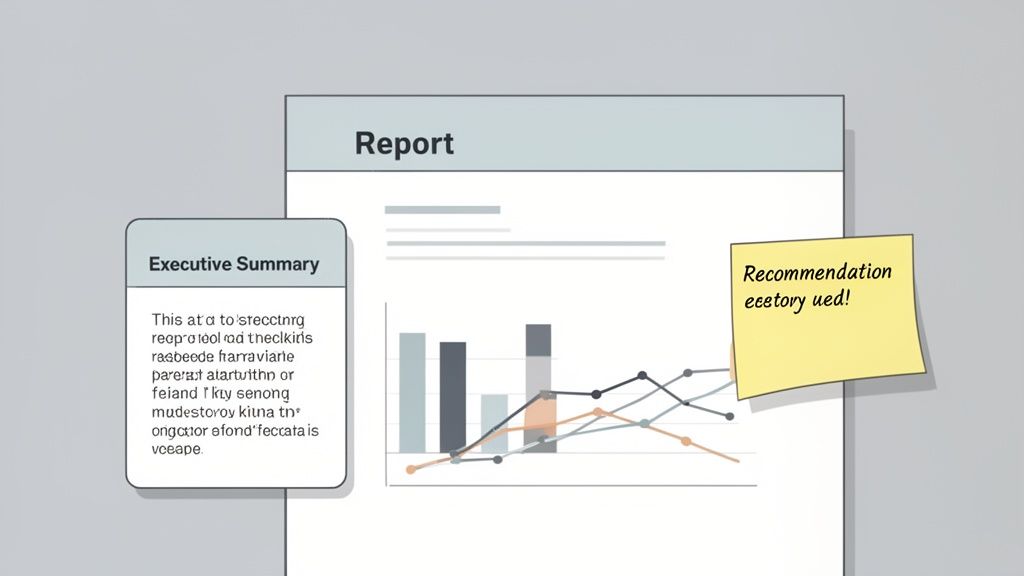
Collecting all that data is one thing, but turning it into a story that actually drives action? That’s where the real work begins. Let’s be honest: a report that just dumps numbers onto a page is destined for the digital bin. But a report that tells a clear, compelling story gets read, understood, and—most importantly—acted upon.
Your real goal here is to move beyond a simple scorecard. You need to connect the dots for stakeholders, showing them not just what happened, but why it matters for the business. This is how your report transforms from a routine update into an essential strategic tool that proves your value.
Structuring Your Report for Maximum Impact
A solid structure is everything. Think of it like a narrative with a clear beginning, middle, and end. If you just overload your team with raw data, you’re guaranteed to lose their attention fast. You need to guide them through your findings logically.
Whether you're reporting monthly or quarterly, make sure these key components are in there:
- Executive Summary: Start with a brief, punchy overview. Put the key findings and recommendations right at the top for busy execs who might not read the whole thing.
- Data Visualisations: Use clean charts and graphs for metrics like branded search volume, direct traffic, and share of voice. Visuals make complex data digestible at a glance.
- Qualitative Insights: This is where you bring the numbers to life. Add colour with highlights from social listening—maybe a standout customer quote, a recurring theme in feedback, or an interesting competitor mention you spotted.
- Key Learnings and Recommendations: End with a sharp analysis. Explain what the data means and propose specific, actionable next steps based on what you’ve found.
Bringing the Data to Life
The best brand awareness reports are a blend of hard numbers and human context. The quantitative data tells you what happened, but the qualitative element tells you why.
For instance, you could show a graph indicating a 15% increase in social media mentions. That’s a good start. But the real insight comes when you pair it with a concrete example: "This spike was driven by a conversation on Reddit about our new feature, where users praised its ease of use. This suggests our messaging for the feature is really resonating."
Pro Tip: My rule is simple: never present a data point without an insight. Instead of just saying, "Direct traffic is up 10%," frame it with context. Try something like, "Direct traffic increased by 10% this month, which coincided with our recent podcast sponsorship campaign, indicating it successfully drove recall among listeners."
This approach of weaving a story around your metrics is fundamental. It shows you truly understand how to measure brand awareness in a way that connects marketing activities to real business outcomes. When you consistently deliver reports that offer clarity and strategic direction, you become an invaluable advisor, not just a data gatherer. Soon enough, your reports will be something stakeholders actually look forward to reading.
Answering Your Brand Awareness Questions
As you start formally measuring brand awareness, you'll run into a few common questions. It’s totally normal. Getting clarity on these points early will help you build a measurement process that actually works and doesn't just create busywork. Let's tackle the ones that pop up most often.
How Often Should I Measure Brand Awareness?
Honestly, the right frequency depends entirely on what you’re doing.
For general, ongoing tracking, a monthly or quarterly check-in works perfectly. This gives you enough data to spot real trends without getting lost in minor, day-to-day blips. You're looking for the signal, not the noise.
But that all changes when you've got a big initiative in play—think a major product launch or a huge advertising campaign. For moments like these, you need to switch to a pre- and post-campaign approach.
- Baseline Measurement: Capture your key metrics right before the campaign kicks off. This is your "before" picture.
- Post-Campaign Measurement: About a month after the campaign wraps up, measure the exact same metrics again.
This before-and-after snapshot is the cleanest way to isolate the impact of that specific activity and see how it moved the needle on things like brand recall or search volume.
What Is a Good Brand Awareness Score?
There's no magic number here. A "good" score is completely relative to your industry, how long you've been around, and—most importantly—your direct competitors.
A new B2B software company might be ecstatic with 15% aided awareness in its niche after a year. On the flip side, a household name in the consumer goods space is likely operating with over 90% awareness. They're playing a different game.
Stop chasing an arbitrary number. The best move is to first benchmark yourself against your closest competitors. Once you know the landscape, your goal should be simple: steady, incremental growth.
For most growing businesses, aiming to bump your key metrics by 3-5 percentage points each quarter is a realistic and ambitious target.
Can I Measure Brand Awareness on a Small Budget?
Absolutely. You don't need to shell out for expensive, large-scale panel surveys to get started. You can uncover some incredibly powerful insights with tools that are either free or very low-cost.
Start with what you already have. Use Google Analytics to track direct traffic and branded search queries. You can also use Google Trends to monitor search interest in your brand over time, and it won't cost you a penny.
For direct feedback, create simple surveys with Google Forms or a basic plan on SurveyMonkey and send them to your email list or social followers. The trick isn't having a huge budget; it's choosing a few methods and applying them consistently so you can track your progress accurately.
Ready to stop guessing what people are saying about your brand? ForumScout provides powerful social listening tools to track mentions, analyse sentiment, and measure your share of voice without breaking the bank. Start your free 7-day trial and turn conversations into revenue.