- 20 min read
A Practical Guide to Benchmark with Competitors for UK Businesses
To get ahead, you have to know where you stand. That's what benchmarking against competitors is all about: a methodical comparison of your performance against your rivals, using real, measurable data. It's the step you take to move past simple observation into a space where you can spot industry standards, uncover strategic gaps, and set growth goals that are actually achievable.
Why You Can't Afford to Ignore Your Competitors

In a market that moves this fast, competitive benchmarking isn't just a nice-to-have—it's critical. It’s the difference between guessing what works and knowing exactly where you fit in. Forget old sayings like 'know your enemy'; this is about understanding the competitive environment so you can make tangible improvements to your own business.
Without consistent analysis, your goals are set in a vacuum. You risk aiming too high and failing, or aiming too low and leaving potential on the table. Benchmarking grounds your strategy in reality.
A Real-World Example
Think about a local UK coffee chain trying to stand out. They decided to benchmark against a much larger, national rival and stumbled upon a goldmine of an insight. The big competitor had a slick app and prime locations, sure, but their social media was a graveyard of unanswered complaints about slow service and impersonal staff.
That was the opening they needed. The smaller chain immediately pivoted their marketing to celebrate their friendly, highly-trained baristas and their obsession with amazing customer service. They took the competitor's biggest weakness and made it their core strength, quickly winning over a loyal crowd who valued experience over convenience.
This guide is all about that—practical, actionable frameworks, not just theory. We'll show you how to turn raw competitive data into a strategic advantage that actually fuels your growth.
The Strategic Value of Looking Sideways
Making competitor benchmarking a regular habit delivers some clear, powerful benefits. It’s not about copying what others are doing; it’s about strategic innovation.
- Spot Industry Trends Early: By watching your competitors, you can catch emerging trends before they go mainstream. This gives you a serious first-mover advantage.
- Uncover Untapped Opportunities: Analysis almost always reveals gaps in the market that everyone else is overlooking. Maybe it’s an underserved audience or a content angle they haven’t touched.
- Validate Your Own Strategy: Benchmarking tells you if your current approach is actually working when compared to the rest of the industry. For a deeper dive, our guide on conducting a social media competitive analysis offers specific frameworks.
- Mitigate Risks: Seeing what failed for others helps you avoid making the same expensive mistakes with your own campaigns and product launches.
Benchmarking shifts your perspective from inward-looking to market-aware. It ensures you’re not just trying to beat your own past performance but are actively working to outperform the best in your field.
Defining Your Benchmarking Goals and KPIs

Before you even think about pulling a single piece of data, we need to talk about the why. Trying to benchmark with competitors without a clear destination is like setting off on a road trip without a map. You'll gather plenty of information, but none of it will guide you where you actually need to go.
So, what are you really trying to achieve? Your answer dictates everything that follows—who you track, what you measure, and how you define a win. Vague goals like "beat the competition" are useless here. We need precision.
Are you aiming to capture a bigger slice of the online conversation? Maybe you need to get a handle on customer sentiment and turn it around. Or perhaps there are gaps in your rivals' product features just waiting to be exploited. Nailing this down upfront ensures every piece of data you collect has a purpose.
Selecting the Right Competitors to Benchmark
Here’s a common mistake: thinking your biggest rival is the only one worth watching. While you definitely need to keep an eye on the industry giants, a smart benchmarking strategy looks way beyond the obvious players. To get a complete picture, you should break down your competitors into a few key groups.
- Direct Competitors: These are the businesses you go head-to-head with every day, offering a similar product to the same audience. Think Nike vs. Adidas. You’re fighting for the same customer pounds.
- Indirect Competitors: These companies solve the same customer problem, just with a different solution. For a high-end cinema, an indirect competitor could be a premium streaming service like Netflix or even a local theatre putting on a popular play.
- Aspirational Competitors: These are the leaders in a related space whose strategies you genuinely admire. A local bakery might look to a national patisserie chain, not as a direct rival, but as a gold standard for marketing and customer service.
- Emerging Disruptors: Don't sleep on the newcomers. These are the startups and smaller players testing out innovative tactics that could completely reshape the market. Ignoring them means you risk missing the next big shift.
By tracking a balanced mix of these competitor types, you’ll get a much richer, more nuanced understanding of the strategic landscape. If you only focus on your direct rivals, you can end up in an echo chamber where everyone just copies each other, killing any chance of real innovation.
The goal isn't just to measure up to your current rivals; it's to understand the full spectrum of choices your customers have. This broader perspective is where you'll find the most valuable opportunities.
Choosing KPIs That Align with Your Business Objectives
With your goals set and competitors identified, it’s time to pick your Key Performance Indicators (KPIs). The metrics you track must connect directly back to your bigger business objectives. Please, don't fall into the trap of chasing vanity metrics like follower counts without knowing how they actually affect your bottom line.
Instead, let’s focus on KPIs that give you real strategic insights. Here are some examples I’ve seen work well.
Essential KPIs for Competitive Benchmarking
Choosing the right metrics can feel overwhelming, so I've put together a table breaking down some of the most essential KPIs across different channels. Use this as a starting point to select the indicators that genuinely reflect what you're trying to achieve, whether that's boosting brand awareness, driving leads, or improving customer loyalty.
| Channel | Metric Category | Example KPI | Why It Matters |
|---|---|---|---|
| Social Media | Brand Awareness | Share of Voice (SOV) | Measures your brand's presence in online conversations versus competitors. A higher SOV often correlates with market share. |
| SEO | Organic Visibility | Keyword Rankings | Tracks your position for target keywords compared to rivals. Higher rankings mean more organic traffic and authority. |
| Website | User Engagement | Bounce Rate | Shows the percentage of visitors who leave after viewing only one page. A lower bounce rate than competitors suggests better content. |
| Paid Media | Ad Performance | Click-Through Rate (CTR) | Indicates how compelling your ad copy and creative are. A higher CTR means your ads are resonating more effectively. |
| Content | Audience Interest | Average Time on Page | Reveals how long users spend with your content. Longer times signal higher engagement and value compared to rivals. |
| PR/Media | Reputation | Sentiment Analysis | Gauges the tone of media mentions (positive, negative, neutral). Helps you understand brand perception and manage reputation risks. |
This isn't an exhaustive list, but it highlights how different KPIs serve different strategic purposes. Pick the ones that tell the story you need to hear.
This foundational work—setting clear goals, picking the right competitors, and selecting meaningful KPIs—is what transforms benchmarking from a reactive chore into a proactive tool for growth. When you benchmark with competitors this way, you're not just collecting data. You're gathering targeted intelligence that translates directly into a smarter, more effective business strategy.
Gathering Intelligence with the Right Tools

So you've got your goals and KPIs sorted. Now for the tricky part: getting the actual data. For small teams, this can feel like a massive hurdle, but you really don't need a huge budget to pull together some powerful insights. The trick is to be smart and pull from multiple sources.
We’re not trying to boil the ocean here. It’s about being strategic. We'll focus on the three areas that give you the most bang for your buck: social listening, SEO analysis, and paid media monitoring. This mix tells you not just what competitors are saying, but how they’re showing up in search and where they’re putting their advertising pounds.
Tapping into Real Customer Conversations
Some of the most honest feedback you'll ever find about your competitors is happening in places they aren't paying attention to. This is where social listening becomes your secret weapon. Forget the mainstream social media platforms for a moment; the real gold is in niche communities where people speak their minds.
Think about it: Reddit threads, industry forums, and even the comment sections on news sites are packed with unfiltered opinions. By tuning into these conversations, you get to hear directly from users about their biggest frustrations, what features they’re begging for, and what they secretly love about a competitor's product. These are the kinds of insights you’ll never get from a press release.
The real magic of social listening isn't just counting brand mentions. It's about getting the why behind the conversation—the context and the emotion that reveal your competitors' biggest weaknesses and strengths.
Choosing the Right Social Listening Platform
To properly benchmark with competitors, you need a tool that gives you both wide coverage and deep insights without costing a fortune. This is where many small businesses in the UK get stuck. The UK's social media platform industry is set to hit £12.5 billion by 2025, but most of the tools feel like they're priced for massive corporations.
Platforms like Sprout Social, for example, charge £249/month for plans with limited features. For a growing business, that’s a tough pill to swallow. In contrast, a tool like ForumScout offers its Growth plan for just $19/month, giving you hourly scans across vital sources like Hacker News and Reddit. It's about finding that sweet spot of value and power.
When you're weighing up your options, keep these things in mind:
- Source Coverage: Does it actually monitor the forums and communities where your audience hangs out?
- Affordability: Is the price something a small or medium-sized team can realistically afford and scale with?
- Actionable Insights: Does it give you sentiment analysis and share-of-voice data? Raw mentions are useless without context.
For a deeper dive, check out our guide on the best social media monitoring tools, where we break down the pros and cons of the top players.
Deconstructing Competitor SEO and Ad Strategies
Beyond the social chatter, you need to get under the bonnet of how your rivals are driving traffic—both organically and through paid ads. SEO and ad intelligence tools let you reverse-engineer their entire game plan, helping you find the gaps they’ve missed.
First, look at their SEO to find keyword gaps. These are the valuable search terms your competitors are ranking for that you aren’t even touching. By identifying these and creating better content around them, you can start to steal some of that organic traffic. Backlink analysis is just as important. Seeing which sites are linking to your competitors can give you a ready-made list of PR and partnership targets.
Then, turn your attention to their paid media. What ad copy are they running? What do their creatives look like? Are they all-in on Google Ads, or are they finding joy on LinkedIn or Facebook? This information helps you spend your own ad budget more wisely, whether that means competing head-on or finding less crowded channels to own. To dig deeper, you can explore some of the best competitor analysis tools available to find a platform that fits your needs.
By weaving together data from social, SEO, and paid media, you build a complete picture of your competitive landscape, turning a mountain of data into a clear path forward.
Turning Data into a Competitive Advantage
Collecting a mountain of data is one thing; turning it into a real-world advantage is another. This is where the magic happens. You move beyond just seeing what competitors are doing and start understanding why it’s resonating with their audience—or why it’s falling flat.
Your first port of call will probably be a broad metric like share of voice (SOV). This number gives you a quick snapshot of how much of the online conversation your brand owns versus your rivals. A low SOV might be a sign you need to ramp up brand awareness, while a high SOV suggests your messaging is cutting through the chatter.
But hold on. A big share of voice isn't always a win. If most of that conversation is negative, you’re just the loudest person at a party everyone wants to leave. That’s why you have to dig deeper.
Go Beyond Sentiment to Understand Emotion
Sentiment analysis is the next logical step. It sorts mentions into positive, negative, or neutral buckets, giving you a general feel for brand perception. To truly get an edge, though, you need to understand the emotions driving those feelings.
This is where emotion analysis becomes a game-changer. It goes past simple positive/negative labels and identifies specific feelings like joy, anger, frustration, or confusion. The most actionable insights live right here.
Picture this: a UK-based SaaS company sees a competitor dominating online mentions. At first glance, it looks like they’re miles ahead. But after running the data through a tool with emotion analysis, they spot a pattern. A huge chunk of the competitor's mentions are tagged with ‘frustration’ and ‘confusion’, mostly centred around a clunky new UI update.
That’s not just data; it’s a direct opportunity. The competitor's users are practically screaming that the platform is hard to use. This is the perfect opening to launch a targeted campaign that hammers home your own intuitive design and top-notch customer support.
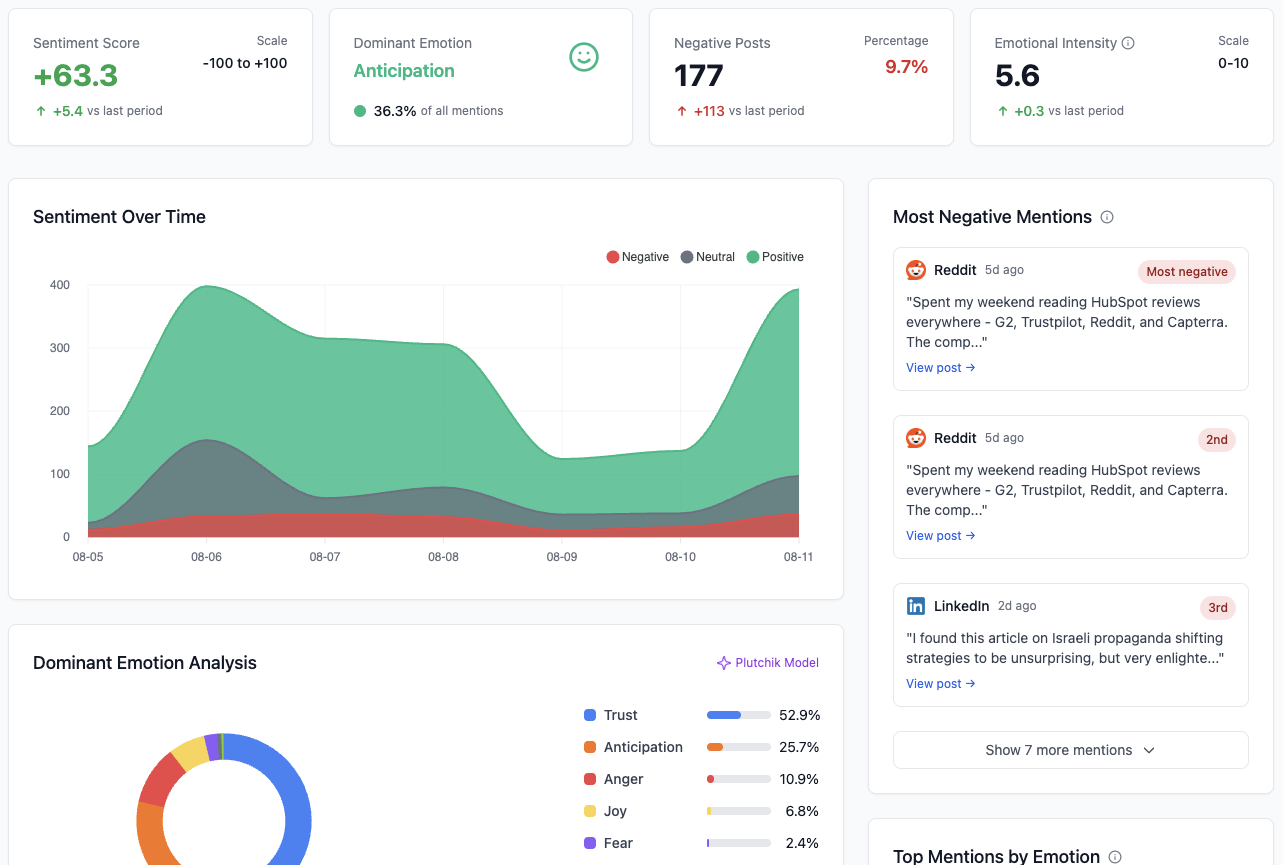
This ForumScout report, for example, breaks down mentions by emotion, painting a far richer picture than a simple sentiment score ever could.
A dashboard like this lets you spot emotional trends at a glance, so you can diagnose problems without getting lost in a sea of individual comments.
Find and Fill the Gaps in Their Content
Once you’ve got a handle on the emotional landscape, it's time to analyse the substance of these conversations. What specific topics, themes, or questions keep popping up about your competitors? This is how you spot content gaps you can drive a truck through.
- Recurring Questions: Are people constantly asking a competitor how to use a specific feature? That’s your cue to create the definitive guide, blog post, or video tutorial that answers that exact question.
- Unaddressed Complaints: See a pattern of complaints about a rival’s rigid pricing or a missing integration? It’s a clear signal to shout about your flexible plans or robust API.
- Feature Requests: Keep an eye on forums and Reddit for features users are begging your competitors to build. If you already offer it, you’ve just found a ready-made audience to target.
When you’re looking at social listening tools in the UK, you have to weigh up capability against cost. The UK social commerce market is set to hit £16 billion by 2028, and that growth is fuelling a massive need for sharp analytics. While tools like Mention offer basic monitoring, they often lack the sophisticated AI emotion analysis needed to find these deeper insights. In contrast, ForumScout provides this level of AI-driven analysis at a much more accessible price point, giving smaller teams the power to punch well above their weight.
Reverse-Engineer Their Campaign Playbook
Finally, use your data to figure out what makes your competitors' campaigns tick. By tracking spikes in their share of voice and shifts in sentiment, you can see exactly what resonates with their audience. You can get a much better grip on this by learning more about how to accurately measure share of voice.
Start asking the right questions:
- Which of their campaigns drove the most positive buzz?
- What messaging or creative completely missed the mark?
- Are they successfully connecting with an audience segment you’ve been ignoring?
This isn’t about blindly copying what they do. It’s about learning from their wins and their mistakes to sharpen your own strategy. By turning raw data into this kind of intelligence, you transform competitive benchmarking from a box-ticking exercise into a powerful engine for growth.
Turning Your Insights into a Winning Strategy

Let's be honest. Analysis without action is just trivia. All the data you’ve carefully gathered and analysed is worthless until you use it to make smarter decisions. This is the final, crucial step where you translate what you’ve learned into a powerful, agile strategy that delivers real results.
It’s easy to get overwhelmed by a long list of potential actions. I've seen teams get stuck here, trying to do everything at once. The key is to have a clear framework for prioritising your opportunities.
A simple but ridiculously effective way to do this is by weighing the potential impact of an action against the effort it would take to execute. This approach helps focus your limited resources on the initiatives that will move the needle the most.
The Impact vs. Effort Matrix
To get started, map everything you've found onto a simple four-quadrant matrix. This visual tool makes it incredibly easy to see where you should focus your attention first.
- High Impact, Low Effort (Quick Wins): These are your top priorities. Jump on them immediately. For example, maybe you spotted a competitor completely ignoring customer questions on X (formerly Twitter). Launching a proactive community engagement initiative there is a relatively low-effort move with a massive potential impact. You can win over their frustrated audience in days.
- High Impact, High Effort (Major Projects): These are the big, strategic moves that could reshape your market position. Think about developing a new product feature that your competitor’s customers are constantly begging for. These require serious planning and resources but offer substantial long-term rewards.
- Low Impact, Low Effort (Fill-in Tasks): These are the small optimisations that are nice to have but won’t revolutionise your business. You can tackle these when you have spare capacity, but don't let them distract you from the bigger picture.
- Low Impact, High Effort (Time Sinks): Avoid these at all costs. Your benchmarking data should clearly highlight which activities fall into this category, helping you steer clear of them. These are the tasks that consume a lot of resources for very little return.
This framework forces you to be realistic about what you can achieve and ensures your team is always working on what truly matters. For a comprehensive approach, a detailed Competitive Analysis Framework Blueprint can help structure your thinking even further.
Weaving Intelligence into Your Daily Operations
Competitive intelligence shouldn’t live in a dusty report that gets looked at once a quarter. To be truly effective, it needs to inform your everyday decisions across the entire business.
Think about how your findings can influence different teams. Your content team can use insights about competitor content gaps to build a more effective editorial calendar. Your product team can use feedback from a rival’s customers to inform their development roadmap. Even your customer support policies can be refined based on what you learn about a competitor’s service failures.
Social listening tools are indispensable here. In the competitive UK social media analytics market, for example, a tool like ForumScout stands out as a cost-effective powerhouse compared to legacy giants. Traditional competitors like Brandwatch and Meltwater can be prohibitively expensive for small and medium-sized businesses (SMBs). Brandwatch's entry plans start at £800/month, while Meltwater often demands £2,000+ for similar features.
ForumScout flips the script with its Growth plan at just $19/month (about £15), delivering 5,000 mentions across Reddit, X, LinkedIn, YouTube, and more. This makes real-time intelligence accessible, not just an enterprise luxury.
Creating a Dashboard for Continuous Monitoring
To ensure benchmarking becomes a strategic habit rather than a one-time project, you need a simple way to track your progress. A dedicated dashboard is the perfect solution.
It doesn’t need to be complicated; a simple spreadsheet or a dedicated section in your analytics tool can work wonders. Your dashboard should provide an at-a-glance view of the KPIs you identified earlier, showing your performance right alongside your key competitors.
A great dashboard tells a story. It should immediately highlight whether your strategic changes are working and where you need to adjust course, turning continuous improvement into a core part of your company culture.
This living document keeps everyone aligned and focused on the real goal: outperforming the competition. It closes the loop, transforming your benchmarking efforts from a static report into a dynamic, ongoing process that consistently drives your business forward.
Common Questions About Competitive Benchmarking
Getting stuck into competitive benchmarking for the first time usually brings up a few questions. Let's tackle the most common ones so you can get started confidently and sidestep the usual hurdles.
How Often Should I Run a Competitor Benchmark?
The real answer? It depends entirely on how fast your industry moves.
For fast-paced sectors like e-commerce or tech, a full-on review every quarter is a solid rhythm. You'll want to back that up with continuous, real-time monitoring of your most important metrics, though. Things change overnight in those spaces.
If you're in a more stable industry, a deep dive every six months might be all you need. The trick is to stay agile no matter what. Use tools that give you real-time alerts on competitor moves. That way, you’re reacting to market shifts as they happen, not months after the fact.
Your goal is to make benchmarking a living, breathing part of your strategy—not a one-off report that gathers digital dust. Regular check-ins keep your plans sharp and relevant.
This habit ensures you're never caught off guard by a surprise campaign or a sudden swing in what customers are saying.
What's the Biggest Mistake People Make?
Hands down, the most common trap is "analysis paralysis." This is where you get so bogged down collecting data that you never actually do anything with it. Benchmarking is only worth the effort if it leads to real strategic changes.
Another classic mistake is obsessing over vanity metrics like follower counts or page likes. These numbers feel good but don't tell you much. Instead, focus on actionable insights like customer sentiment or share of voice. The aim isn't to copy your competitors; it's to understand their playbook so you can find—and exploit—their weaknesses.
Don't just collect numbers. Find the story they're telling you about your market.
How Can a Small Business Benchmark on a Tight Budget?
When resources are tight, focus is your superpower.
Don't try to track ten competitors. Pick just two: your most direct rival and an aspirational leader in your space. Same goes for KPIs. Instead of tracking twenty different things, pick the three that directly impact your revenue or core business goals.
Lean on smart, cost-effective tools built for smaller teams. A platform that combines several functions—like brand monitoring, sentiment analysis, and share of voice—into one affordable package gives you high-quality intelligence without the enterprise price tag. Most of these tools offer free trials, so you can prove their value before you commit.
This focused approach lets you benchmark with competitors effectively, even on a shoestring budget.
Ready to uncover what your competitors are missing? ForumScout gives you the power to monitor conversations across Reddit, forums, and social media, turning competitor weaknesses into your biggest opportunities. Start your free trial today and get the intelligence you need to win. Find out more at https://forumscout.app.