
- 22 min read

A Practical Guide To The Monitoring of Social Media
At its heart, social media monitoring is all about using smart tools to track and make sense of online conversations. It’s the shift from just broadcasting content to actively listening to what people are saying about your brand, your competitors, and your entire industry.
When you do this right, you turn random chatter into real business opportunities.
Why You Can't Afford to Ignore Social Media Monitoring
Look, just having a social media profile isn't enough anymore. A constant stream of conversation is happening around your brand right now, whether you’re part of it or not. Ignoring it is a huge risk. You're missing out on honest feedback, leads who are ready to buy, and the chance to get ahead of reputation problems.
Good monitoring is like having eyes and ears everywhere online. It takes all that unstructured noise and turns it into intelligence you can actually use.
This dashboard from ForumScout shows what I mean-it’s tracking brand mentions and breaking them down so you can see what’s going on at a glance.
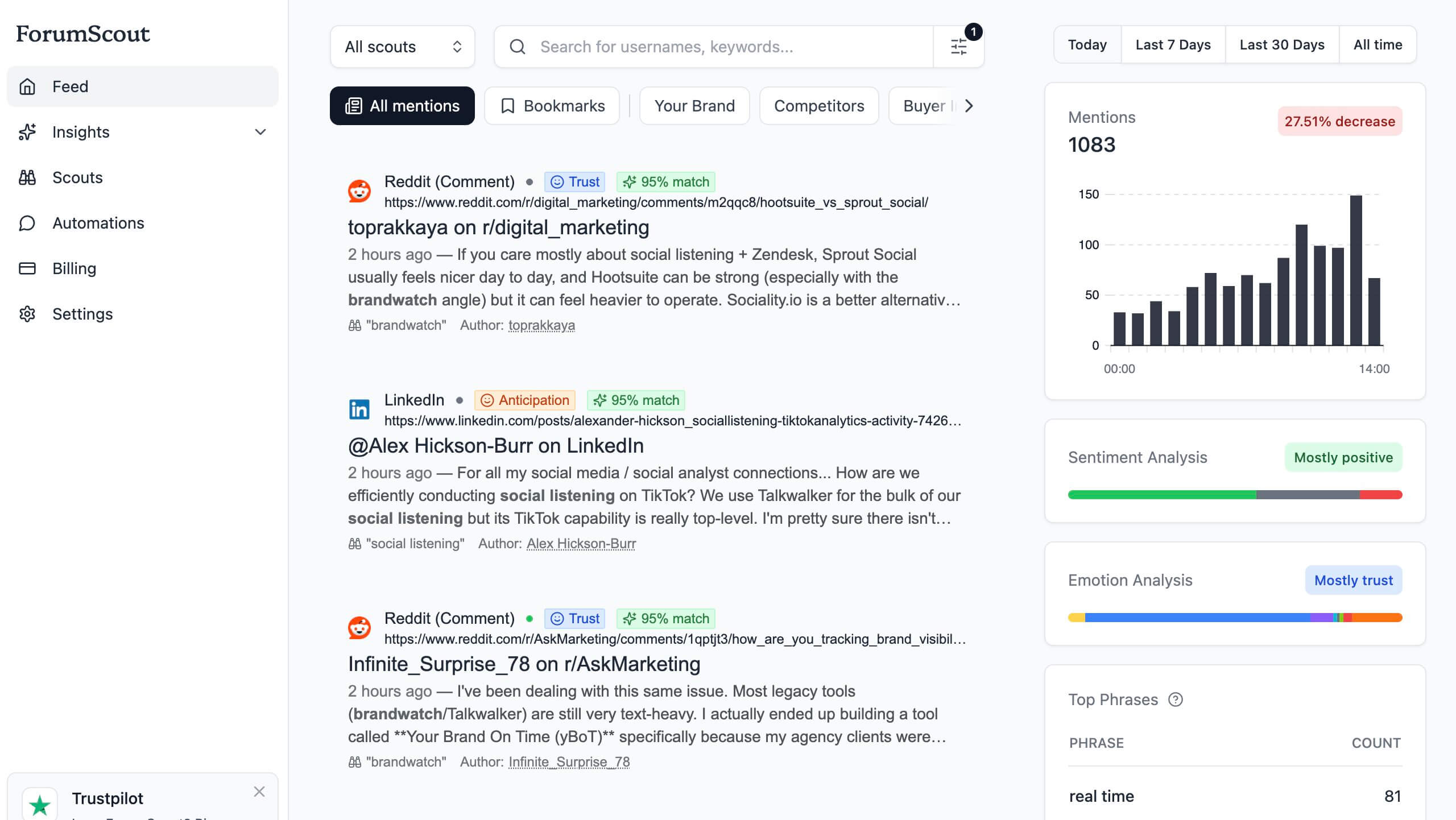
With a visual breakdown like this, teams can instantly spot sentiment, trending topics, and where the most important conversations are happening.
Go Beyond Just Tracking Your Brand Name
Effective monitoring isn't just a vanity check to see who’s mentioning your company. It’s about uncovering opportunities that have a direct impact on your bottom line.
By listening carefully, you can achieve some pretty specific business goals:
- Find High-Intent Leads: Imagine someone on Reddit asking for alternatives to your competitor's product. That's not a cold lead; that's someone actively looking for a solution you offer.
- Deliver Better Customer Service: Spotting a negative comment on X (formerly Twitter) and responding quickly can stop a small hiccup from turning into a public relations nightmare.
- Gain a Competitive Edge: When a rival launches a new product, you can see the raw, unfiltered customer reactions in real time. This feedback highlights their strengths and, more importantly, their weaknesses—intel you can use to your advantage.
The real goal here is to shift from being reactive to proactive. Instead of waiting for customers to come to you, you're joining the conversations where buying decisions are being made. That’s where the real growth is.
The scale of these conversations is massive. In early 2025, the UK had 54.8 million social media users, which is 79.0% of the entire population. With nearly eight out of ten Brits active on these platforms—and a staggering 48.6% using them to research brands—manually keeping up is impossible.
A solid reputation monitoring service is the only way to cut through all that noise.
To give you a clearer picture, here’s a quick rundown of the main objectives you can tackle with a good monitoring strategy.
Key Objectives for Social Media Monitoring
| Objective | What to Track | Business Impact |
|---|---|---|
| Brand Health & Reputation | Brand mentions, sentiment trends, share of voice | Protect brand image, manage crises, and measure public perception. |
| Lead Generation | Competitor mentions, "alternative to" queries, pain points | Identify warm leads who are actively looking for solutions you provide. |
| Customer Support | Negative feedback, product questions, technical issues | Improve response times, increase customer satisfaction, and reduce churn. |
| Competitive Intelligence | Competitor launches, customer complaints, campaign performance | Uncover competitor weaknesses and market gaps you can exploit. |
| Product Feedback | Feature requests, bug reports, user-generated content | Gather real-world insights to inform product development and innovation. |
Ultimately, a smart approach to social media measurement is non-negotiable for any business that’s serious about growth. It transforms raw data from online chats into a clear roadmap for improving your products, sharpening your marketing, and building a much stronger brand.
How to Build a Powerful Keyword Strategy
Effective social media monitoring all starts with knowing exactly what to listen for. If you're only tracking your brand name, you're missing out on the most valuable conversations happening online. A truly powerful keyword strategy turns monitoring from a simple brand-tracking exercise into a goldmine for leads, customer insights, and competitive intel.
This is about building a net to catch every relevant mention, not just the obvious ones. The goal is to get beyond basic brand tracking and start intercepting conversations that signal intent, frustration, and opportunity.
Expanding Beyond Your Brand Name
First things first: think bigger than just your company’s name. A solid keyword list needs to be organised into clear categories that map back to your business goals. This structure makes sure every alert serves a purpose, whether it's flagging a hot lead for sales or a support issue for the customer service team.
Here are the essential keyword categories I always recommend starting with:
- Brand Variations: This is non-negotiable. Include common misspellings, abbreviations, and even your old company name if you've rebranded. You don't want to miss crucial feedback because of a simple typo.
- Product and Service Names: Track both the official names of your products and the generic terms people use to find them. For instance, a CRM company should track its own product, "SalesFlow," alongside the broader term "customer relationship management software."
- Key Executives: Keep tabs on the names of your CEO, CTO, and other public-facing leaders. What people say about them can directly shape how your brand is perceived.
- Competitor Intelligence: Set up alerts for your top competitors' brand names, new product launches, and any branded hashtags they're pushing. This is your direct line into what their customers really think.
These conversations are happening everywhere. In the UK alone, adult internet users spend an average of 1 hour and 37 minutes on social media every day. With platforms like Reddit seeing massive growth, an organised keyword strategy is the only way to catch valuable discussions scattered across these communities.
Uncovering High-Intent Keywords
This is where social media monitoring shifts from a defensive play to a proactive growth engine. You need to hunt for keywords that signal someone is actively looking for a solution like yours. We often call these "buying intent" keywords, and they are pure gold for lead generation.
Start by brainstorming the exact phrases people would use when they're researching or comparing their options.
A great query is like a magnet for opportunity. Setting up a search for
"looking for an alternative to [competitor name]"is one of the highest-leverage actions a marketing team can take. It delivers a real-time feed of warm leads directly to you.
Think about the specific, conversational language your potential customers use. It’s usually problem-focused, not product-focused. Here are a few real-world examples to get you thinking:
"recommend a good CRM for small business""help me choose between [Your Product] and [Competitor Product]""anyone used [Your Industry] software? looking for feedback""cheaper alternative to [Competitor Name]"
These queries pinpoint users who are ready to make a decision. On platforms like Reddit, where people genuinely ask for recommendations, setting up specific Reddit keyword alerts can be an absolute game-changer for finding these high-value conversations.
Refining Your Search with Boolean Operators
Once you have a solid keyword list, the next challenge is cutting through the noise. A simple search for "SalesFlow" might bring up job postings, irrelevant news articles, or spam. This is where Boolean operators—simple commands like AND, OR, and NOT—become your best friends.
Using these operators lets you create incredibly specific and targeted search queries.
- AND: This narrows your search by making sure all your keywords are present. For example,
"SalesFlow" AND "review"will only show mentions that contain both terms. - OR: This broadens your search to include mentions that have one keyword or another. A query like
"[Competitor A]" OR "[Competitor B]"lets you track multiple rivals in a single search. - NOT: This is perfect for cleaning up your results. It excludes any mention containing a specific term. For example,
"SalesFlow" NOT "job" NOT "hiring"filters out all the recruitment spam, leaving you with a clean feed of actual customer feedback.
Modern tools like ForumScout make this even easier with plain-English AI filtering. Instead of wrestling with complex Boolean strings, you can just tell the tool what you want, like "show me posts asking for a cheaper alternative to our competitor but exclude job postings". Combining a smart keyword strategy with intelligent filtering is the key to making sure every notification you get is relevant and actionable.
Adapting Your Tactics for Different Platforms
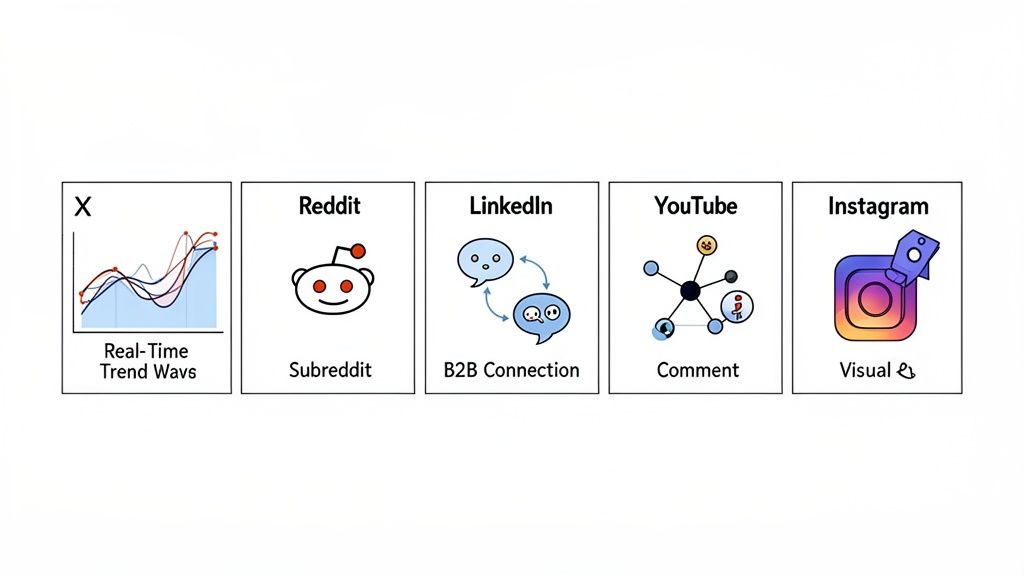
Effective social media monitoring isn’t a one-size-fits-all game. Far from it. Each platform has its own culture, user behaviour, and unspoken rules. Treating a professional discussion on LinkedIn the same way you would a fast-moving trend on X (formerly Twitter) is a recipe for missed opportunities and wasted effort.
A genuinely effective strategy means adapting your tactics to the unique environment of each channel. You need to move beyond a single, generic keyword list and tailor your approach. After all, the conversations people have on Reddit are fundamentally different from those on Instagram, and your monitoring needs to reflect that reality.
Monitoring X for Real-Time Insights
X is all about speed. It’s the home of breaking news, viral moments, and immediate customer reactions. Your approach here needs to be laser-focused on real-time intelligence and rapid response.
The goal is to tap into the live pulse of your industry. Set up alerts for event-specific hashtags, track conversations around product launches (both yours and your competitors'), and keep an eye out for customer service issues that demand an immediate reply. A delayed response on X can quickly escalate a minor complaint into a very public problem.
Uncovering Honest Feedback on Reddit
If you want unfiltered, brutally honest opinions, Reddit is where you’ll find them. Users gather in niche communities, known as subreddits, to discuss specific interests, problems, and products with a level of detail you simply won't find anywhere else. Monitoring Reddit is less about tracking brand mentions and more about understanding genuine customer sentiment.
Focus your efforts on the specific subreddits where your target audience hangs out. Instead of just tracking your brand name, search for keywords that signal a genuine need for your solution, like:
recommendation for [product category]help me choose a [service type][competitor] alternative
Engaging here requires a delicate touch. The community values authenticity over corporate speak, so participating genuinely is the only way to build trust and gather truly valuable product feedback.
Generating B2B Leads on LinkedIn
LinkedIn is the undisputed king of B2B intelligence. The conversations are professional, and users are there to network, share industry knowledge, and make business decisions. Your monitoring strategy should be squarely focused on lead generation and identifying key decision-makers.
Track industry-specific keywords, monitor posts from influential figures in your sector, and pay close attention to discussions where potential clients are outlining their business challenges. A comment like, "Our current project management tool is creating bottlenecks," is a direct invitation for your sales team to step in and offer a solution.
For B2B monitoring, think like a salesperson. Your objective is to identify pain points and connect with individuals who have the authority to solve them. LinkedIn provides the perfect environment for this kind of strategic, high-value engagement.
Analysing Sentiment on YouTube and Instagram
Visual platforms like YouTube and Instagram present their own unique challenges and opportunities. While you can certainly track text-based comments and descriptions, the real value often lies in understanding the visual context and audience emotion.
On YouTube, the comments section is an absolute goldmine for detailed user feedback and sentiment analysis. Monitor comments on your own videos, your competitors' content, and reviews from industry influencers to gauge how a product is really being received.
For Instagram, your focus should be on visual brand mentions. This means tracking not just tagged posts but also untagged images where your product or logo appears. Advanced monitoring tools can use image recognition to spot these visual mentions, giving you a complete picture of your brand's presence.
This fragmentation across platforms is a key challenge. For instance, in the UK, Facebook commands a dominant 66.54% share of social network visits, but platforms like X and Instagram still account for over 17% of traffic combined. This reality means a hot lead might surface on a niche Reddit forum while a critical support issue blows up on Facebook, making a comprehensive tool that covers all key sites essential. You can discover more insights about UK social media usage on Talkwalker.
Platform Monitoring Focus
To help you organise your approach, here’s a quick-reference table comparing what to prioritise when monitoring different social media platforms for business intelligence.
| Platform | Primary Focus | Example Use Case |
|---|---|---|
| X (Twitter) | Real-time trend tracking and crisis management. | Immediately responding to a customer complaint during a service outage. |
| Uncovering honest product feedback and pain points. | Finding a thread in r/smallbusiness discussing alternatives to your competitor. | |
| B2B lead generation and identifying decision-makers. | Engaging with a director who posted about needing a new software solution. | |
| YouTube | In-depth sentiment analysis and user reviews. | Analysing comments on a product review video to identify common feature requests. |
| Visual brand mentions and influencer discovery. | Spotting an untagged photo of a customer using your product and asking to feature it. |
By tailoring your monitoring to the specific nuances of each platform, you transform a passive data collection exercise into a powerful, proactive strategy that drives real business results.
Turning Raw Data Into Actionable Insights
Collecting a stream of mentions is a great start, but it’s only half the battle. The real magic happens when you transform that raw data into clear, strategic intelligence. This is the moment you go from just collecting conversations to actually understanding the story they tell about your brand, your customers, and your market.
The goal isn't just to gather data; it's to interpret it. Think of it like this: your monitoring tool has handed you a pile of puzzle pieces. Analysis is how you fit them together to see the bigger picture, helping you make smarter, faster decisions without needing a degree in data science.
Decoding Customer Emotion with Sentiment Analysis
One of the most powerful metrics you'll get your hands on is sentiment analysis. At its core, this is an automated process that sorts each mention into positive, negative, or neutral buckets. It gives you an instant, high-level snapshot of how people feel about your brand online.
A dashboard full of green, positive mentions is obviously a good sign, but the real insights often live in the shifts and trends.
- A sudden spike in negative sentiment could be an early warning of a product flaw, a website outage, or a marketing campaign that missed the mark. Catching this early means you can get ahead of a potential crisis.
- A gradual lift in positive sentiment after a new feature launch is direct validation for your product roadmap. It also gives your marketing team powerful social proof to work with.
But it’s not just about the what; it's about the why. For a deeper dive into how this all works, you can learn much more about sentiment analysis for social media and see how it uncovers the emotions that drive real-world decisions.
Measuring Your Presence with Share of Voice
Another must-track metric is Share of Voice (SoV). This is a straightforward comparison of conversations about your brand versus conversations about your competitors. It's a brilliant way to benchmark your influence and see how much space you occupy in your industry's conversation.
Imagine you and your main rival both launch new campaigns in the same week. By tracking SoV, you can see whose message is actually cutting through the noise. If your competitor's SoV suddenly jumps by 15%, that’s a clear signal their campaign is resonating, and it’s time to dig into their strategy to see what’s working.
Share of Voice isn't just a vanity metric; it's a competitive one. It tells you how much of the market's attention you currently own and where the opportunities are to grab more. A rising SoV often correlates directly with a bump in market share.
Tracking this over time lets you measure the cumulative impact of your marketing and PR efforts. A steady climb in your SoV quarter-over-quarter is a strong indicator that your brand-building is paying off.
Uncovering Trends and Opportunities
Beyond sentiment and SoV, your data is hiding clues about emerging trends and patterns. By filtering and sorting mentions, you can uncover insights that inform everything from product development to your next blog post.
For example, a clothing brand might notice a recurring theme where customers are asking for a specific jumper in a new colour. This isn't just random feedback; it's a direct, data-backed request from your audience. Passing this insight to the product team could lead to a new bestseller.
Similarly, you might spot common questions or points of confusion that customers have. This is a goldmine for your content team. They can create targeted blog posts, FAQs, or video tutorials that solve these exact problems, improving the customer experience and taking a load off your support team.
The real power of social media monitoring clicks into place when you stop looking at individual mentions and start seeing the collective intelligence they represent. By analysing sentiment, tracking your share of voice, and spotting recurring themes, you turn a noisy stream of data into a clear, actionable roadmap for growth.
Creating Smart Alerts and Automated Workflows
Collecting data is one thing, but turning it into action without drowning your team is a whole different ball game. Effective social media monitoring isn't just about watching a feed of mentions roll in; it's about making that stream of data work for you. This is where you graduate from passive data collection to building an active, automated system that supports your business goals.
Think of it as building a smart nervous system for your brand online. Imagine an instant Slack notification firing off to your support team the moment a mention includes keywords like 'broken' or 'complaint'. At the same time, a curated daily email digest of positive feedback lands in the marketing team's inbox. This level of precision ensures every notification adds value instead of just creating more noise.
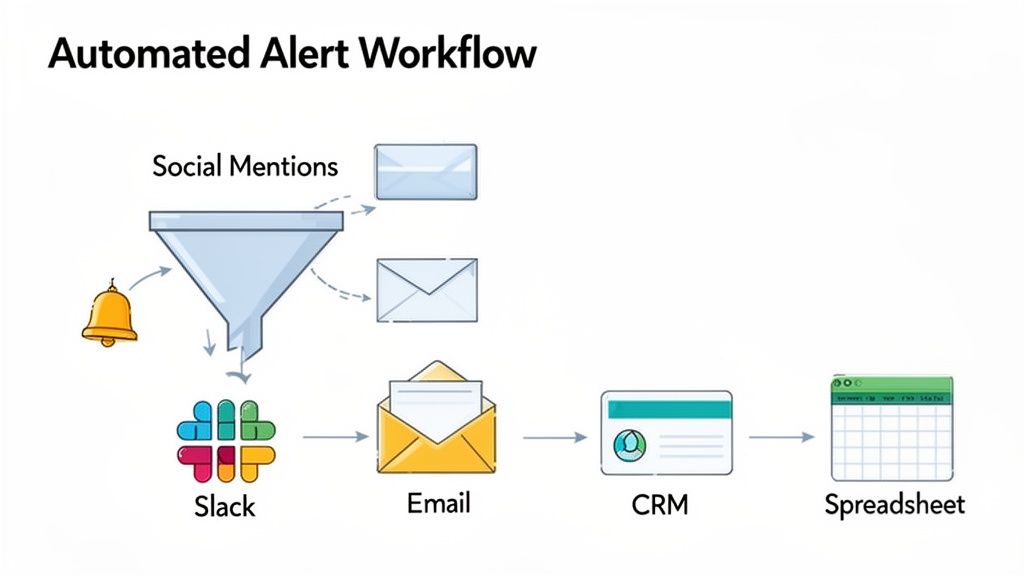
This approach turns your monitoring tool into a proactive engine that directly fuels different parts of your organisation.
Setting Up Intelligent Alerts
The foundation of any good workflow is an intelligent alert system. Let's be honest, a constant barrage of notifications for every single brand mention will lead to one thing: alert fatigue. Before long, your team will just start ignoring them. The secret is to create highly specific triggers based on the content and context of each mention.
Modern monitoring tools use relevance scoring and AI filtering to get this right. Instead of just matching keywords, they analyse the entire post to figure out how important it is. This means you can design alerts that are far more specific and genuinely useful.
Here are a few practical examples of alerts you can set up:
- Urgency: Instantly ping the support team on Slack or Microsoft Teams for any mentions with high negative sentiment that include words like "frustrated," "issue," or "can't log in."
- Opportunity: Send an email alert to the sales team when a mention includes a competitor's name alongside phrases like "looking for an alternative" or "switching from."
- Praise: Create a daily or weekly email digest of mentions with high positive sentiment for the marketing team. This is gold for finding social proof or engaging with happy customers.
This targeted approach ensures the right person gets the right information at exactly the right time.
Building Automated Workflows with Integrations
Once your smart alerts are dialled in, the next step is to automate the actions that follow. This is where integrations become your superpower, connecting your monitoring platform to the other tools your business relies on every day. By linking these systems, you create seamless workflows that save a ton of time and kill manual data entry.
Webhooks are the magic behind the scenes here. They act as messengers that push data from your monitoring tool to other applications the second a trigger is met.
Think of a webhook as a digital domino effect. When a new mention meets your criteria, it automatically tips over the first domino, triggering a chain of events in other platforms without any human intervention. This turns monitoring into a truly active part of your tech stack.
For instance, a mention flagged as a potential sales lead can automatically create a new contact and task in your CRM, like HubSpot or Salesforce. That lead is now in the pipeline, ready for follow-up, and no one had to lift a finger.
Here’s a breakdown of common integrations and what they can do:
| Integration Type | Target Tool | Automated Workflow Example |
|---|---|---|
| Team Communication | Slack, Teams | An urgent customer complaint is posted directly into a dedicated #support-alerts channel. |
| Reporting & Analysis | Google Sheets | All mentions from a specific campaign are automatically logged in a spreadsheet for analysis. |
| Customer Relationship | HubSpot, Salesforce | A high-intent lead from Reddit is automatically created as a new deal in the CRM pipeline. |
| Task Management | Trello, Asana | A piece of negative feedback is converted into a task card for the product team to review. |
To get these workflows running smoothly, exploring the best social media automation tools can be a game-changer. These platforms help bridge the gap between different apps, letting you build sophisticated automations that turn insights into immediate, organised action. By automating these processes, you free up your team to focus on strategy and engagement rather than getting bogged down by manual data handling.
Common Questions About Social Media Monitoring
Getting started with social media monitoring always brings up a few questions. It's totally normal to wonder about the budget, the jargon, and how you’re going to prove it’s all worth it.
Let's clear up some of the most common questions I hear. My goal is to give you the confidence to get your monitoring strategy off the ground.
How Do I Start Monitoring on a Small Budget?
This is the most common question, and the good news is, you absolutely can. Most businesses start this way. You don’t need a massive, enterprise-level tool on day one to get value out of monitoring.
You can begin with free tools like Google Alerts or just by manually searching for your brand name on platforms like X and Reddit. It’s a bit of legwork, but it works.
But let's be honest, manual searches eat up your time. For a small investment, you can get an affordable, specialised tool. Many offer free trials or entry-level plans that automate the tracking and use AI to filter out the noise. This lets you focus on your brand name and maybe one key competitor, delivering real impact without the hefty price tag.
What Is the Difference Between Social Monitoring and Listening?
People often use these terms interchangeably, but they’re two sides of the same coin. Think of it as tactics versus strategy.
-
Social Media Monitoring is the act of collecting the data. It’s about finding mentions of your keywords and gathering them all in one place. This answers the question, “What are people saying?”
-
Social Listening is what you do with that data. It’s the analysis—interpreting the conversations to understand the sentiment, context, and trends behind them. This answers the real question: “Why are they saying it, and what should we do about it?”
A great platform does both seamlessly. It handles the heavy lifting of monitoring to collect the data, then gives you the tools you need for true social listening. It’s about turning raw mentions into genuine business intelligence.
How Can I Measure the ROI of Social Media Monitoring?
Measuring the return on investment (ROI) is all about connecting your monitoring efforts to actual business results. You have to draw a straight line from finding a mention to hitting a specific goal. This is how you shift monitoring from a “nice-to-have” marketing task to a measurable growth driver.
For example, you can track ROI in a few key areas:
-
Sales and Leads: When you find a lead from a social mention, track it. See how many convert in your CRM. That’s a clear monetary value right there.
-
Customer Support: Monitor how your response times improve or how your customer satisfaction (CSAT) scores go up after you start catching support queries on social media.
-
Brand Health: Chart the changes in your brand’s sentiment over time. When you launch a campaign, benchmark your share-of-voice against your top competitors.
By tying your monitoring to these concrete metrics, you can easily show its financial value and justify the investment to anyone who asks. You’re not just tracking conversations anymore; you’re actively improving the business.
Ready to turn online conversations into real opportunities? ForumScout gives you the power to monitor mentions across Reddit, X, LinkedIn, and more, all with intelligent AI filtering and actionable analytics. Start your free 7-day trial and see what you've been missing.