
- 22 min read
A Social Media Strategy Template That Actually Drives Growth
Posting on social media without a plan might feel productive, but let's be real—it's often just noise. A social media strategy template is what turns that random activity into a structured, goal-driven plan. It’s the framework that moves you from simply being on social media to actually using it as a serious tool for business growth.
Why a Template Is Your Most Powerful Social Media Tool
So many businesses fall into the trap of posting reactively. A trending sound pops up, so you scramble to make a Reel. A competitor runs a promotion, so you quickly launch your own. I've seen it a hundred times. While this feels agile, it usually just leads to inconsistent messaging, wasted effort, and absolutely no way to measure your return on investment.
This "winging it" approach creates some major headaches:
- Inconsistent Branding: Your posts lack a unified voice and visual style, which just ends up confusing your audience.
- Wasted Effort: You spend time and money creating content that doesn't connect with the right people or support any real business goals.
- No Measurable ROI: Without clear objectives, it’s impossible to know what’s working. Good luck trying to justify your social media budget with that.
A well-designed template cuts through all that by giving you a clear, repeatable process to follow.
From Chaos to Clarity
Look, a social media strategy template isn't about creating rigid, boring content. Think of it as a flexible guide for clarity and accountability. It forces you to make deliberate decisions about your goals, audience, and messaging before you even think about creating a single post.
The whole point of a template is to systematise your strategy, not sterilise your creativity. It provides the structure that actually frees you up to focus on creating compelling, relevant content that genuinely connects with people.
This structured approach is absolutely vital in a crowded market. Here in the UK, for instance, a solid social media strategy has to account for a massive and mature audience. As of early 2024, the UK had 54.8 million social media users—that’s 79% of the entire population. For most UK businesses, this means social media is a universal touchpoint, not some niche channel. You can explore more detailed statistics on UK digital trends to get the full picture.
Ultimately, using a template turns your social media presence from a list of daily chores into a genuine business asset. It gives you the roadmap needed to cut through the noise, build a loyal community, and drive tangible results that actually contribute to your bottom line.
Defining Your Goals and Understanding Your Audience
Posting on social media without a clear purpose is like shouting into a void. Before you even think about what to create, your strategy needs to answer two fundamental questions: Why are we doing this, and who are we doing it for? Answering these honestly is the difference between random activity and a plan that drives actual business growth.
It all starts with tying your goals directly to the company's bigger objectives. Forget vague ambitions like "get more followers." We need to get specific and accountable. This is where the classic SMART framework is invaluable.

Setting SMART Social Media Goals
Your social media efforts should never exist in a silo; they must support the business. A SMART goal forces you to connect your actions to tangible outcomes.
- Specific: Clearly state what you want to achieve. Instead of "increase engagement," try "Increase the average comment count on our Instagram posts."
- Measurable: Define how you'll track progress. For that goal, the metric is simply the average number of comments per post.
- Achievable: Be realistic. If your current average is five comments, aiming for 500 in one month is a fantasy. Aiming for 15 is a solid, ambitious start.
- Relevant: Make sure the goal aligns with business objectives. Does a higher comment count correlate with stronger community loyalty or more website clicks? It should.
- Time-bound: Set a deadline. "Increase the average comment count on Instagram posts from 5 to 15 by the end of Q3."
This level of detail moves your strategy from a hopeful wish to a concrete plan of action you can fill into your template.
Key Takeaway: A goal isn't a real goal until you can measure it and connect it back to your business's bottom line. Everything else is just a vanity metric that looks good on a report but doesn't actually prove value.
Once you know why you're posting, it's time to figure out who you're talking to.
Moving Beyond Demographics to Build Audience Personas
Knowing your audience's age and location is a starting point, but it’s not enough. To create content that truly resonates, you need to dig deeper into their psychographics—their interests, motivations, challenges, and online behaviours. This is where you build detailed audience personas.
A persona is a semi-fictional representation of your ideal customer. Give them a name, a job title, and a story. What keeps them up at night? What are their biggest professional or personal pain points? What kind of content do they find valuable, and what makes them scroll right past a post?
This process feels creative, but it has to be rooted in data, not guesswork. This is where monitoring online conversations becomes a game-changer. By using tools to track keywords and brand mentions, you can listen in on what your potential customers are actually saying. This practice, known as social listening, helps you understand their language, discover unmet needs, and identify where they hang out online. If you're new to this, our guide explains what is social listening and how it can inform your entire strategy.
For example, a B2B software company might create a persona named "Marketing Manager Mark."
- Demographics: Male, 32, based in Manchester.
- Pain Points: Struggling to prove ROI on his marketing campaigns to his boss; overwhelmed by too many software tools that don't integrate.
- Online Behaviour: Active on LinkedIn during work hours, browses tech forums for solutions on his commute, follows industry influencers on X (formerly Twitter).
With this detailed persona, the company's content strategy becomes crystal clear. They know to create content for LinkedIn that focuses on ROI and tool integration, using the same language Mark uses in online forums. This foundational work ensures every piece of content you create is precisely targeted, making your social media efforts far more effective.
Choosing Your Platforms with Data, Not Guesswork
One of the fastest ways to burn out your social media efforts is trying to be everywhere at once. I’ve seen it time and time again. A weak, inconsistent presence on six platforms will always get beaten by a strong, focused presence on the two channels where your audience actually hangs out.
The key is to stop guessing and start using the data from your audience personas to make deliberate choices.
A classic mistake I see is a local boutique pouring all its energy into LinkedIn, or a B2B tech firm trying to make a splash on Pinterest. While it’s not impossible for these to work, you’re essentially choosing to play the game on hard mode. Your resources—time, money, and creative energy—are finite. You need to invest them where they’ll deliver the biggest punch.
This is where all that hard work on your audience personas really pays off. Go back to your notes. Where does "Marketing Manager Mark" actually spend his time online? If your research showed he’s active on LinkedIn during work hours and follows industry leaders on X, that’s your starting point. You're not just picking a platform; you're choosing to show up where your ideal customer is already looking for solutions.
Aligning Platforms with Business Goals
Every social media platform has its own culture, user base, and content strengths. Your choice shouldn't just be based on where your audience is, but also on what you’re trying to achieve. The sweet spot is the intersection of your audience’s location and your business goals.
For instance, think about these pairings:
- Brand Awareness: Platforms with massive reach and highly visual content like Instagram (especially Reels) or TikTok are brilliant for getting your brand in front of new eyes.
- Lead Generation: For B2B businesses, LinkedIn is pretty much unmatched. Its professional focus and targeting options let you connect directly with decision-makers in specific industries.
- Community Building: Facebook Groups or a dedicated subreddit can be incredible for fostering a sense of belonging and gathering unfiltered customer feedback.
- Driving Website Traffic: Pinterest is a visual search engine where users are actively looking for ideas and products, making it a powerful driver of traffic to e-commerce sites and blogs.
The goal is to create a focused plan. Your social media strategy template should have a section dedicated to justifying why you've chosen each platform, linking it directly back to a specific audience persona and one of your SMART goals.
To help you map this out, I've put together a quick reference table. It breaks down the major platforms, who you'll find there, and what they're best used for.
Choosing the Right Social Media Platform for Your Business
| Platform | Primary Audience | Best For (Business Goal) | Content Format Focus |
|---|---|---|---|
| Broad (Gen X, Millennials) | Community Building, Local Marketing, Brand Loyalty | Video, Images, Text, Stories, Live Streams | |
| Millennials, Gen Z | Brand Awareness, E-commerce, Influencer Marketing | High-quality Images, Reels, Stories, Carousels | |
| X (Twitter) | Professionals, Journalists, Tech | Real-time Updates, Customer Service, Public Relations | Short Text, Memes, News Links, Short Video |
| B2B Professionals, Decision-Makers | B2B Lead Generation, Professional Networking, Employer Branding | Articles, Text Posts, Case Studies, Professional Video | |
| Predominantly Female, DIYers, Planners | Driving Website Traffic, E-commerce Sales, Inspiration | Vertical Images (Pins), Idea Pins, Infographics | |
| TikTok | Gen Z, Young Millennials | Viral Marketing, Brand Awareness, Trend Engagement | Short-form Vertical Video, User-Generated Content |
| Niche Communities, Tech-savvy Users | Community Engagement, Market Research, Niche Marketing | Text Posts, Memes, Links, AMAs (Ask Me Anything) |
This table isn't exhaustive, but it's a solid starting point for aligning your strategy with the right channels. Remember, you don't need to be on all of them. Pick one or two that are a perfect fit and commit to doing them exceptionally well.
Quality Over Quantity in a Crowded Space
The pressure to be on every new channel is real, especially when you see competitors popping up everywhere. But the data tells a different story. In the UK, while the average adult internet user scrolls through 6-7 social platforms a month, their total daily time spent on social media has actually fallen by 11% year-on-year to just 1 hour and 37 minutes. You can dig into these UK digital consumption trends yourself, but the takeaway is clear: you're competing for a shrinking slice of their attention.
This trend reinforces a critical principle for your strategy: high-quality, relevant content on the right platforms will always beat high-volume, generic content spread thinly across every platform. It's better to be a must-see account on Instagram than a forgotten one on five different apps.
To put this into practice, use some of the best social media monitoring tools to analyse where conversations about your industry are already happening. This isn't about eavesdropping; it's about finding where people are actively engaged. This data gives you concrete evidence to back up your platform choices, turning a hunch into a strategic decision. By focusing your energy, you ensure your message isn’t just posted—it’s actually seen and heard by the people who matter most to your business.
Developing Your Content Pillars and Calendar
Okay, you've figured out your goals, who you’re talking to, and where you'll find them. Now for the fun part: building the creative engine that drives your entire social media presence. This is where we shift from the why and who to the what—crafting the actual content that brings your brand to life on screen.
To avoid falling into the trap of posting random, one-off updates, we need structure. That structure comes from content pillars.
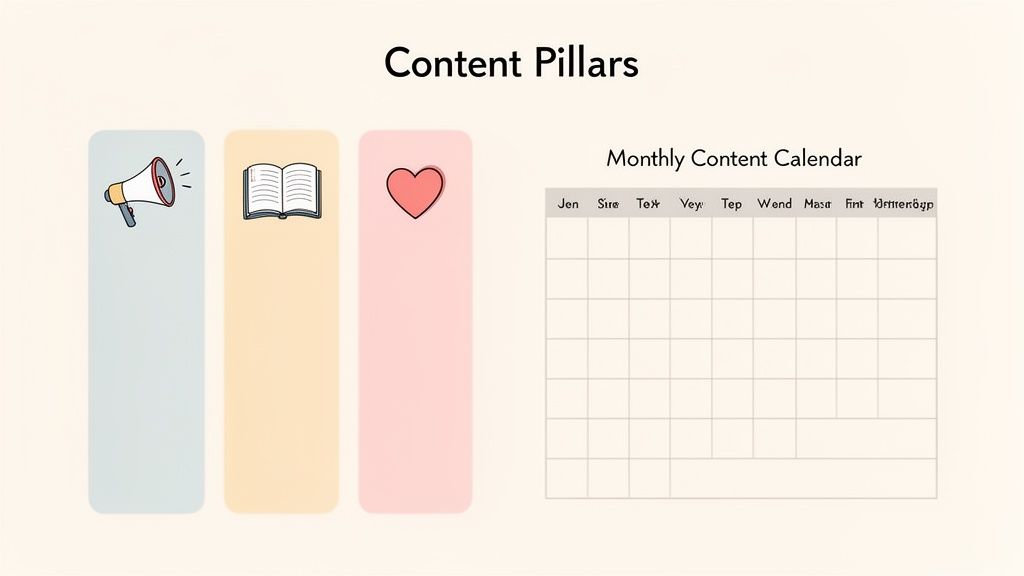
Think of content pillars as the 3-5 core themes or topics your brand will own and talk about consistently. They’re like the main sections in your brand’s own magazine. These pillars should flow directly from your audience research, making sure every single thing you create is relevant, valuable, and reinforces what your brand is all about.
Defining Your Core Content Themes
Your content pillars should live at the intersection of what your audience genuinely cares about and what your brand actually offers. It’s the sweet spot.
For instance, a sustainable fashion brand isn't just selling clothes; they're selling a lifestyle and a philosophy. Their pillars might look something like this:
- Ethical Production: Behind-the-scenes content showing how their garments are made, the materials they use, and the people behind the process.
- Styling Timeless Pieces: Practical how-to guides and lookbooks on building a capsule wardrobe that lasts beyond fleeting trends.
- Sustainability Education: Quick, digestible tips on reducing fashion waste, caring for clothes, and making more conscious choices.
- Community Spotlight: Featuring real customers, their stories, and how they style their pieces in everyday life.
See how that works? These pillars give you a solid framework. Instead of waking up and asking, "What on earth should we post today?" you can ask, "What can we create under our 'Styling Timeless Pieces' pillar this week?" This small shift makes brainstorming so much more focused and helps you fill your social media strategy template with ideas that actually have a purpose.
Building a Practical Content Calendar
With your pillars locked in, it’s time to get organised. The content calendar is your single source of truth—it dictates what gets posted, where it goes, and when it goes live. This is what turns your big-picture strategy into a concrete, actionable plan. No more last-minute scrambles for content.
A great content calendar is more than just a list of topics. It needs enough detail to keep your workflow smooth and your team aligned. Here's what it should include:
- Date and Time: The exact moment a post is scheduled to go live.
- Platform: Which channel is this for? An Instagram Reel is very different from a LinkedIn article.
- Content Pillar: Which of your core themes does this post support?
- Format: Is it a video, carousel, single image, or just a text post?
- Copy and Hashtags: The final, approved text and all the relevant hashtags.
- Visuals: A link to the finished image or video file.
- Status: Where is this post in the pipeline? (e.g., Idea, In Progress, Scheduled).
This level of detail is a lifesaver. It keeps everyone on the same page and ensures your posting schedule stays consistent. If you want to get really granular, you can learn how to use a content calendar template to streamline everything.
Balancing Your Content Mix
Let's be honest: one of the biggest turn-offs on social media is a feed that’s constantly selling. Your calendar is the perfect tool to maintain a healthy balance and keep your audience from tuning out. A guideline I’ve always found effective is the 80/20 rule.
80% of your content should be dedicated to educating, entertaining, or inspiring your audience. This is the value you give away for free. The remaining 20% can be promotional, where you directly talk about your products, services, or special offers.
This approach is all about building trust and community. When you consistently show up with valuable content, your audience is far more receptive when you do eventually ask for the sale.
Here’s how this mix might look in your calendar:
- Educational Content: How-to guides, industry insights, or myth-busting posts that help your audience.
- Entertaining Content: Fun behind-the-scenes glimpses, team culture highlights, or even memes and trends that fit your niche.
- Community-Building Content: Sharing user-generated content, running polls and Q&As, or featuring customer spotlights.
- Promotional Content: Product launches, special offers, and powerful customer testimonials.
By planning these different post types in your calendar, you guarantee a varied and engaging feed that serves your audience first. This methodical approach is the operational heart of a successful social media strategy. It transforms social media from a reactive chore into a proactive, strategic asset for your business.
How to Measure What Truly Matters
Let's be honest: a social media strategy without a clear measurement plan is just wishful thinking. You're throwing content out there, hoping something sticks. To actually prove your efforts are working (and to make smarter decisions next time), you need to track your performance against the goals you’ve already set.
This is where we move beyond guesswork. It’s time to stop getting distracted by vanity metrics—like your total follower count or the number of likes on a single post. Sure, they feel good, but they rarely tell you anything about the real impact on your business.
Instead, let's tie your metrics directly back to those SMART goals.
Matching Metrics to Your Goals
The KPIs you track should be completely different for each of your main objectives. A metric that signals a win for a brand awareness campaign is often useless for a lead generation campaign. It’s all about using the right tool for the job.
Here’s how that looks in practice:
Goal: Brand Awareness. The whole point here is getting your brand seen by more of the right people. You’ll want to focus on Reach (how many unique people saw your post) and Impressions (how many times your content was shown in total). For a deeper look, you can also learn how to measure brand awareness with metrics like share of voice.
Goal: Engagement. If you're trying to build a community, you need to see how people are actually interacting with you. Look at your Engagement Rate (likes, comments, and shares divided by reach), Comments per Post, and Shares. These prove your content is hitting the mark and encouraging people to act.
Goal: Lead Generation. This is where the rubber meets the road—driving tangible results for the business. Your most important KPIs here are Click-Through Rate (CTR), which shows how many people clicked a link, and Conversion Rate, which tracks how many of those clicks led to a signup or a purchase.
This is especially critical in the UK market. A recent study found that 48.6% of UK adult internet users use social media to research brands. That means your content has to perform well right from the discovery stage, making awareness and engagement metrics absolutely vital for driving future sales. You can discover more about UK consumer behaviour to fine-tune your measurement strategy.
Establishing a Reporting Cadence
Collecting data is one thing; actually using it is another. A consistent reporting schedule forces you to regularly review what’s happening and make timely adjustments. The chaotic, "we'll look when we have time" approach simply doesn't cut it.
I’ve always found a two-tiered system works best, and it's something you can build right into your strategy template:
- Weekly Check-ins: Think of this as a quick, high-level pulse check. Spend 30 minutes looking at post-level performance. Did that new video format land well? Did a certain topic get way more shares? This is for making small, tactical tweaks on the fly.
- Monthly Deep Dives: This is your more formal report. Here, you’ll look at your main KPIs and track progress against your bigger quarterly goals. Are we on track to hit that 10% increase in lead conversion rate? This is where you make bigger strategic decisions.
A useful social media report doesn't just present numbers; it tells a story. It should answer three simple questions: What happened? Why did it happen? What should we do next?
A good report should be visual and easy to scan. Use charts to show trends over time and don't be afraid to include screenshots of your best—and worst—performing posts. This context is what transforms a dry spreadsheet into a powerful decision-making tool that helps you constantly refine your strategy.
Putting Your Social Media Strategy into Action
A perfectly crafted plan is a brilliant starting point, but execution is everything. Even the most detailed social media strategy template is useless until it translates into consistent, real-world activity. This final part is all about bridging that gap—moving from a document to daily practice with a clear, actionable checklist.
Think of it as your pre-flight check before launching the new strategy. It ensures all the foundational pieces are in place, your tools are ready, and your team knows exactly what to do from day one. Getting this right prevents the momentum from fizzling out after the initial excitement.
Your Launch Readiness Checklist
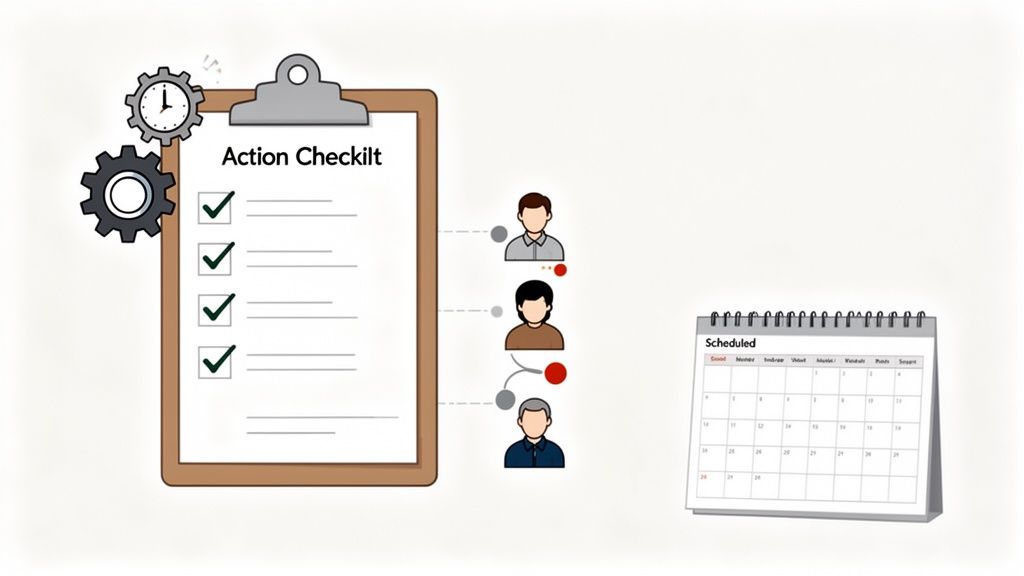
Before you hit "publish" on that first wave of content, run through these essential setup tasks. Ticking these boxes ensures your profiles are optimised and your workflow is smooth, preventing a lot of common operational headaches down the line.
Profile Optimisation: Do a quick audit of every social media profile you've chosen. Make sure your bio is updated with relevant keywords, your profile picture and banner are high-quality and on-brand, and your website link is correct and working. It sounds basic, but you'd be surprised how often this is missed.
Tool Configuration: Get your scheduling and monitoring tools set up properly. Connect all your social accounts, configure your social listening keywords (think brand name, competitor names, and key industry terms), and create any automated reports you'll need for your weekly check-ins.
Team Roles and Responsibilities: Get crystal clear on who does what. Assign specific people to handle content creation, scheduling, community engagement (replying to comments and messages), and performance reporting. This simple step stops tasks from falling through the cracks.
With these technical and logistical steps handled, you can pour your energy into creating great content and engaging with your community.
Building Sustainable Daily Habits
A strategy only succeeds through consistent daily effort, not just sporadic bursts of activity. The goal here is to build sustainable habits that become a natural part of your team's routine. This is what keeps the momentum going long after launch day.
For a deeper dive into turning your plans into results, this guide is an excellent resource. You might find Your Social Media Marketing Strategy Playbook particularly helpful.
Now, let's lock in some ongoing habits:
Schedule Your First Month: Use your content calendar to schedule all approved posts for the next 30 days. Front-loading your content like this creates a crucial buffer. It gives your team breathing room to focus on engagement and plan future content without feeling the daily pressure to post.
Block Time for Engagement: This is completely non-negotiable. Schedule 15-30 minutes every single day, specifically for proactive and reactive engagement. This is your time to reply to comments, answer questions, and join in on relevant conversations.
Plan for Reactive Content: Keep an open slot in your weekly calendar for timely, reactive content. This gives you the flexibility to jump on relevant trends or news stories without derailing your entire pre-planned schedule.
Ultimately, a strategy document is just a map. It shows you the destination and the best route to get there. This checklist is about making sure the car is fuelled, the engine is checked, and everyone knows how to drive. Now, you’re ready to start the journey.
Got Questions? We've Got Answers
Even the best social media strategy template is going to spark a few questions once you start putting it into action. Let's tackle some of the most common ones we hear from businesses that are just getting serious about their social media marketing.
How Often Should I Actually Update My Social Media Strategy?
Think of your strategy as a living document, not some stone tablet you carve once a year. A major review every quarter is a solid rhythm to get into. This gives you enough runway to spot real trends in your data and lets you pivot if your main business goals have shifted.
That said, don't just sit on your hands for three months if something is clearly bombing. You should be glancing at your key performance indicators every week. This weekly check-in is perfect for making small, tactical tweaks—like shifting your post times or trying out a new content format—without having to tear down and rebuild the whole plan.
If I Only Focus on One Thing, What's the Most Important Part of This Template?
Easy. Your audience and goals. Everything else flows from there.
Without a razor-sharp understanding of who you’re trying to reach and what you want to accomplish, the rest of your strategy is just guesswork. Your platform choices, your content pillars, even your tone of voice—it all depends on getting this part right first.
Your metrics, content, and channel selection should all flow directly from these two core components. If you get this part right, every other decision you make becomes simpler and far more effective. It’s the compass that guides all your actions.
We’re a Small Business. How Can We Use This Strategy Without Getting Overwhelmed?
For small businesses, the secret is to be ruthless with your focus. It’s so tempting to think you need to be everywhere, but that's a quick recipe for burnout. Dive into your audience research from the template and find the one or two channels where your customers are genuinely hanging out. Then, pour all your energy into those.
The aim isn't to do more; it's to make what you do count. A great way to manage this is to use the template to plan your content in batches. Block out one afternoon and create and schedule all your posts for the week. This batching method is a game-changer for saving time and keeping you consistent, even when you're swamped. It's all about working smarter, not harder—that’s how small teams win.
Ready to stop guessing and start growing? ForumScout gives you the social listening power to understand your audience, track competitors, and find high-intent leads in real-time. Turn conversations into revenue and build a strategy based on data, not assumptions. Start your free 7-day trial of ForumScout today.