
- 21 min read

How to Find Your Target Audience and Stop Wasting Your Budget
Defining your audience is a blend of art and science. It’s about mixing hard data (quantitative) with human stories (qualitative). We’ll start by digging into your current customer base, peeking at what your competitors are doing, and then using social listening to tune into real, unfiltered conversations. This groundwork helps us build sharp customer personas that we can then test and refine with ongoing analysis.
Stop Guessing Who Your Customers Are

So many businesses fall into the trap of thinking their product is for "everyone." It feels safe, right? Inclusive. But in reality, it’s a fast track to wasting your marketing budget, watering down your message, and wondering why nobody is converting. When you try to speak to everybody, you end up connecting with nobody.
Think about a gym that markets itself to "people who want to get fit." That message is so broad it’s meaningless. It completely misses the mark for both the 22-year-old bodybuilder and the 45-year-old professional looking for yoga to de-stress. Their goals, their problems, and where they hang out online are worlds apart.
The Power of a Precise Focus
This is where you need to shift your mindset. Stop casting a wide, hopeful net and start sharpening your spear. When you get laser-focused on a well-defined audience, you can create marketing that feels like it was written just for them. This clarity doesn’t just make your campaigns better; it shapes everything from product development to customer service.
The goal is to move beyond assumptions and base your strategy on real data and human insights. When you truly understand who you're talking to, every marketing pound is invested more effectively, building stronger customer relationships and driving sustainable growth.
Knowing your niche inside and out lets you: * Craft compelling messaging: You can speak their language, addressing their specific pain points and goals. * Choose the right channels: Stop guessing and put your budget where your audience actually spends their time—whether that’s LinkedIn, TikTok, or a niche forum. * Improve your product: Gather targeted feedback to build features that your ideal customers genuinely need and will pay for.
Laying the Foundation for Discovery
Before we jump into the nitty-gritty of data and personas, it’s vital to get this mindset right. Learning how to identify your target audience isn't just about spreadsheets; it's a strategic process that turns vague ideas into actionable intelligence.
This guide will walk you through a framework that combines different research methods to create a complete, 360-degree view of your ideal customer.
To get started, we need a clear plan. The table below outlines the core methods we'll use to turn guesswork into a data-backed audience profile. Each technique builds on the last, giving you a progressively clearer picture of who you're trying to reach.
Core Methods for Audience Discovery
| Method | What It Achieves | Primary Tools |
|---|---|---|
| Foundational Analysis | Defines a starting point based on existing customers and market data. | Your CRM, Google Analytics, Customer Surveys |
| Competitor Intelligence | Reveals who your rivals are targeting and where they're succeeding (or failing). | SEMrush, Ahrefs, Social Media Analysis |
| Social Listening | Uncovers unfiltered conversations, pain points, and sentiment in real-time. | ForumScout, Brand24, Google Alerts |
| Persona Creation | Translates raw data into relatable, human profiles of your ideal customers. | Persona Templates, Miro, User Interviews |
| Audience Validation | Tests your assumptions with real-world feedback and campaign performance. | A/B Testing, Landing Page Analytics, Feedback Forms |
With these methods in your toolkit, you'll be able to confidently define, find, and connect with the people who truly need what you have to offer. Let’s get started.
Building Your First Customer Persona
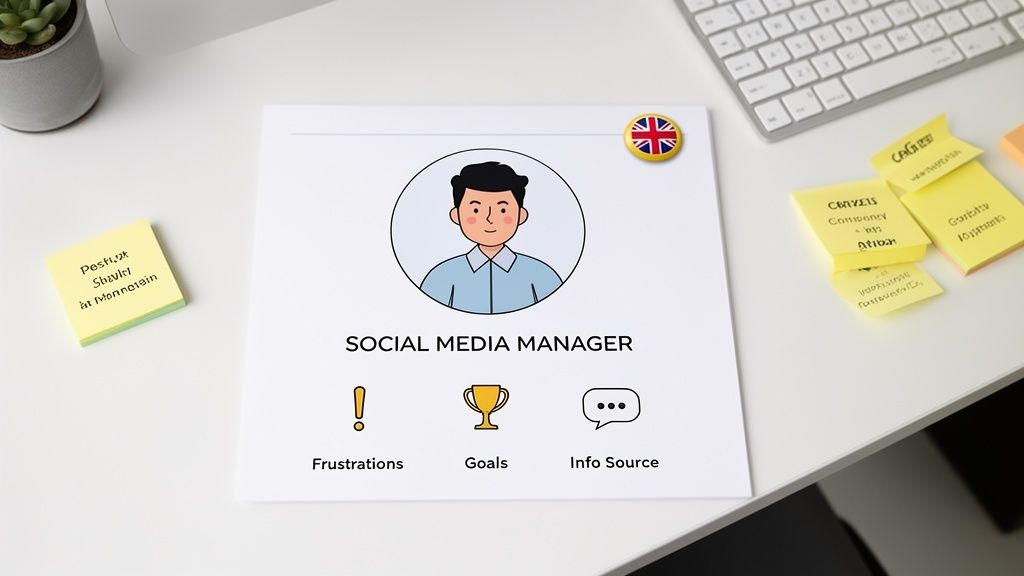
Before you can find your audience, you need a crystal-clear picture of who you're actually looking for. This is where a customer persona comes in. It’s not just a dry list of demographics; it's a fictional character you build to represent your ideal customer. This simple exercise turns abstract data into a real, relatable person who will guide every single marketing decision you make.
Think of it like sketching a character for a story. You’re not just noting their age and job title. You're digging into their motivations, their daily headaches, and what winning looks like in their world. This detailed profile makes it so much easier to create messaging that genuinely lands.
Moving Beyond Generic Templates
Let's be honest: most persona templates out there are pretty useless. They fixate on superficial details like age and location while completely missing the "why" behind your customer's actions. Instead of just filling in boxes, we're going to focus on three core areas that deliver genuine insight.
To keep things practical, let's imagine we're a UK-based SaaS startup. Our product helps small businesses schedule social media content more efficiently. We'll build a persona for our perfect first customer.
Persona Example: 'Sarah the Social Media Manager' * Role: Social Media Manager at a growing UK e-commerce SMB (25-50 employees). * Age: 28-35. * Location: Manchester or another major UK city.
This is a decent starting point, but the real gold is found when we ask deeper questions about Sarah's professional life.
A great persona doesn't just describe who your customer is today. It captures who they want to become and what's standing in their way. Solving their problems is how your product becomes indispensable.
What Are Their Biggest Frustrations?
This is where you nail down the pain points your product is built to solve. For Sarah, our Social Media Manager, these might hit close to home:
- Reporting Hell: She sinks hours every month manually yanking data from different platforms just to build performance reports for a boss who doesn't really get the metrics anyway.
- The Content Treadmill: She’s under constant pressure to churn out fresh, engaging content for multiple channels, all with a shoestring budget and limited creative help.
- Approval Bottlenecks: Her perfectly planned content calendar gets thrown into chaos while she waits for feedback on posts from multiple stakeholders.
Understanding these frustrations lets you tailor your marketing to show exactly how you provide relief. Your messaging can go from a bland "Save time on social media" to a sharp, specific "Stop wasting hours on manual reports."
What Drives Their Goals?
Beyond just putting out fires, what does Sarah actually want to achieve in her career? When you understand her ambitions, you can position your product not just as a tool, but as a stepping stone to her success.
- Career Goals: She wants to be seen as a strategic player, not just the person who schedules posts. Her aim is to prove the ROI of social media to secure a bigger budget and, one day, lead her own small team.
- Personal Goals: Sarah craves a healthy work-life balance. She needs a tool that lets her properly switch off after 5 PM, without the nagging worry that the company's social channels will go silent.
Where Do They Seek Information?
Finally, to actually find your target audience, you have to know where they hang out online. Where does Sarah go for advice, industry news, and to chat with her peers?
- Online Communities: She’s probably active in marketing-focused subreddits like r/socialmedia or niche Slack communities for digital marketers.
- Professional Networks: LinkedIn is her go-to for connecting with other UK marketing pros and following industry leaders.
- Industry Blogs & Newsletters: She’s likely subscribed to publications like The Drum or follows UK-based marketing blogs to stay on top of trends and pick up new tips.
With this initial persona mapped out, you now have a solid hypothesis of who your customer is. The next steps are all about using real data to validate and refine this profile. This ensures Sarah isn't just a good guess, but a true reflection of the people who desperately need what you're selling. Capturing the voice of the customer is an ongoing process that will only make this picture sharper over time.
Using Social Listening to Find Real Conversations
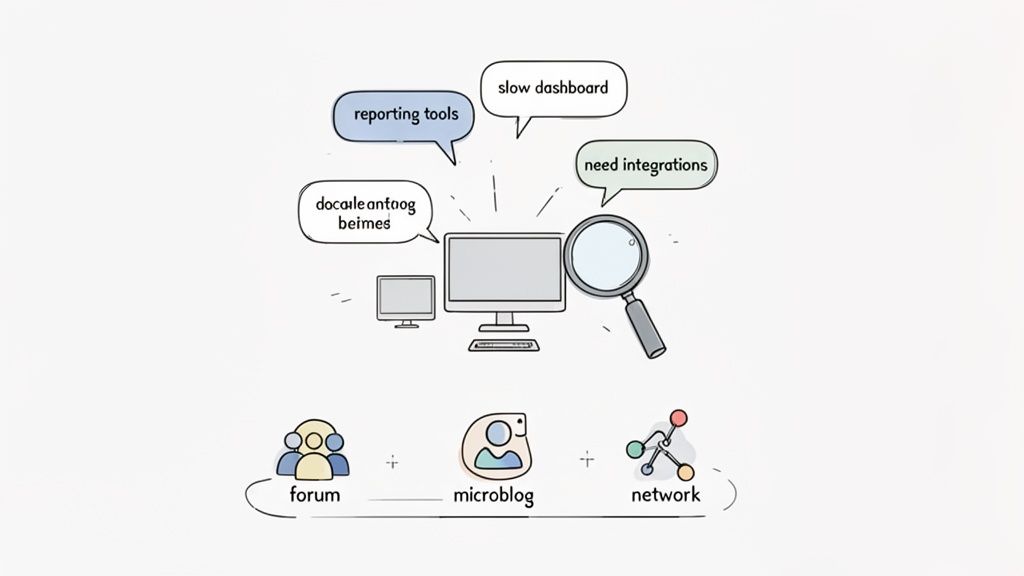
Your customer persona is a brilliant starting point, but let's be honest—it’s still just a hypothesis. Now it's time to see if "Sarah the Social Media Manager" actually exists out there and, more importantly, what she’s really talking about. This is where your theory meets reality, thanks to social listening.
Unlike surveys that can feel a bit sterile, social listening turns you into a fly on the wall in genuine, unfiltered conversations. Your target audience is already online, talking about their problems, raving about products they love, and venting about the tools that drive them mad. Tapping into these discussions gives you raw, qualitative data that’s impossible to get any other way.
This is your chance to hear the exact language your audience uses—which is absolute gold for crafting marketing copy that actually connects. You’ll shift from making educated guesses to building a strategy on data-backed insights about their real needs.
Setting Up Your Listening Post
To kick things off, you need to monitor keywords and phrases tied to your industry, brand, and competitors. This isn't about vanity metrics; it's about strategic intelligence gathering. A dedicated tool like ForumScout is built for exactly this, letting you track chatter across Reddit, X (formerly Twitter), LinkedIn, and niche forums where your audience is probably hanging out.
Your initial setup should include a mix of keyword types: * Brand Keywords: Your company name, product names, and any common misspellings. * Competitor Keywords: The names of your direct and indirect competitors. You want to know what their customers are saying. * Problem-Based Keywords: Phrases people would use when describing the problem your product solves. Honestly, this is often the most insightful category.
For our SaaS startup trying to reach Sarah, we wouldn't just track something generic like "social media scheduling." We’d get much more specific.
Social listening is less about tracking mentions and more about understanding context. The goal isn't just to find every time your brand is named, but to discover the conversations that reveal what your audience truly cares about.
Crafting Queries That Cut Through the Noise
The real magic happens when you use plain English to pinpoint hyper-relevant discussions. Instead of broad terms, think like your persona. What would Sarah type into a search bar when she's frustrated or looking for recommendations?
Here’s how you can translate her pain points into powerful search queries for a tool like ForumScout: * "social media reporting is a nightmare" * "recommend a good Hootsuite alternative" * "struggling to prove social media ROI" * "anyone else hate their approval workflow"
These queries will bring back conversations packed with emotion and specific details. You'll uncover the features people are desperate for, the price points they see as reasonable, and the integration headaches that keep them up at night. Our guide on what social listening is and how it works goes even deeper into these strategies.
Finding Your Audience in the UK Digital Space
If you're launching in the UK, pinpointing your audience is critical. The good news is the digital landscape is brimming with opportunity. The UK has 54.8 million active social media users, which is 79% of the entire population—a figure way higher than the global average. This means your customers are online, but you need to know where to find them.
For instance, X has 22.9 million UK users, and 32.6% are aged 25-34, a key demographic for startup founders and marketers like Sarah. Digging into UK social media demographic insights on sproutsocial.com can really help refine your channel strategy.
By analysing these conversations, you’re no longer just marketing to a persona. You’re engaging with a living, breathing community. You’ll learn their slang, their in-jokes, and the thought leaders they actually trust. This deep understanding is what separates brands that feel authentic from those that are just shouting into the void. The insights you gather here will become the foundation for everything that comes next.
Analysing Your Competitors' Audience
Why build your audience profile from a blank slate? Your competitors have already poured time and money into figuring out who buys their products, which means they’ve done a lot of the heavy lifting for you.
By strategically analysing their audience, you can get a massive head start, uncover gaps in the market, and even poach their dissatisfied customers. This isn't about blindly copying what they do. It’s about smart intelligence gathering that shows you who they're targeting, how they’re doing it, and—most importantly—where they’re falling short.
First, Know Who to Watch
Before you dive in, you need a clear list of who you're actually up against. Don't just laser-focus on the biggest names in your industry. A truly comprehensive analysis looks at a few different kinds of competitors.
- Direct Competitors: These are the businesses offering a very similar product to a similar audience. For a social media scheduling tool, this would be another platform like Hootsuite or Buffer.
- Indirect Competitors: They solve the same core problem, just with a different solution. Think of a freelancer using a spreadsheet and manual posting, or an all-in-one marketing suite where social scheduling is just one small feature.
- Aspirational Competitors: These are the brands you look up to. They might be in a slightly different niche but absolutely nail their community building and marketing in a way you want to emulate.
Once you have a list of 3-5 key players across these categories, you can start to deconstruct their approach. For a more structured framework, a deeper dive into how to conduct a competitor analysis can be a huge help.
Uncover Their Audience Strategy
Alright, time to put on your detective hat. Your goal is to reverse-engineer who your competitors think their ideal customer is by looking at all the public-facing evidence.
Comb through their website, blog content, and social media channels. Pay close attention to the language they use, the imagery they choose, and the problems they claim to solve. Is their messaging formal and corporate, or is it casual and witty? Do they feature case studies from huge enterprises or testimonials from small business owners? Each of these choices is a deliberate signal about who they’re trying to attract.
By monitoring your competitors' brand mentions, you're not just spying on them—you're getting free, unfiltered focus group data from their customers. You'll see what people genuinely love, what they complain about, and what they wish the product could do.
Listen in on Their Customers
This is where the real magic happens. A company’s marketing tells you who they want to reach, but listening to their customer conversations tells you who they’re actually reaching and how those people really feel.
Using a social listening tool like ForumScout, you can set up alerts to monitor mentions of your competitors’ brand names across platforms like Reddit, X, and LinkedIn. This is where you find the gold.
Imagine one of your direct competitors announces a big price increase. A simple search for "[Competitor Name]" + "price increase" will instantly pull up threads filled with unhappy customers. You’ll find people actively looking for alternatives, venting their frustrations, and outlining the exact features they need at a better price point. This isn't just data; it's practically a list of warm leads handed to you on a silver platter.
By tracking these conversations, you can pinpoint their audience's biggest pain points and spot weaknesses in their product. Maybe their customer support is painfully slow, a key feature is buggy, or they're completely ignoring a specific market segment. Every complaint is an opportunity for you to position your product as the better solution. You can literally find your target audience by solving the problems your competitors create.
Refining Your Audience with Data and Segmentation
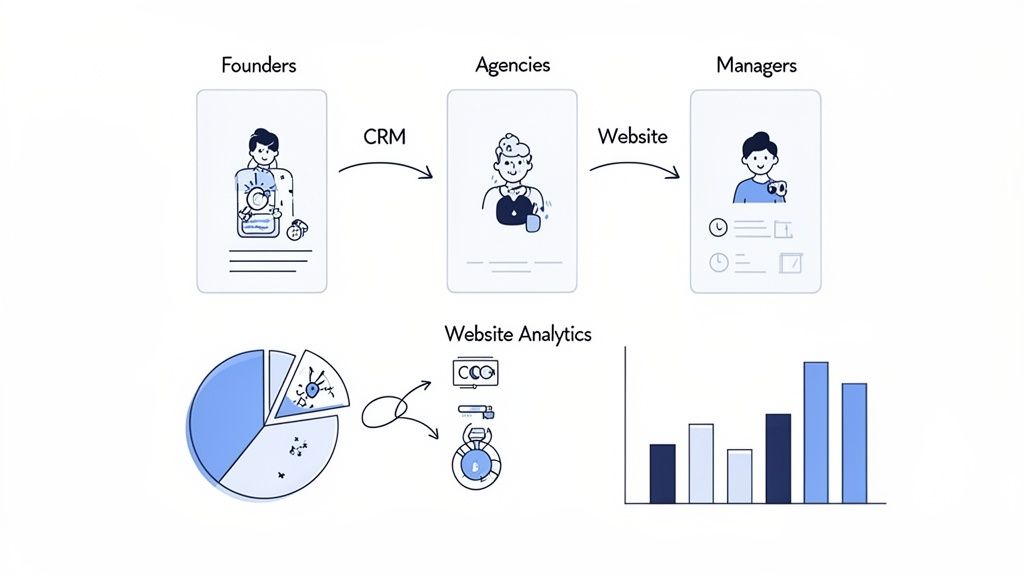
Alright, the qualitative work is done. You’ve dug into social listening and competitor analysis, giving you a story-driven feel for your audience. You know their goals and what keeps them up at night.
Now it's time to sharpen that picture. We're going to layer on quantitative data to move from a single, broad persona to multiple, distinct audience segments. This is the step that turns a good strategy into a great one.
Think about it. Instead of just targeting "Sarah the Social Media Manager," you might find there are several versions of her out there, each with completely different needs. Data-backed segmentation helps you find them.
Unlocking Demographics and Psychographics
Your insights dashboard inside a tool like ForumScout is the perfect place to start putting hard numbers to those stories. It moves beyond what people are saying and shows you exactly who is saying it. You can instantly see a breakdown of the people talking about your brand, your rivals, or your industry keywords.
You’ll want to pull out a few key data points: * Demographics: What’s the age, gender, and location of the people in these conversations? This will either confirm or completely shatter the basic assumptions from your initial persona. * Psychographics: Dig into their common interests, professions, and even the sentiment behind their posts. This adds the colour and context you need.
For example, you might discover that while your "Sarah" persona is a social media manager, a huge chunk of the conversation is actually driven by startup founders under 30 who are trying to manage their own marketing. Those are two very different audiences.
Integrating Your Own Data Sources
Social listening data is powerful, but it's pure gold when you combine it with your own internal analytics. You have to connect what’s happening "out there" with what's going on inside your own house.
Start by pulling data from these two sources: 1. Your Website Analytics: Fire up Google Analytics and check the 'Audience' tab. It's a treasure trove of information on visitor demographics, interests, and how they found you in the first place. 2. Your CRM or Sales Data: This is your ground truth. Analyse your customer list to find common traits among your best accounts. Look for patterns in job titles, company sizes, and industries.
By cross-referencing this info, you build a much clearer profile. Let's say your website analytics show a traffic spike from Manchester, and your CRM data reveals a cluster of high-value customers there. Boom. You've just identified a hot geographic market to double down on.
The goal is to create a unified view of your audience. When the person you see in your social listening data matches the person visiting your website and the person buying your product, you've found your sweet spot.
Building Your Audience Segments
With all this data at your fingertips, it’s time to segment. Segmentation is just a fancy word for grouping your audience into smaller, well-defined categories based on shared traits. It's what allows you to stop shouting one message at everyone and start having real conversations.
Let’s go back to our SaaS example. After crunching the numbers, we might identify three clear segments: * Segment A: Agency Marketers: They need advanced features, slick integrations, and a way to manage multiple client accounts. They’re not too worried about the price. * Segment B: In-House SMB Marketers: This is our original "Sarah." She’s focused on efficiency, collaboration tools, and anything that helps her prove ROI to her boss. Her budget is moderate. * Segment C: Startup Founders: This group is extremely price-sensitive. They want a simple, affordable tool to get them off the ground and are often early adopters.
Suddenly, that single marketing message you had is useless. Each of these segments needs a different approach, from the features you highlight on your landing page to the content you create. Once you have this clarity, you can really start to write SEO articles that consistently rank.
Focusing on the UK Market
If you're targeting customers in the UK, you absolutely have to understand the local social media landscape. The data is clear: Gen Z and young Millennials are the dominant force here. A staggering 94% of people under 24 use at least one social platform every single day.
This youthful audience is especially important for businesses targeting startups and indie hackers. Platforms like TikTok and Snapchat are massive with this demographic. Meanwhile, professionals tend to gather on X (formerly Twitter), where 36% of users are Millennials and 29% have bachelor's degrees—a prime hunting ground for marketing pros.
By using data to refine your audience, you swap vague assumptions for specific, actionable segments. This clarity allows you to speak directly to each group's unique needs, making your marketing sharper, your budget more efficient, and your customer relationships much stronger.
Got Questions About Finding Your Target Audience?
Even with a solid game plan, defining your audience can throw a few curveballs your way. Let's walk through some of the most common hurdles I see businesses run into and give you some clear, practical advice to get you moving forward.
How Do I Find My Target Audience with No Existing Customers?
Starting from scratch can feel like you're guessing in the dark, but it’s actually a huge advantage. You get to build a data-driven foundation from day one, without any biased customer data to lead you astray.
Without your own customers to analyse, your best friends are educated assumptions and sharp market observation.
Kick things off by creating a 'proto-persona'. This is just a fancy term for a hypothetical profile of who you believe your ideal customer is. Don't overthink it. Just base it on the problem your product solves. Who feels that pain most intensely?
Next, you need to become a professional eavesdropper. Dive headfirst into competitive analysis and social listening. Find the online communities, Reddit forums, and social channels where this ideal customer would hang out. Say you’re launching a project management tool for freelancers; you should be searching for conversations where people are complaining about their current software or asking for recommendations. This raw, unfiltered feedback is gold for building your first audience profile.
When you have zero customers, the market is your focus group. Listen to the conversations already happening, and you'll find the people who are practically waiting for a solution like yours.
What Is the Difference Between a Target Market and a Target Audience?
People throw these two terms around like they're the same thing, but they represent two very different levels of focus. Nailing the distinction is key to creating marketing that actually connects instead of just making noise.
Think of it like this:
- A target market is the broad, total group of people you want to reach. It’s a wide category, like 'small businesses in the UK'. It's big-picture stuff.
- A target audience is a much more specific, defined slice of that market. This is who your actual marketing messages are for. For instance, your target audience could be 'marketing managers at UK-based B2B tech startups with 10-50 employees'.
Sure, your product might eventually serve the entire market, but your time and budget are limited. Your efforts become way more effective when your copy, visuals, and channel choices speak directly to the specific pain points of your target audience. You market to the audience to eventually capture the market.
How Often Should I Revisit My Target Audience Personas?
Your audience personas aren't a 'one-and-done' task you can tick off a list and forget about. Markets change, customer needs shift, and new tech completely alters how people behave. Your personas have to be living, breathing documents that adapt.
A good rule of thumb is to formally review and update your personas at least once a year.
That said, certain events should trigger an immediate review:
- Launching a significant new product.
- Expanding into a new geographical market.
- Noticing a big shift in customer feedback or sales data.
- A key competitor making a major move.
Beyond those scheduled check-ins, continuous social listening is your early warning system. It keeps a constant pulse on what your audience is talking about. If you start seeing new trends, fresh pain points, or different competitors popping up in conversations, that’s a massive signal that it’s time to revisit your personas. This ensures they always reflect the real people you’re selling to, keeping your marketing sharp and effective.
Ready to stop guessing and start listening? ForumScout helps you tap into real conversations across Reddit, X, LinkedIn, and more, so you can find and understand your target audience with precision. Start your free 7-day trial today and turn online chatter into actionable insights.