- 23 min read
Unlocking Growth with the Voice of Customer
Think of the Voice of Customer (VoC) as a continuous, candid conversation happening about your business. It’s the process of tuning into what your customers are actually saying about their experiences with you—capturing their expectations, frustrations, and needs in real-time. This isn't just about collecting feedback; it's about turning those raw opinions into a core strategy for growth.
Why the Voice of Customer Is Your Business Compass

Ever tried navigating a ship in a storm without a compass? You might drift forward, but every turn is a guess. That’s exactly what running a business feels like when you ignore your customers. The voice of customer is that compass. It points you directly towards smarter product updates, marketing messages that actually land, and the kind of service that builds loyalty.
Let's be honest, the days of the dusty old suggestion box are long gone. Customers now expect you to be listening everywhere they are. This shift has created a constant stream of valuable, unfiltered feedback that’s happening right now, whether you’re tuned in or not.
The Shift From Passive to Active Listening
Today's customers don't hold back. They share unfiltered opinions on social media, write detailed reviews on sites like G2 or Trustpilot, and dive deep into discussions on forums like Reddit. A smart VoC strategy isn't about waiting for someone to fill out a survey; it’s about actively joining these digital conversations.
This proactive approach gives you the kind of authentic insight that structured feedback rarely captures. It’s the difference between asking, "How was your experience?" and stumbling upon a Reddit thread where a customer is raving about a minor feature you never even considered a selling point. To do this right, you need to understand what social listening is and how to use it to tap into these organic conversations.
"Companies that invest in customer feedback programs experience much higher client retention, employee engagement and spend less on customer service. Best of all, they generate a 10x greater year-over-year increase in annual company revenue."
— The Aberdeen Group
The gap between businesses that get this and those that don't is widening. Companies that embed customer feedback into their DNA can pivot quickly, innovate with confidence, and build real relationships. Those who stay deaf to the conversation risk becoming irrelevant as nimbler competitors align themselves perfectly with what customers want.
From Data Points to a Strategic Roadmap
One of the biggest mistakes I see is treating VoC as a simple data collection exercise. Piling up feedback is just the start. The real magic happens when you translate that raw data—all the needs, wants, and frustrations—into a clear, actionable roadmap for your entire business.
A powerful VoC programme should directly influence your most important decisions:
- Guide Product Development: Use customer pain points and feature requests to decide what to build next. No more guesswork.
- Sharpen Your Marketing: Discover the exact words your happiest customers use to describe your value, then use that language in your campaigns.
- Improve Customer Support: Spot recurring problems before they become widespread issues, allowing you to build better help docs or train your team more effectively.
Ultimately, a robust VoC strategy isn't just about collecting comments. It’s about cultivating a customer-obsessed culture. It ensures that every single decision, from a tiny tweak on your website to a major product launch, is guided by the people who matter most. Your customers. This is how you go from being a ship lost at sea to one confidently navigating toward its destination.
How to Capture What Customers Really Think

If you want to truly understand your customers, you can’t just listen where it’s convenient. You have to be everywhere they are. This means building a listening engine that pulls in feedback from every single touchpoint—whether you started the conversation or not.
A solid strategy combines two different but equally important types of feedback: the stuff you ask for, and the stuff you don’t.
Think of solicited feedback as a planned conversation where you set the agenda. On the other hand, unsolicited feedback is the real goldmine—the spontaneous, unfiltered opinions people share on their own terms. Let’s look at how to get both.
Asking Directly: The Classic Approach with Surveys and Interviews
Direct feedback methods are the bedrock of most VoC programmes. They’re structured, targeted, and give you total control over the questions you need answered.
- Surveys: These are your go-to for gathering structured feedback at scale. Think short, in-the-moment pop-up surveys on your website or more detailed questionnaires sent by email after a customer makes a purchase or talks to support.
- Customer Interviews: Sure, they’re time-consuming, but one-on-one chats offer a depth that surveys just can’t match. They let you dig deeper with follow-up questions and really get to the "why" behind someone's feelings.
These methods are fantastic for collecting hard numbers (like an NPS score) and checking if your assumptions are correct. But they do have a built-in bias—you're only hearing from people who are willing to respond, and you're the one leading the discussion.
Listening In: Tapping into Unsolicited Feedback
This is where the most honest, raw insights are usually hiding. Unsolicited feedback happens when customers talk about you, not just to you. It’s where you’ll find the unvarnished truth.
Your main sources for this treasure trove of information are:
- Online Reviews: Sites like Trustpilot, G2, or Capterra are purpose-built for customers to share detailed experiences, good and bad.
- Social Media: People use platforms like X (formerly Twitter), Facebook, and LinkedIn to shout out brands they love, ask for help, or vent their frustrations publicly.
- Online Forums & Communities: Niche communities, especially on Reddit, are hotspots for incredibly candid conversations about products and services. You’ll find detailed use cases and nitty-gritty frustrations here.
- Support Tickets & Chat Logs: Your own support channels are a direct pipeline to your customers' biggest pain points. Analysing these conversations will quickly show you recurring issues and where people are getting stuck.
Trying to keep up with all these channels manually is a recipe for disaster. The sheer volume is overwhelming, which is why modern tools are so essential. They turn an impossible, manual slog into an automated, non-stop stream of intelligence.
For example, a 2023 HMRC survey in the UK revealed that only 58% of individuals had a positive experience, a steep drop from 65% the previous year. The data showed that digital VoC is crucial, as users interacting only online reported much higher satisfaction (65%) than those who had to mix online and phone channels (47%). You can dive into the full findings on the UK government website.
Comparing VoC Data Collection Methods
Choosing the right mix of methods is key to a well-rounded VoC programme. Some methods give you scale, while others offer depth. Here’s a quick breakdown to help you decide where to focus your efforts.
| Method | Type | Pros | Cons |
|---|---|---|---|
| Surveys | Solicited | Scalable, easy to quantify, great for tracking metrics over time. | Low response rates, potential for survey fatigue, lacks deep context. |
| Interviews | Solicited | Provides rich, qualitative detail and uncovers the "why" behind feedback. | Time-consuming, not scalable, can be expensive to conduct. |
| Online Reviews | Unsolicited | Honest, detailed feedback, publicly available, influences other buyers. | Can be skewed by extreme positive/negative experiences, reactive. |
| Social Listening | Unsolicited | Real-time, authentic, unprompted feedback at massive scale. | Can be noisy, requires tools to filter and analyse effectively. |
| Support Tickets | Unsolicited | Direct pipeline to user frustrations and product/service friction. | Focuses only on problems, misses what's working well. |
Ultimately, a strong VoC programme doesn’t rely on just one channel. It blends the quantitative certainty of surveys with the raw, qualitative insights from social listening and reviews to build a complete picture.
Using Social Listening to Automate and Scale
Let’s be real: manually checking dozens of websites and social feeds every day just isn’t going to work. It’s a massive time sink, and you’re guaranteed to miss crucial conversations. This is exactly the problem that social listening platforms were built to solve.
Imagine a tool that’s always scanning the web for mentions of your brand, your competitors, or key industry problems. Instead of you hunting for feedback, it lands right in your inbox. This completely changes the game for building a robust VoC programme.
Tools like ForumScout automate the monitoring of high-value channels like Reddit and X (Twitter), giving you a continuous, unfiltered stream of what people really think. For instance, setting up real-time Reddit keyword alerts can instantly ping you when someone mentions a problem your product solves, creating a perfect opportunity to jump in and help.
This automated approach lets you capture the voice of the customer at a scale that would be impossible by hand, revealing patterns and trends you’d never have spotted otherwise. It bridges the gap between structured surveys and the messy, authentic world of online chatter, giving you a truly 360-degree view of your customer experience.
Turning Customer Conversations into Actionable Intelligence

Collecting feedback is just the start. All those raw, unfiltered comments are like a mountain of puzzle pieces—the real picture only emerges when you start fitting them together. The magic of VoC analysis is turning all that noise into a clear signal you can actually use to make smart decisions.
Think of it as the difference between just hearing what customers say and truly understanding what they mean. You’re moving beyond a single angry tweet or a glowing review and building a data-backed picture of the entire customer journey. The goal here is to spot the patterns and trends that one-off comments could never show you.
At its core, this is all about taking unstructured text from reviews, social media posts, and support tickets and turning it into structured, measurable insights. Modern tools have thankfully made this way more accessible, letting you crunch thousands of data points automatically.
Decoding Customer Feelings with AI
Two of the most powerful tools for your first pass at analysis are sentiment and emotion analysis. They give you a quick, high-level snapshot of how customers feel about your brand, product, or a specific campaign.
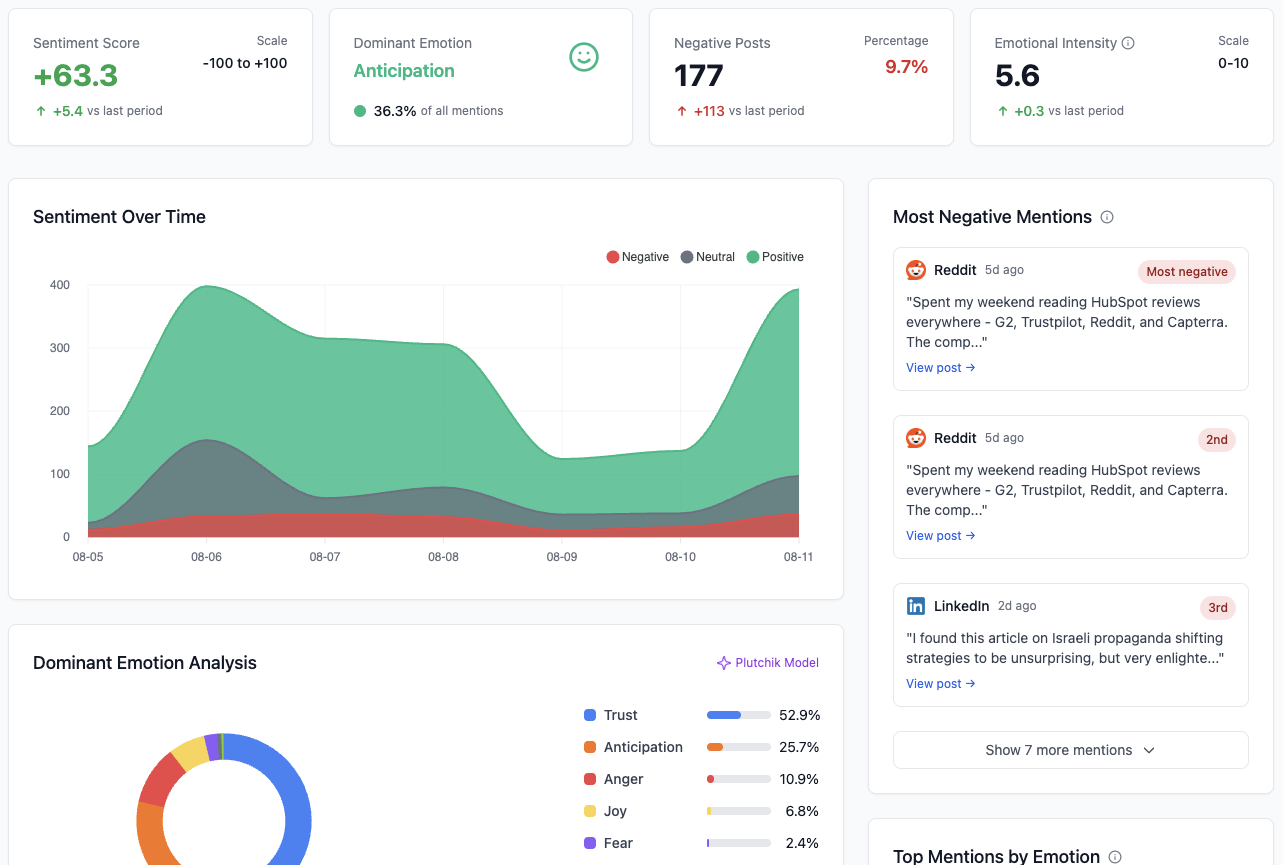
Sentiment analysis is your first line of defence. It automatically sorts text into positive, negative, or neutral buckets, helping you triage feedback in seconds. A sudden spike in negative sentiment on X (formerly Twitter) right after a feature launch? That's a huge red flag you need to jump on immediately.
Emotion analysis, on the other hand, goes a level deeper. It can pick up on more nuanced feelings like joy, anger, surprise, or frustration. Knowing a customer is "negative" is useful, but knowing they're "frustrated" with your checkout process gives your product team a much clearer problem to solve. We dive deeper into this in our guide to sentiment analysis for social media.
These AI-driven techniques are non-negotiable for anyone dealing with a high volume of feedback. Instead of spending days manually reading every comment, you get an instant emotional barometer for your entire customer base.
By looking past simple positive or negative labels, emotion analysis helps you understand the why behind the feedback. A customer expressing "surprise" might have found a delightful new feature, while one showing "sadness" could be reacting to a discontinued product they really loved.
Identifying Key Themes and Topics
Once you've got a handle on the overall mood, the next job is to figure out what everyone is talking about. This means digging into the feedback to find recurring themes, keywords, and topics. This is where a VoC programme really starts to pay off.
This process, often called theme or topic clustering, uses AI to automatically group related comments together. For instance, it might pull together thousands of different comments that all boil down to "slow delivery times," "confusing user interface," or "amazing customer support."
By putting a number on these themes, you can build a priority list of your customers' biggest headaches and wishes:
- Product Teams: Discover that 15% of all feedback mentions a confusing navigation menu, making it an obvious priority for the next design sprint.
- Marketing Teams: Find that your happiest customers consistently praise your "reliability," giving you powerful messaging for your next ad campaign.
- Support Teams: See a surge in questions about "billing," which tells you it’s time to create clearer documentation or a quick tutorial video.
This is the step that turns messy, qualitative feedback into hard, quantitative data you can act on. A powerful approach called Conversation Intelligence uses AI to capture, transcribe, and analyse this feedback at scale. It stops you from getting distracted by the loudest person in the room and instead points you toward the most widespread issues.
Ultimately, analysing the voice of the customer is about finding the signal in the noise. It’s how you go from guessing what your customers want to knowing for sure, grounding every strategic move in real, measurable human experience.
How to Build a Powerful Voice of Customer Programme

Turning random customer comments into a genuine strategic asset isn’t magic—it's a process. A proper Voice of Customer (VoC) programme isn’t just another project; it’s a system that weaves customer insights right into the fabric of your company. It all starts with knowing exactly what you’re trying to accomplish.
Without clear goals, your VoC efforts are just noise. You’ll collect feedback, sure, but you won’t know what to do with it.
Step 1: Set Clear and Measurable Goals
Before you even think about surveys or social listening, you need to ask a simple question: what problem are we actually trying to solve? Vague ambitions like “understanding our customers better” just won’t cut it. Your goals need to be sharp, measurable, and tied directly to a business outcome.
Here’s what I mean:
- Reduce customer churn by 15% in the next year by finding and fixing the top three headaches in our onboarding flow.
- Boost our Net Promoter Score (NPS) by 10 points in six months by building the features our most loyal customers are begging for.
- Improve the first-contact resolution rate by 20% by creating help docs that answer the same questions support agents hear over and over.
Setting targets like these gives your programme purpose. It shifts VoC from a passive listening exercise to an active strategy for growth.
Step 2: Choose Your Listening Posts Wisely
With your goals locked in, it’s time to decide where to listen. You don’t need to be everywhere at once. The trick is to focus on the channels where your customers are already talking and where the feedback will directly help you hit your targets.
A good mix usually involves both direct and indirect feedback. You might send targeted NPS surveys via email while also using a social listening tool like ForumScout to catch unsolicited chatter on Reddit and X. The key is to funnel all this data into one place—whether that’s a simple spreadsheet, your CRM, or a dedicated VoC platform, make it accessible.
Step 3: Analyse, Synthesise, and Prioritise
This is where you turn raw data into real intelligence. As the feedback pours in, your job is to spot the patterns. Look for recurring pain points, popular feature requests, and the exact words customers use to describe their wins and frustrations.
Once you’ve pulled out the key themes, you have to prioritise. Let’s be honest, not all feedback is created equal. A bug that 30% of your highest-paying customers complain about is a five-alarm fire. A one-off feature request from a single user? Not so much. Create a simple framework to rank issues based on frequency, severity, and how much they impact your goals.
The impact of a superior voice of customer programme is clear. A comprehensive 2023 report on the UK customer experience found the average Net Promoter Score was a modest +12. However, the top 10% of brands in industries like Automotive and Media achieved scores over +40, demonstrating a huge gap between leaders and laggards. The key drivers were product quality and ease of getting help—insights that are directly uncovered through effective VoC. Discover more findings from the State of Customer Experience Report.
Step 4: Close the Feedback Loop
Here’s the part everyone forgets: acting on what you’ve learned. Collecting feedback is pointless if it just sits in a dashboard. The final, and most critical, step is to “close the loop.” This means sharing insights with the teams who can make a difference—and then telling your customers what you did.
This feedback cycle is what gives a VoC programme its real power.
- Share Insights: Don’t just send a data dump. Package your findings into a clear, simple report and share it with leaders in product, marketing, and support.
- Assign Ownership: Make someone accountable. For every key insight, assign a specific person or team to own the next step.
- Take Action: This could be anything from fixing a bug or updating a help article to getting a new feature on the product roadmap.
- Communicate Back: When you make a change based on feedback, tell your customers! A simple email or update shows them you’re listening and makes them feel valued.
When you get this cycle running, you turn feedback from a static report into a living, breathing engine for improvement. That’s how the voice of the customer becomes more than just a buzzword—it becomes your most sustainable driver of growth.
Putting VoC to Work with Real-World Examples
Theory is one thing, but seeing real results is what actually matters. A great voice of customer strategy isn’t just about passively listening; it’s an active playbook for sparking innovation, getting a leg up on the competition, and protecting your reputation. The magic happens when those customer insights are used to make better business decisions across the board.
Every team, from product to marketing to support, can turn raw feedback into tangible wins. Let's look at a few concrete examples of how they can put VoC into action, drawing a straight line from a single customer comment to a real business victory.
Product Teams Build What Customers Actually Want
Product development can often feel like a high-stakes guessing game. VoC takes the guesswork out of the equation.
Imagine a software company that keeps seeing a theme pop up in Reddit threads: users are praising a competitor’s dead-simple user interface. Instead of shrugging it off, the product team flags this as a critical insight. They use that feedback to prioritise a design overhaul in their next development sprint, zeroing in on the clunky navigation that customers are clearly struggling with.
By tuning into these honest, unsolicited conversations, they build a feature that solves a known market frustration.
This simple act of listening leads to big wins:
- Reduced User Friction: The new, cleaner design slashes the number of support tickets related to navigation issues.
- Increased Adoption: Users who once found the software confusing now have a much smoother experience and stick around.
- Competitive Advantage: The product now directly challenges one of its main rival's key strengths.
Marketing Teams Craft Campaigns That Resonate
Marketers are always on the hunt for the perfect message. The voice of the customer hands them the exact language they need, straight from the source.
Picture a marketing team digging into negative reviews and X (formerly Twitter) complaints aimed at a competitor. They quickly spot a pattern—customers are fed up with the rival brand's hidden fees and terrible communication. This is a golden opportunity.
The team builds a new ad campaign that hammers on their own company’s transparent pricing and proactive customer updates. They aren't just guessing what matters; they're directly addressing a proven pain point in the market. To really get this right, mastering customer experience journey mapping is an essential skill for understanding and improving every touchpoint.
By turning a competitor’s weakness into a core marketing message, the team creates a powerful unique selling proposition. This leads to better-quality leads and a much stronger brand identity.
Support Teams Solve Problems Proactively
For support teams, VoC is like having an early warning system. Instead of just reacting to a flood of tickets, they can spot emerging problems before they blow up.
Let's say a support manager at an e-commerce company is monitoring online forums where people discuss their products. They notice a few posts from customers complaining that a recent software update is breaking the checkout process on a specific web browser. While only a handful of tickets have come in so far, the forum chatter points to a much bigger problem brewing.
The support team immediately alerts the engineering department.
This proactive approach allows them to:
- Prevent a Crisis: The bug gets fixed before it affects thousands of customers and tanks sales.
- Improve Customer Trust: The company looks responsive and on top of its game.
- Reduce Support Load: By stopping a widespread issue in its tracks, they avoid a massive wave of tickets and angry phone calls.
Unfortunately, many organisations are falling behind. In 2023, the UK Customer Satisfaction Index dropped to 77.7 out of 100, with the biggest dip seen in how companies handle complaints. This shows a worrying trend where UK businesses are failing to act on what their customers are telling them. You can learn more about these UK customer service findings.
These real-world examples prove that a solid VoC programme connects every part of the business, turning customer feedback into a shared roadmap for success.
Measuring the ROI of Your VoC Strategy
A voice of customer programme is more than just a listening exercise; it’s a strategic investment. But how do you prove it’s actually paying off? To get buy-in from leadership, you have to connect your VoC efforts to the financial metrics they care about most, turning it from a perceived cost centre into a proven engine for growth.
This means moving beyond just tracking feedback volume. The real goal is to translate your insights into tangible business outcomes. It’s all about drawing a clear, undeniable line from what a customer told you to a positive result on the balance sheet.
Connecting VoC to Business Outcomes
To demonstrate return on investment, you need to show how specific VoC initiatives directly influence core business metrics. You’re looking for a clear cause-and-effect relationship: we listened to this, we did that, and here’s how the numbers moved.
Focus on measuring a few key areas:
Customer Retention and Churn: This is where a successful VoC programme makes its most direct impact. When you use feedback to fix pain points, you’re literally fixing the reasons people leave. Since a 5% increase in customer retention can boost profits by 25% to 95%, this is an incredibly powerful story to tell.
Customer Lifetime Value (CLV): Happy customers don't just stick around; they buy more, more often. Acting on feedback improves the entire customer experience, which boosts satisfaction and, in turn, CLV. Track this for customer groups where you’ve made changes based on their specific feedback.
Cost to Serve: VoC data is a goldmine for spotting recurring problems that clog up your support channels. By proactively fixing these issues—like improving your help docs based on common questions—you reduce support tickets and lower your operational costs.
Building Your VoC Dashboard
To make your case effectively, you need to present your findings in a clear, compelling way. A simple dashboard or report can visualise the impact of your voice of customer strategy. It doesn't need to be complicated; it just needs to tell a story with data.
For example, you might show how a spike in negative sentiment around a new feature led to a product update. Then, you can correlate that update with a subsequent 10-point jump in your Net Promoter Score (NPS) and a 5% drop in churn for that user cohort over the next quarter.
This approach transforms abstract feedback into a concrete narrative of problem, action, and financial result. By consistently tracking and reporting these connections, you prove that listening to the voice of the customer isn't just a nice-to-have—it’s one of the smartest financial decisions your business can make.
Common Questions About Voice of Customer (VoC)
Jumping into the world of customer feedback can feel a bit overwhelming. Let’s clear up some of the most common questions people have when they're getting started with a voice of customer (VoC) programme.
What's the Real Difference Between Voice of Customer and Market Research?
This is a big one. While both are about listening to your audience, they have completely different jobs.
Think of market research as using a telescope to look at the horizon. It's all about exploring future possibilities and asking big questions like, "Should we build a brand new product?" It's usually a one-off project, designed to look forward.
On the other hand, voice of customer is more like using a microscope to examine what’s happening right now. It's a continuous, always-on process focused entirely on the experiences your current customers are having. VoC answers the question, "How can we make what we already have better?" by using a constant stream of feedback to improve the customer journey.
Can Small Businesses Really Build a VoC Programme on a Tight Budget?
Absolutely. You don't need a massive budget to start listening to your customers. Small businesses can get an effective voice of customer programme off the ground by starting with free or low-cost tools.
Begin where your customers are already talking. Manually check the social media platforms, online communities, and forums they hang out in. Set up some Google Alerts for your brand name and send out simple feedback surveys with free tools. The first step is just showing up where the conversations are happening.
As you grow, you can bring in an affordable social listening tool to do the heavy lifting. These platforms automate the data collection and analysis, giving you powerful insights without the enterprise price tag.
How Do I Turn All This VoC Data into Actual Business Changes?
This is the most critical part. Collecting data is pointless if it just gathers dust in a report. The secret is to create a formal "feedback loop" that forces action and accountability.
A good feedback loop isn't complicated. It just needs a few key steps:
- Synthesise and Share: Boil down the key findings into a simple, regular report. Get it in front of the leaders in product, marketing, and support so everyone is on the same page.
- Assign Ownership: Every insight needs a clear owner. If a piece of feedback is actionable, assign it to a specific person or team who is responsible for seeing it through.
- Track Resolution: Let's say your VoC data flags a recurring bug on your website. That feedback should become a ticket, assigned to the engineering lead, and tracked all the way to completion.
This simple structure makes sure the customer's voice doesn't just get heard—it gets acted on and drives real improvements across the business.
Ready to turn customer conversations into your biggest growth driver? With ForumScout, you can automatically monitor feedback across Reddit, X, and more, turning raw chatter into actionable insights. Start your free 7-day trial and hear what you’ve been missing at https://forumscout.app.