
- 27 min read
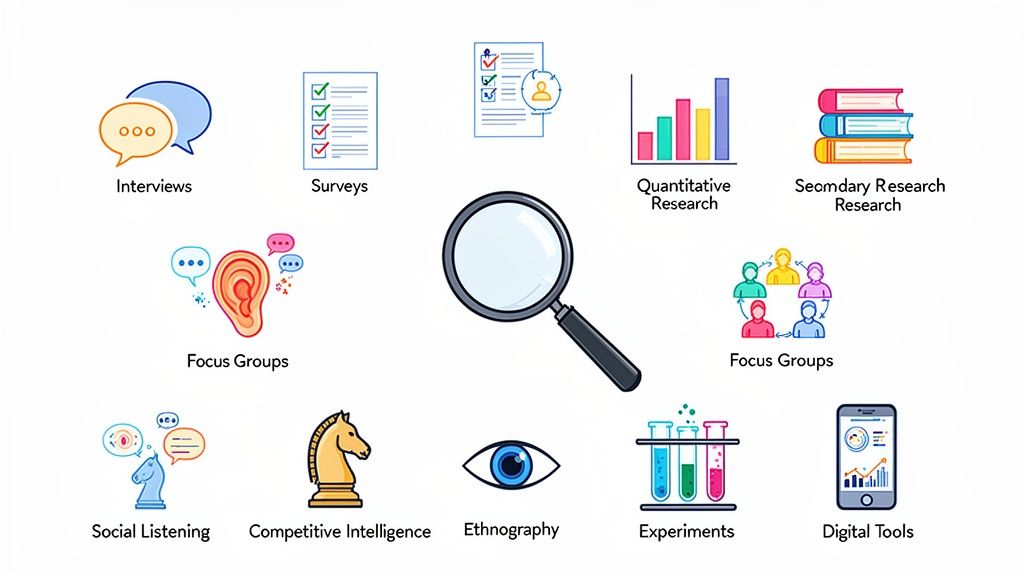
10 Essential Kinds of Market Research to Master in 2026
In a market saturated with data, understanding your customer is the single most important competitive advantage. Yet, many businesses still rely on a narrow set of methods, often missing the full picture of what their audience truly wants. The most powerful insights emerge not from a single survey or report, but from combining different approaches to understand what customers say, do, think, and feel in their own, unfiltered words.
This guide moves beyond the basics to explore 10 essential kinds of market research, providing a modern, holistic framework for gathering actionable intelligence. We are not just listing methods; we are providing a complete toolkit. For each type of research, you will find practical examples, a clear breakdown of its pros and cons, and guidance on when to use it for maximum impact. Embracing a comprehensive Voice of the Customer (VoC) approach is crucial, and this article will show you how to integrate multiple data streams into a cohesive strategy.
From analysing forum discussions to conducting competitive intelligence, you will learn how to build a continuous feedback loop that informs product development, marketing campaigns, and customer service. We'll also demonstrate how tools like ForumScout can streamline this process, turning scattered conversations into strategic assets. By the end, you will have a clear roadmap to uncover the customer truths that drive sustainable business growth and build a more resilient brand. Let's dive into the methods that will define market understanding in 2026 and beyond.
1. Social Listening & Sentiment Analysis
Social listening involves monitoring digital conversations across social media platforms, forums, and online communities to understand what people are saying about a brand, its competitors, and the wider industry. It moves beyond simple mention tracking by analysing the underlying sentiment (positive, negative, neutral) and emotional context of these conversations. This approach is fundamental to modern market research, capturing authentic, unsolicited customer feedback as it happens.
This method allows businesses to tap into raw, unfiltered customer opinions. Beyond basic keyword tracking, the integration of advanced Large Language Model applications is transforming how businesses extract deep insights and sentiments from online conversations and customer feedback. Platforms like ForumScout specialise in this, helping you find valuable discussions on sites like Reddit.
When to Use This Method
Social listening is incredibly versatile and powerful when you need to: * Gauge Brand Health: Continuously track brand perception and sentiment over time. * Perform Competitive Analysis: Monitor competitor product launches, marketing campaigns, and customer complaints to find strategic openings. * Identify Customer Pain Points: Discover frustrations or desired features that customers are discussing organically online. * Manage Crises: Quickly detect and respond to spikes in negative sentiment before they escalate. * Find New Opportunities: Identify emerging trends, potential influencers, and untapped market niches.
Practical Implementation Tips
To get the most out of social listening, focus your efforts with these actionable steps:
- Be Specific: Start with 10-20 highly targeted keywords related to your brand, products, and key competitors rather than casting a wide net.
- Refine Your Search: Use Boolean operators (AND, OR, NOT) and AI-powered filters to reduce irrelevant mentions and false positives.
- Avoid Alert Fatigue: Set up smart notifications that only trigger for significant changes in mention volume or sentiment, rather than for every single mention.
- Integrate Your Data: Connect your social listening tool to your CRM or other business systems using webhooks to give sales and support teams real-time context.
- Analyse Competitor Voice: Track your "share of voice" (how much your brand is mentioned versus competitors) to benchmark your market presence. To dig deeper, explore the nuances of sentiment analysis for social media.
2. Surveys & Questionnaires
Surveys and questionnaires are structured research instruments designed to collect both quantitative and qualitative data directly from a target audience through a standardised set of questions. This method is a cornerstone of many kinds of market research, allowing businesses to gather specific, firsthand information about customer preferences, satisfaction levels, and purchase intentions. Deployed online, via email, or embedded on a website, surveys provide statistically significant insights that can validate findings from more passive methods.
This direct approach bridges the gap between passive social listening and direct customer interaction, enabling you to ask precise questions that online conversations may not cover. For instance, while social listening reveals what customers are saying, surveys can uncover the specific why behind their opinions, such as the reasoning behind their Net Promoter Score (NPS) or their post-purchase satisfaction rating.
When to Use This Method
Surveys are exceptionally effective when you need to: * Measure Customer Loyalty: Use NPS surveys to track customer loyalty and advocacy over time. * Gather Post-Purchase Feedback: Understand the customer experience immediately after a purchase to identify strengths and weaknesses. * Prioritise Product Features: Ask users to rank or rate potential new features to guide your development roadmap. * Define Market Size: Collect demographic and psychographic data to quantify the potential market for a new product or service. * Map the Customer Journey: Deploy targeted surveys at different touchpoints to understand pain points and opportunities for improvement.
Practical Implementation Tips
To maximise the value of your surveys and ensure high-quality data, implement these focused strategies:
- Keep it Concise: Aim for surveys under 10 questions to maintain respondent engagement and significantly improve completion rates.
- Use Conditional Logic: Personalise the survey experience by showing or hiding questions based on a user's previous answers, making it more relevant.
- Incentivise Participation: Encourage responses by offering a small discount, a free resource, or entry into a prize draw.
- Pilot Test Your Questions: Before a full launch, send the survey to a small internal group to identify any confusing or leading questions.
- Cross-Validate with Social Data: Compare your quantitative survey findings with the qualitative insights from social listening to get a more complete and reliable picture.
- Segment Your Results: Analyse responses based on customer personas, purchase history, or demographic data to uncover deeper, more actionable insights.
3. Focus Groups & Interviews
Focus groups and interviews are core qualitative research methods that facilitate in-depth conversations with target customers. Focus groups gather a small selection of participants (typically 6-10) for a moderated group discussion, while interviews are one-on-one conversations. Both methods are designed to explore the motivations, attitudes, and reasoning behind customer behaviour, providing rich, contextual insights that quantitative data cannot capture.
These conversational formats allow researchers to dig deep into the "why" behind customer actions and opinions. They are invaluable for understanding emotional drivers and complex decision-making processes, offering nuanced feedback that can steer product development and marketing strategy in the right direction. This makes them a vital component of a comprehensive understanding of the different kinds of market research available.
When to Use This Method
This hands-on approach is most effective when you need to: * Test New Concepts: Evaluate early-stage product ideas, features, or marketing campaigns before a full-scale launch. * Explore Customer Pain Points: Uncover the detailed frustrations and unmet needs that customers face with your product or in the market. * Evaluate Messaging Resonance: Understand how specific branding, advertising copy, or value propositions land with different personas. * Investigate Customer Churn: Conduct exit interviews to learn the specific reasons why customers are leaving. * Understand B2B Decision-Making: Map out the complex buying criteria and stakeholder influences within a business context.
Practical Implementation Tips
To ensure your qualitative sessions yield high-quality insights, follow these best practices:
- Recruit Thoughtfully: Ensure participants accurately represent your key customer personas to gather relevant feedback. Aim for diversity within those profiles.
- Use a Flexible Guide: Prepare a moderator guide with key open-ended questions, but allow the conversation to flow naturally to uncover unexpected insights.
- Listen More Than You Talk: The moderator’s primary role is to guide and probe, not to lead the participants to specific conclusions.
- Record and Analyse: Always get permission to record sessions. This allows you to perform a thorough analysis later without relying on memory alone.
- Reach Saturation: Plan for 4-6 focus groups or 10-15 interviews per persona. You've reached "thematic saturation" when you stop hearing new core ideas.
- Encourage Observation: Invite product managers, designers, and marketers to observe sessions live (discreetly) to build direct customer empathy.
4. Competitive Intelligence & Benchmarking
Competitive intelligence involves systematically monitoring and analysing your competitors' activities, products, messaging, and overall market strategy. It is complemented by benchmarking, which compares your company's performance metrics against those of top competitors and industry standards. This dual approach is one of the most crucial kinds of market research for identifying market gaps, anticipating competitive moves, and discovering strategic advantages.
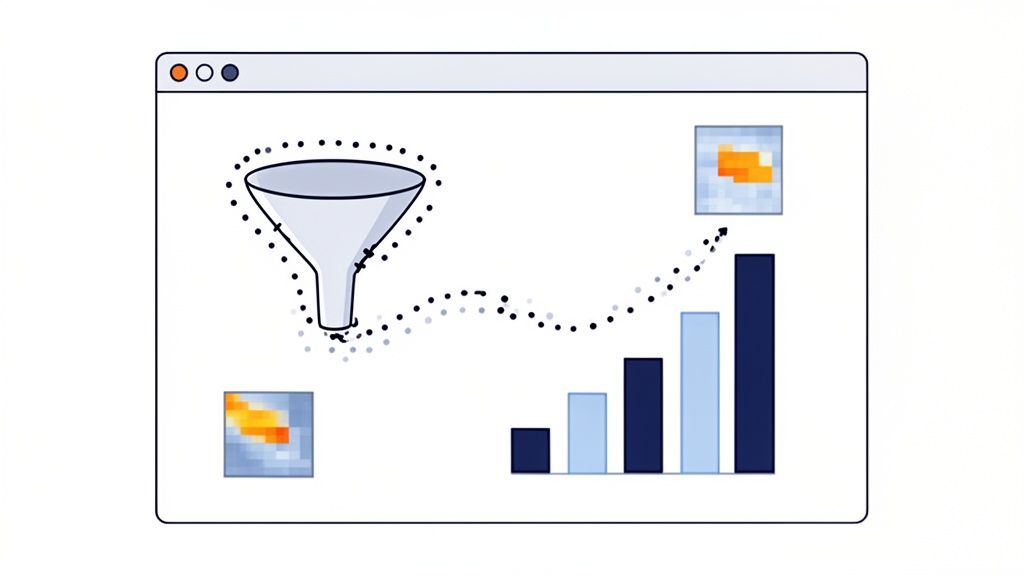
This method provides an external perspective, grounding your strategy in market realities rather than internal assumptions. By observing what works (and what doesn't) for others, you can refine your own tactics without costly trial and error. Modern tools, especially social listening platforms, excel at this by tracking competitor mentions, customer sentiment, and campaign performance in real-time, giving you an unfiltered view of their market reception.
When to Use This Method
Competitive intelligence and benchmarking are essential when you need to: * Refine Your Market Positioning: Understand how competitors are positioning themselves and identify a unique value proposition for your brand. * Inform Product Development: Discover features your competitors' customers are requesting or complaining about to guide your own roadmap. * Optimise Pricing Strategies: Analyse competitor pricing models, discounts, and promotional offers mentioned in online discussions. * Identify Strategic Threats and Opportunities: Spot emerging competitors or shifts in market strategy early on. * Benchmark Your Performance: Measure your 'share of voice', customer satisfaction, and other key metrics against a clear competitive baseline.
Practical Implementation Tips
To execute this research effectively, integrate these focused actions into your workflow:
- Select Key Rivals: Start by consistently monitoring 3-5 of your most direct competitors to maintain focus and avoid information overload.
- Track Competitor Keywords: Set up alerts for your competitors' brand names, product names, and unique campaign slogans alongside your own.
- Analyse Customer Pain Points: Systematically review negative mentions and complaints about your competitors to identify their weaknesses, which can become your messaging strengths.
- Monitor Feature Launches: Pay close attention to customer sentiment shifts immediately following a competitor's new feature or product launch.
- Document Win/Loss Data: Gather insights from customer conversations to understand precisely why a prospect chose you or a competitor. For a deeper dive, learn more about how to conduct a competitor analysis.
5. Web Analytics & Behavioural Data
Web analytics involves tracking and analysing user behaviour on websites and digital properties to understand how visitors interact with content, products, and services. It provides quantitative data on metrics like traffic sources, conversion rates, bounce rates, user flow, and on-page engagement patterns. This method is a cornerstone of digital marketing, offering clear evidence of what is and isn't working online.
When combined with qualitative insights from methods like social listening, web analytics becomes even more powerful. It connects the "what" (e.g., a spike in website traffic) with the "why" (e.g., a popular Reddit thread discussing a product). This synthesis allows businesses to understand the direct impact of online conversations on actual user actions and conversions, making it one of the most practical kinds of market research available.
When to Use This Method
Web analytics is essential when you need to: * Optimise Conversion Funnels: Identify where users are dropping off in the journey from discovery to purchase. * Measure Campaign ROI: Track which marketing channels (social, email, paid search) are driving the most valuable traffic and conversions. * Improve User Experience (UX): Analyse user flow and heatmaps to discover confusing navigation or underperforming pages. * Validate Product-Market Fit: See which features or content users engage with the most. * Attribute Traffic to Social Mentions: Directly measure the impact of PR or viral social media conversations on website visits and sign-ups.
Practical Implementation Tips
To get meaningful insights from your web analytics, move beyond basic page views with these steps:
- Tag Everything: Use UTM parameters on all your marketing links (social posts, emails, ads) to precisely track where your traffic is coming from.
- Define and Track Goals: Set up specific conversion events in your analytics platform (e.g., Google Analytics) that align with business goals, such as form submissions, purchases, or newsletter sign-ups.
- Correlate Data: When your social listening tool detects a traffic spike from a site like Reddit, cross-reference the timestamp with your web analytics to analyse the behaviour of that specific cohort of visitors.
- Segment Your Audience: Create custom segments to compare the behaviour of users from different channels, like organic social media visitors versus paid search visitors.
- Analyse the Full Journey: Use flow reports to understand the paths users take through your website, identifying both popular routes and common exit points.
- Integrate with a CRM: Connect your analytics to a Customer Relationship Management system to track the long-term value of customers acquired from different channels.
6. Customer Reviews & Feedback Analysis
Customer reviews and feedback analysis involves systematically collecting, categorising, and analysing opinions from dedicated platforms like Google Reviews, Trustpilot, Capterra, and various app stores. Unlike the broad scope of social listening, this method focuses on structured feedback channels where customers explicitly share their experiences with a product or service. This process uncovers crucial patterns in satisfaction, common feature requests, and product quality issues.
This targeted approach provides a direct line to the voice of the customer, offering structured data that is often more specific than general social media chatter. By analysing this feedback, businesses can pinpoint exact areas for improvement, from user interface bugs identified in App Store reviews to packaging defects mentioned on Amazon. This makes it one of the most actionable kinds of market research available.
When to Use This Method
This highly focused method is ideal when you need to: * Improve Product Development: Use direct feedback from platforms like G2 or Capterra to prioritise your product roadmap and fix bugs. * Enhance Customer Experience: Identify and address recurring service issues or usability problems that lead to negative reviews. * Monitor Product Quality: Track Amazon or other e-commerce reviews to catch early warnings about manufacturing defects or quality control lapses. * Benchmark Against Competitors: Analyse competitor reviews to understand their strengths and weaknesses from the customer's perspective. * Track Satisfaction Over Time: Monitor changes in star ratings and sentiment to measure the impact of product updates or service improvements.
Practical Implementation Tips
To turn customer feedback into a strategic asset, apply these focused techniques:
- Implement a Tagging System: Categorise every new review by theme (e.g., bug, feature request, customer service, pricing) to quantify problem areas.
- Set Up Real-Time Alerts: Configure notifications for all new reviews, especially negative ones, to enable rapid public responses and internal escalation.
- Track Rating Velocity: Monitor the volume and average rating of reviews over time. A sudden drop can signal a critical issue that needs immediate attention.
- Respond Publicly and Professionally: Always reply to negative reviews to demonstrate that you are listening and committed to resolving issues. This builds trust with potential customers.
- Integrate Feedback into Planning: Use quantitative data from your review analysis (e.g., "35% of negative reviews mention slow loading times") to justify priorities in development and operational meetings.
7. Community & Forum Discussions
This method involves the deep analysis of discussions taking place in online communities, forums, Reddit threads, and other niche discussion platforms. Here, users organically share problems, seek peer-to-peer advice, and form a community consensus about products, solutions, and industry challenges. This approach taps into a highly engaged and often knowledgeable segment of a target market, revealing authentic pain points and desires.
Unlike broad social media, these platforms host in-depth, topic-specific conversations that provide rich qualitative data. For instance, a software company might monitor the Reddit subreddit r/webdev for feedback on developer tools, or a hardware manufacturer could analyse niche hobbyist forums to understand advanced user needs. This is one of the most effective kinds of market research for understanding a specialised audience.
When to Use This Method
Community and forum analysis is particularly effective when you need to: * Understand Niche Audiences: Gain deep insights into the specific language, problems, and preferences of a highly targeted user group. * Validate Product Ideas: See if the problem your product solves is something people are actively seeking solutions for in communities. * Generate Content Ideas: Identify the most frequently asked questions and unresolved problems to create relevant blog posts, guides, or tutorials. * Improve Product Development: Track bug reports, feature requests, and common frustrations discussed by power users. * Discover Unmet Needs: Find gaps in the market by analysing what solutions community members are hacking together themselves.
Practical Implementation Tips
To effectively leverage community discussions for market research, follow these steps:
- Identify Key Hubs: Pinpoint the top 3-5 online communities (forums, Reddit, Discord servers) where your target audience actively congregates.
- Track Problem Language: Don't just search for your brand name. Monitor keywords related to the problems your product solves to find organic conversations.
- Analyse Questions and Answers: Pay close attention to both the questions being asked and the solutions recommended by the community to understand common issues and existing workarounds.
- Engage Authentically: Participate by offering genuine help and expertise without overt promotion to build trust and gather firsthand feedback.
- Monitor Sentiment Shifts: Track how community opinion changes in response to new product launches, feature updates, or competitor activities.
8. Influencer & Power User Analysis
Influencer and power user analysis involves identifying and studying the key individuals who shape opinions, drive conversations, and hold a disproportionate impact within a target market. This goes beyond celebrity endorsements to include niche content creators, industry experts, micro-influencers, and community leaders. By understanding who they are, what they advocate for, and the nature of their audience, businesses can create highly targeted partnership and messaging strategies.
This method provides a strategic shortcut to building trust and credibility. Rather than reaching an audience one person at a time, you leverage the established authority of figures who already have your target customers' attention and trust. It's one of the most direct kinds of market research for understanding how influence flows through a community and who the real trendsetters are.
When to Use This Method
This type of analysis is most effective when your goal is to: * Boost Brand Credibility: Partner with respected voices to gain a halo effect for your product or service. * Execute Targeted Product Launches: Seed your product with key influencers to generate authentic initial reviews and buzz. * Understand Niche Audiences: Analyse the content of micro-influencers to understand the specific language, values, and pain points of a highly-engaged sub-market. * Perform Competitive Intelligence: Track which influencers and experts your competitors are working with to understand their marketing focus. * Identify Early Adopters: Find power users who are often the first to try new technologies and can provide invaluable early-stage feedback.
Practical Implementation Tips
To effectively analyse and engage with influential figures, follow these steps:
- Prioritise Engagement Over Follower Count: Look for influencers with high engagement rates (likes, comments, shares) relative to their follower size, as this indicates a more loyal and active audience.
- Verify Audience Authenticity: Use tools to check for fake followers or bots before investing time or resources in outreach. A smaller, real audience is far more valuable.
- Engage Micro-Influencers: Focus on creators with 10k-100k followers. They often have higher engagement, lower costs, and a more authentic connection with their audience, delivering superior ROI.
- Provide Value First: Before asking for a promotion, build a genuine relationship. Offer them exclusive information, free products without obligation, or amplify their own content.
- Monitor Influencer Sentiment: Track what key voices are saying about your entire product category, not just your brand. This can reveal unmet needs or shifting market preferences.
9. Sales Intelligence & Lead Scoring
Sales intelligence fuses market research with direct sales processes, using data to identify and qualify high-intent prospects. It involves actively monitoring digital channels for buying signals, such as budget discussions, timeline references, or competitor comparisons, and then scoring these leads based on their engagement and explicit needs. This modern approach transforms raw data into actionable sales opportunities.
This method moves beyond traditional lead generation by incorporating real-time insights from social media, forums, and news outlets. By analysing conversations and content engagement, businesses can prioritise prospects who are actively in a buying cycle, dramatically improving sales efficiency and personalising outreach with relevant context. This is one of the more proactive kinds of market research that directly fuels revenue generation.
When to Use This Method
This powerful method is ideal when your goal is to: * Identify High-Intent Prospects: Find potential customers who are openly discussing their need for a solution like yours. * Prioritise Sales Efforts: Score leads to ensure your sales team focuses its energy on the most promising opportunities. * Enable Predictive Selling: Use historical data and real-time signals to anticipate which accounts are likely to convert. * Personalise Outreach: Arm your sales team with specific insights, like a prospect's pain points or competitor mentions, to craft highly relevant messaging. * Support Account-Based Marketing (ABM): Gather deep intelligence on target accounts to tailor campaigns and engagement strategies effectively. * Identify Churn Risks: Monitor existing customer conversations for signals of dissatisfaction to enable proactive retention efforts.
Practical Implementation Tips
To effectively integrate sales intelligence into your workflow, follow these steps:
- Define Clear Buying Signals: Identify specific keywords and phrases relevant to your sales cycle, such as "looking for a replacement for [competitor]," "budget approval," or "need a new CRM."
- Build a Scoring Model: Develop a lead scoring system based on historical data from won and lost deals, weighting signals like company size, industry, and expressed intent.
- Integrate Data with Your CRM: Use webhooks or native integrations to automatically push socially-sourced leads and their context directly into your customer relationship management platform.
- Train Your Sales Team: Equip your sales representatives to interpret and act on social insights, turning conversation data into compelling sales conversations.
- Monitor Competitor Mentions: Set up alerts for your competitors' names to identify dissatisfied customers you can target as win-back opportunities.
10. Crisis Management & Issue Monitoring
Crisis management and issue monitoring is a defensive form of market research focused on proactively identifying and mitigating potential threats to a brand's reputation. It involves using real-time monitoring tools to track negative sentiment, product complaints, and emerging PR issues across digital channels. This approach allows organisations to detect problems early, understand their context, and respond swiftly before they escalate into widespread crises.
This method transforms market research from a purely strategic function into a critical, real-time operational tool. By setting up alerts for specific keywords, sudden spikes in negative emotion, or mentions from influential accounts, businesses can address customer service failures, product bugs, or misinformation before they go viral. It's about containing the fire before it spreads, using data to inform an immediate, authentic response.
When to Use This Method
This proactive monitoring is essential for protecting brand equity and is most effective when you need to: * Prevent PR Crises: Spot and address potential reputational threats, such as negative influencer posts or emerging boycott calls, before they gain traction. * Identify Product Flaws: Quickly detect patterns in customer complaints about bugs or defects being discussed on platforms like Reddit or Twitter. * Monitor Service Failures: Uncover and respond to clusters of complaints regarding poor customer service experiences or logistical problems. * Track Security Concerns: Get an early warning on mentions of data breaches or security vulnerabilities before they are picked up by mainstream media. * Manage Negative Campaigns: Identify coordinated negative reviews or smear campaigns early to formulate a strategic response.
Practical Implementation Tips
To turn monitoring into effective crisis management, apply these structured tactics:
- Create Pre-Approved Responses: Develop a playbook with approved messaging for common issue types (e.g., shipping delays, website outages) to enable a rapid and consistent response.
- Set Up Priority Alerts: Configure notifications for high-risk keyword combinations (e.g., "[Brand Name] AND unsafe") or significant, sudden spikes in negative sentiment.
- Establish an Escalation Path: Define a clear protocol for who needs to be notified and involved as the severity of an issue increases, from the community manager to the executive team.
- Know When to Go Private: Respond publicly to acknowledge the issue, then swiftly move the detailed conversation to a private channel like direct messages or email to resolve it personally.
- Analyse Post-Incident: After an issue is resolved, document the event and analyse the conversations to extract feedback for product, service, or policy improvements. Explore best practices for managing crisis communication to refine your strategy.
10 Market Research Methods Compared
| Method | 🔄 Implementation complexity | ⚡ Resource requirements & speed | 📊 Expected outcomes | 💡 Ideal use cases | ⭐ Key advantages |
|---|---|---|---|---|---|
| Social Listening & Sentiment Analysis | Medium — keyword setup, model tuning | Low–Medium ongoing tooling; real-time monitoring | Real-time sentiment trends, alerts, competitor mentions | Continuous brand monitoring, trend spotting, crisis early-warning | Captures unsolicited authentic feedback; continuous, cost-effective insights |
| Surveys & Questionnaires | Low–Medium — survey design and sampling | Low; one-off deployment; incentive costs possible | Quantifiable, statistically-valid metrics (NPS, preferences) | Hypothesis validation, satisfaction measurement, demographic segmentation | Direct, targeted feedback; statistically analyzable results |
| Focus Groups & Interviews | High — recruitment and skilled moderation required | High; time-intensive recruiting, sessions, transcription | Deep qualitative "why" insights and rich contextual data | Concept testing, messaging evaluation, exploring motivations | Provides nuanced, empathetic understanding; uncovers unexpected insights |
| Competitive Intelligence & Benchmarking | Medium — ongoing competitor tracking and analysis | Medium; monitoring tools and analyst time | Share-of-voice, positioning gaps, benchmarking metrics | Positioning strategy, product roadmap, competitor launch monitoring | Reveals competitor weaknesses and market gaps; informs realistic targets |
| Web Analytics & Behavioral Data | Medium — technical setup and tracking logic | Low–Medium; analytics tools and tagging; fast data access | Conversion metrics, funnel drop-offs, attribution insights | Validating social impact on conversions, funnel optimization, A/B testing | Direct measurement of behavior and revenue impact; supports optimization |
| Customer Reviews & Feedback Analysis | Low–Medium — aggregation and tagging workflows | Low; monitoring platforms and response processes | Star-rating trends, verified user feature requests, issue patterns | Product improvement, UX prioritization, reputation management | Credible, actionable feedback; clear trend signals from verified users |
| Community & Forum Discussions | Medium — threaded parsing and context analysis | Low–Medium; platform-specific monitoring expertise | Peer consensus, long-form problem/solution threads, power-user signals | Niche audience insights, developer/product feedback, community-driven trends | Highly authentic, detailed discussions; identifies advocates and solutions |
| Influencer & Power User Analysis | Medium — identification and audience verification | Medium; outreach coordination and vetting time | Ranked influencers, engagement signals, partnership candidates | Influencer outreach, credibility-building campaigns, early adoption seeding | High-leverage partnerships; shapes market narratives; finds rising voices |
| Sales Intelligence & Lead Scoring | High — CRM integration and model building | High; integrations, training, ongoing model refinement | High-intent lead identification, improved conversion timing, churn signals | Sales enablement, account-based marketing, pipeline acceleration | Boosts sales productivity; enables personalized outreach and timing |
| Crisis Management & Issue Monitoring | High — 24/7 alerts, protocols, escalation workflows | High; monitoring, rapid-response teams, approval processes | Early detection of negative spikes, faster resolution, reduced damage | PR response, customer support escalation, product safety issues | Real-time protection of brand reputation; prevents escalation when acted on |
Building Your Integrated Market research Engine
Navigating the diverse landscape of market research can feel overwhelming. We've journeyed through ten distinct kinds of market research, from the real-time pulse of social listening to the structured insights of surveys and the intimate discussions of focus groups. Each method offers a unique lens through which to view your customers, competitors, and the broader market. Yet, the most profound understanding doesn't come from mastering a single technique in isolation.
The true power lies in integration. Think of these methods not as a checklist to be completed, but as interconnected gears in a single, powerful intelligence engine. The real magic happens when you layer these approaches, creating a continuous feedback loop where each discovery informs the next line of questioning. This is how you move from merely collecting data to building a strategic, insight-driven organisation.
Creating a Strategic Feedback Loop
An integrated research strategy means that insights from one method become the catalyst for another. This synergistic approach prevents you from operating on isolated data points and instead helps you build a holistic, multi-dimensional view of your market.
Consider this practical workflow:
- Spark: You begin with Social Listening using a tool like ForumScout, monitoring discussions on platforms like Reddit and niche forums. You notice a recurring theme: customers are complaining about a competitor's confusing onboarding process. This is your initial spark, an unverified but intriguing signal from the market.
- Hypothesise: This observation becomes a hypothesis: "A significant portion of our target audience finds our main competitor's product difficult to set up."
- Validate: You then deploy a Survey to a segment of your audience, asking specific questions about their experiences with onboarding processes for products in your category. The results confirm that, yes, 25% of respondents abandoned the competitor's product during setup. Now you have quantitative validation.
- Deepen: To understand the why behind the what, you organise a small Focus Group with individuals who reported a negative onboarding experience. In these discussions, you uncover the specific pain points: the user interface is cluttered, and the instructions are unclear.
- Action: Armed with these layered insights, your product team can confidently prioritise a new, streamlined onboarding flow for your own product, turning a competitor's weakness into your strategic advantage.
This is the essence of an integrated engine. Social listening provided the lead, surveys provided the scale, and qualitative interviews provided the context. None of these kinds of market research would have been as powerful on their own.
Start Small, Scale Smartly
Adopting this integrated approach doesn't require a massive budget or a dedicated research department from day one. The key is to start small and build momentum. For many small and medium-sized businesses, the most accessible and high-impact starting point is combining two key areas:
- Social Listening & Community Monitoring: This provides a constant stream of unsolicited, authentic feedback about your brand, your rivals, and your industry's needs. It's your early-warning system and your opportunity-spotting radar.
- Competitive Intelligence: Systematically tracking your competitors' messaging, product updates, and customer complaints allows you to identify gaps in the market and anticipate their next move.
By mastering these two foundational pillars, you create a solid base of market awareness. From there, you can progressively layer in other methods like customer feedback analysis or targeted surveys as your resources and needs grow. The goal is not to do everything at once, but to build a scalable research habit that evolves with your business.
Ultimately, mastering the different kinds of market research is about more than just gathering information. It's about cultivating a culture of curiosity and deep customer empathy. It's about making smarter decisions, reducing risk, and building a business that genuinely resonates with the people it aims to serve. By weaving these methods together, you stop guessing what your market wants and start building a sustainable competitive advantage based on what you know.
Ready to build the foundational layer of your research engine? ForumScout helps you tap into authentic conversations on Reddit, Indie Hackers, and other communities to fuel your competitive intelligence and social listening efforts. Start your free 7-day trial and begin uncovering invaluable market insights today at ForumScout.