- 22 min read
Brandwatch vs Hootsuite The Ultimate UK Business Comparison
Let's get one thing straight right from the beginning: trying to compare Brandwatch and Hootsuite is a bit like comparing a telescope to a megaphone. They both operate in the same universe—social media—but they serve fundamentally different purposes.
Hootsuite is your operational command centre. It’s built for the hands-on work of social media management: publishing content, scheduling posts, and fostering team collaboration. Think of it as the megaphone you use to broadcast your message.
On the other hand, Brandwatch is your strategic intelligence partner. It’s a powerful consumer research platform designed for deep social listening and understanding brand health. It's the telescope you use to observe the entire galaxy of online conversation.

Choosing Between Brandwatch And Hootsuite
The decision really boils down to a single question: do you need to manage your social media presence, or do you need to understand the conversations shaping your market?
Hootsuite is engineered for the first part—the day-to-day execution of your social strategy. Brandwatch is built for the second—pulling high-level insights from massive online data sets to inform your entire business strategy. Getting this distinction right is the key to aligning your investment with what your business actually needs.
Here in the UK, both platforms have carved out distinct niches. Brandwatch, which was founded in Brighton back in 2007, cemented its reputation by providing deep consumer intelligence for large enterprises. Hootsuite, a Canadian company, has always focused on accessible pricing and a straightforward user experience, making it a go-to for UK small businesses and agencies that just need to get social media done efficiently.
At-A-Glance Brandwatch vs Hootsuite Key Differences
Before we dive deep, this table gives you a quick snapshot of where each platform stands. It’s a handy reference for their core purpose, ideal user, and pricing philosophy.
| Aspect | Brandwatch | Hootsuite |
|---|---|---|
| Primary Purpose | Consumer intelligence, deep social listening, and strategic brand analysis. | Social media management, content scheduling, publishing, and engagement. |
| Ideal User | Enterprise-level market research teams, brand strategists, and large corporations. | Social media managers, digital marketing agencies, and small to medium-sized businesses. |
| Pricing Model | Custom, quote-based pricing aimed at enterprise budgets (annual contracts). | Transparent, tiered monthly plans with a custom enterprise option. |
| Core Strength | Uncovering why conversations are happening and identifying market trends. | Streamlining how social media content is published and managed. |
This clear separation in focus is obvious even from their marketing. Brandwatch’s messaging centres on enterprise-level consumer intelligence and data-driven strategy, positioning it as a tool for understanding customers on a global scale. It’s a strategic research partner, not just a management tool.
With that foundation laid, we can get into the nitty-gritty details to help you figure out which platform truly fits your company’s immediate needs and long-term ambitions.
A Detailed Feature Comparison For UK Businesses
Forget the simple feature checklist. To really compare Brandwatch and Hootsuite, you need to look at them side-by-side through the lens of your actual business goals. For UK businesses, this means understanding how a platform’s features deliver real outcomes, whether that's a better campaign performance or a deeper grasp of the market.
It boils down to this: Hootsuite is built to manage and execute your social media strategy, while Brandwatch is designed to listen and analyse market conversations from a bird's-eye view. This core difference shapes everything about their toolsets, from the data they pull to how your team would use them day-to-day. Let's break it down.
Social Listening And Consumer Intelligence
This is where the two platforms are worlds apart. Brandwatch was born from a need for deep consumer intelligence, making it an absolute powerhouse for market research and tracking brand health.
Hootsuite, on the other hand, gives you solid social listening for the everyday tasks of a social media manager. You can easily track mentions, keywords, and hashtags across the big social networks. It’s perfect for spotting chances to engage, handling customer service issues, and keeping an eye on campaign chatter. Its purpose is operational—finding conversations you can jump into right now.
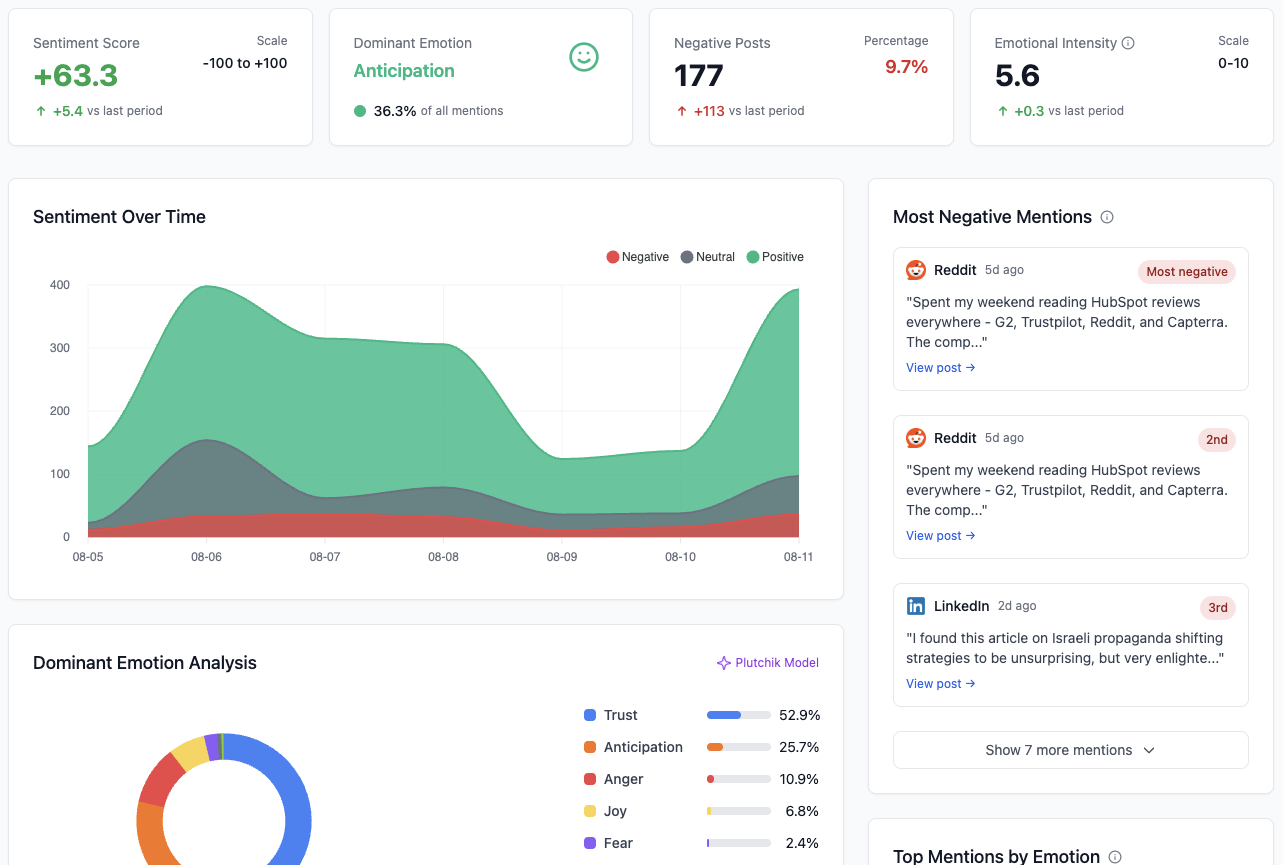
Brandwatch takes a far more expansive and sophisticated approach. Its AI-driven sentiment analysis doesn't just slap a "positive" or "negative" label on a mention; it uncovers nuanced emotions to get to the why behind what people are feeling. It gathers data not just from social media, but from millions of sources like blogs, forums, news sites, and review platforms, giving you a complete picture of the consumer landscape.
Key Differentiator: Brandwatch isn't just a listening tool; it's a consumer research engine. Hootsuite helps you hear what people are saying about your brand now, but Brandwatch helps you understand broader consumer trends, competitor moves, and market shifts before they even hit the mainstream.
For example, a UK retailer could use Hootsuite to find a customer tweeting about a late delivery and respond instantly. That same retailer could use Brandwatch to analyse thousands of conversations about "sustainable packaging" across the entire UK retail sector, identifying key consumer worries to shape their product strategy for the next five years.
Publishing And Scheduling Workflows
When it comes to publishing and scheduling, the tables are completely turned. This is Hootsuite’s turf, and it’s built for efficiency and teamwork.
Hootsuite provides a powerful, easy-to-use content calendar where teams can plan, create, schedule, and approve posts across all major social networks from one place. Features like bulk scheduling (up to 350 posts at once), smart recommendations for the best time to post, and clean approval workflows make it indispensable for busy marketing teams and agencies juggling multiple clients.

The platform is clearly designed to make executing social media campaigns, from planning through to engagement, as smooth as possible.
Brandwatch, however, has very limited direct publishing features. While it can integrate with other management tools, its core job isn't scheduling content. A team using Brandwatch would almost certainly need a separate platform—like Hootsuite or one of the many other great social media monitoring tools—to manage their content calendar and daily posts.
Analytics And Reporting Capabilities
Both platforms offer robust analytics, but true to form, their focus determines the kind of insights you get. Hootsuite is the champion of performance analytics, whereas Brandwatch leads the pack in strategic analytics.
Hootsuite’s reporting is all about campaign and channel performance. It delivers clear, customisable reports on the metrics that matter to social media managers:
- Engagement Rate: Likes, comments, shares, and clicks.
- Reach and Impressions: How many eyeballs your content reached.
- Follower Growth: Tracking your audience size over time.
- Team Productivity: Reporting on how quickly your team responds to customer queries.
These are the operational stats needed to prove ROI and tweak campaigns on the fly. When you're digging into paid social performance, it's also helpful to get insights into various ad tracking tools to see how they can plug into your main platform.
Brandwatch’s analytics suite, especially its Vizia data visualisation platform, serves a completely different master. It boils down massive amounts of conversational data into high-level strategic insights. A Brandwatch dashboard is more likely to track:
- Share of Voice: How much of the market conversation your brand owns compared to competitors.
- Sentiment Trends: How public perception of your entire industry is changing over months or years.
- Emerging Trends: Spotting new topics or consumer needs before they peak.
- Audience Demographics: Deep dives into the interests and behaviours of different customer segments.
The numbers tell the story. Hootsuite details its listening coverage across 150 million websites and 30 social channels, while analyst reports show Brandwatch scoring 89% to Hootsuite's 87% in overall perceived capability. It’s a tight race, highlighting their different but equally powerful strengths.
Comparing Cost And Value For Your Business
When you're weighing up Brandwatch vs Hootsuite, the conversation about cost goes way beyond the price tag. It’s really about what each platform is built to do for your business, and their pricing models reflect that perfectly. Hootsuite gives you clear, scalable plans designed for operational efficiency, while Brandwatch is a custom, strategic investment for deep market intelligence.
Getting this distinction right is the first step to figuring out your potential return on investment (ROI). Are you investing in a tool to save time and streamline your social media workflow, or are you funding a platform to uncover insights that could shape your entire market strategy?

Hootsuite: The Value Of Operational Efficiency
Hootsuite's pricing is designed to be accessible. With clear tiers like Professional, Team, and Business, it's easy for a UK small business or a digital marketing agency to budget effectively. You know exactly what you’re getting at each price point.
The value here is tangible and immediate. For a predictable monthly fee, you’re getting a tool that can save your team dozens of hours every week. The ROI is pretty straightforward to calculate:
- Time Saved: How many hours is your team saving on scheduling, reporting, and juggling different accounts?
- Increased Output: How much more content are you publishing or how many more campaigns can you run without hiring more staff?
- Improved Responsiveness: Are you replying to customers faster? That has a direct impact on satisfaction and loyalty.
For most small to medium-sized businesses, Hootsuite is a clear operational win. It centralises your workflow, helps your team collaborate, and delivers efficiency gains you can measure right away.
Brandwatch: A Strategic Investment In Intelligence
Brandwatch plays in a completely different league with its custom, quote-based pricing. This isn't a tool you just sign up for online; it’s a significant annual investment aimed squarely at enterprise-level organisations. The cost reflects its sheer power as a consumer intelligence engine.
Framing the value of Brandwatch requires a strategic mindset. You aren't just buying software; you’re effectively funding a research and strategy department. Its ROI isn't measured in hours saved, but in major business outcomes:
- Risk Mitigation: Spotting a potential PR crisis before it blows up can save a company millions in reputational damage.
- Market Opportunity: Uncovering a multi-million-pound gap in the market or an unmet consumer need through deep social listening.
- Informed Product Development: Using consumer insights to guide R&D, making sure your new products actually meet market demand.
A Brandwatch subscription is a strategic expenditure. It’s for departments focused on market research, competitive intelligence, and brand strategy. It’s less about managing social media day-to-day and more about understanding the entire market landscape to make smarter, high-stakes decisions.
Calculating Your Potential Return
To choose wisely, you have to align the platform’s cost with what you’re trying to achieve. Don’t just compare features; compare the potential financial impact each tool could have on your business. Let’s break down how this might look for different UK companies.
Typical Investment and Value Proposition
| Company Profile | Hootsuite Investment & Value | Brandwatch Investment & Value |
|---|---|---|
| UK Startup / Small Business | £50 - £600/month. The value is in efficiency—saving 10-20 hours a week on scheduling, engagement, and basic reporting. Clear, immediate ROI. | Not a typical fit. The investment would be disproportionate to the scale of operations. The value is in high-level strategy, which is often less of a priority than day-to-day execution. |
| Mid-Sized Agency / SME | ÂŁ200 - ÂŁ2,000/month. Value comes from client management, team collaboration, and streamlined approval workflows. It enables scaling without a linear increase in headcount. | ÂŁ20,000+/year. A strategic choice for specific projects like a major product launch or market entry analysis. ROI is measured in campaign success or risk avoidance, not just time saved. |
| Large Enterprise / Corporation | Used departmentally for execution. It remains an operational tool for social media teams to manage a high volume of content and engagement efficiently. | ÂŁ50,000 - ÂŁ150,000+/year. A core investment for market research, brand, and strategy teams. The value is in informing multi-million-pound decisions, from M&A to global product strategy. |
When you're evaluating long-term value, it's worth considering how both platforms can help you build out centralized marketing metrics that connect your social media efforts directly to the bottom line.
Ultimately, if your primary need is more efficient social media management on a tight budget, you’ll get great value from Hootsuite or even some of the more affordable cheap social listening tools out there. But if your goal is to harness huge volumes of consumer data to drive top-level corporate strategy—and you have the budget for an enterprise solution—the investment in Brandwatch could deliver an ROI that reshapes your entire business.
Real-World Scenarios: Which Platform Is Better?
Theory and feature lists are great, but the real test is how these tools perform in the wild. To cut through the noise in the Brandwatch vs Hootsuite debate, let’s look at three distinct scenarios that UK businesses run into every day. By placing each platform into a real-world context, you’ll get a much clearer picture of which one actually fits your team’s needs and long-term goals.
We’ll break down how each tool serves an agile digital agency, a global brand launching in the UK, and a public sector organisation. Each scenario ends with a clear verdict to give you the context you need to make the right call.

Scenario 1: The Agile UK Digital Marketing Agency
Picture an agency in Manchester juggling social media for ten different clients, from a local restaurant chain to a growing e-commerce brand. Their world revolves around speed, efficiency, and keeping clients happy. They need one central dashboard to schedule content, manage engagement, and pull performance reports for multiple accounts without mixing things up.
In this situation, Hootsuite is the undeniable champion. Its entire platform is practically built for this exact job.
- Multi-Client Management: The team can set up separate, secure workspaces for each client, completely avoiding any crossover or confusion.
- Approval Workflows: They can send draft posts directly to clients for approval right inside the platform. This creates a clear audit trail and seriously speeds up the whole content process.
- Team Collaboration: A junior account manager can handle the scheduling while a senior strategist oversees the content calendar, all with permissions set for each role.
Trying to use Brandwatch for these day-to-day tasks would be like using a sledgehammer to crack a nut. Its focus on high-level market intelligence makes it clunky for operational work, and its enterprise-level cost is just not practical for an agency focused on execution.
Verdict for the Agency: Hootsuite wins, hands down. It’s an operational powerhouse designed for the speed and scale needed to manage a full client roster. It streamlines workflows, makes reporting a breeze, and helps the team execute flawlessly.
Scenario 2: The Global Brand Launching in the UK
Now, let’s imagine an established American tech company planning to launch its flagship product in the United Kingdom. Before they pour millions into a marketing campaign, they need to really understand the local market. Their mission is to analyse UK consumer sentiment, identify key local competitors, and pinpoint influential voices in the British tech scene.
This is precisely where Brandwatch shines, proving its worth as a strategic intelligence tool. The brand's research team can tap into its powerful listening engine to:
- Analyse Market Sentiment: Go way beyond simple positive/negative tracking to understand the nuanced opinions British consumers have about similar products.
- Conduct Competitive Intelligence: Measure the share of voice for existing UK competitors, dissect their campaign strategies, and identify their customers’ biggest complaints.
- Identify Key Influencers: Find genuine thought leaders and journalists in the UK tech space to build relationships with, instead of just chasing vanity metrics.
Hootsuite's listening tools would only scratch the surface here, mainly tracking brand name mentions once the campaign is already live. It simply lacks the historical data and deep analytical power needed for proper pre-launch market research. For more context on enterprise-level listening, our guide comparing Brandwatch vs Sprout Social offers some extra insight.
Verdict for the Global Brand: Brandwatch is the essential strategic tool for this job. It provides the deep consumer and market intelligence needed to de-risk a major market entry, ensuring the launch is built on solid data, not just assumptions.
Scenario 3: The Public Sector Body Monitoring Public Opinion
Finally, consider a UK government department with two critical jobs. First, they must understand public chatter and sentiment around a new public health initiative to get ahead of misinformation and manage potential crises. Second, they need to push out official information and campaign updates across multiple social channels.
This scenario is a perfect example of when using both platforms is the smartest move.
For the first objective, Brandwatch is vital. Its ability to monitor millions of conversations across news sites, forums, and social media in real-time is crucial for crisis management. The department can track sentiment trends, identify emerging narratives, and grasp public concerns with a depth that’s impossible with a standard social media tool.
Hootsuite, on the other hand, is perfectly built for the second objective. It provides the secure, structured environment they need to schedule and publish approved government communications. Its analytics can then track the reach and engagement of their official campaigns, proving their message is getting through.
Verdict for the Public Sector Body: A dual-platform approach is best. Brandwatch acts as the strategic early-warning system for monitoring public opinion, while Hootsuite serves as the reliable operational workhorse for executing communication campaigns.
Making Your Final Decision (And Actually Sticking To It)
Alright, you’ve seen the side-by-side comparisons. Now it’s time to move from analysis to action. The final choice between Brandwatch and Hootsuite isn’t about picking the tool with the longest feature list; it’s about aligning a platform’s core DNA with what your business desperately needs to achieve.
This is where you ask the hard questions. Are you trying to make your social media team’s day-to-day life easier, or are you hunting for big-picture insights to steer company strategy? Your answer points you straight to the right tool.
A No-Nonsense Decision-Making Checklist
Before you get anywhere near a contract, pull your team into a room and walk through these questions. A bit of honesty here will save you from a world of buyer’s remorse later.
Is our main goal management or intelligence? If your team is buried in scheduling posts, juggling DMs, and pulling campaign reports, you need a management tool. That’s Hootsuite. If you need to know what the market really thinks, how your competitors are perceived, and where the next big trend is coming from, you’re after intelligence. That’s Brandwatch.
Where is the budget coming from? Hootsuite is an operational expense with a predictable monthly cost—it sits nicely in a marketing or social media team’s budget. Brandwatch is a serious annual investment that belongs in a market research, brand strategy, or competitive intelligence budget. The numbers are in completely different leagues.
Who is actually going to use this every day? A social media manager lives and breathes inside Hootsuite’s content calendar and engagement inbox. A market analyst or brand strategist, on the other hand, will spend their time deep in Brandwatch’s dashboards, hunting for patterns in messy consumer data.
Do we need to act or understand? This is the simplest way to put it. Hootsuite is built for action—publishing, responding, and executing. Brandwatch is built for understanding—analysing, interpreting, and informing the next big move.
Planning Your Rollout For a Smooth Start
Picking the right platform is only half the job. A sloppy rollout can kill the tool’s value before you even get started. The implementation for each of these platforms looks completely different, because they solve different problems.
For Hootsuite, a good setup is all about creating efficient workflows from day one.
- Set Up Team Roles and Permissions Immediately: Define who can create, approve, and publish content. This prevents rogue posts and creates a clear chain of command for campaigns.
- Get Everyone Using the Hootlet Browser Extension: Train your team to use the browser extension. It’s a game-changer for sharing interesting articles or images on the fly, making content curation almost effortless.
- Build Your Content Library: Don’t wait. Pre-load your approved brand assets, logos, and campaign visuals. It saves a ton of time and keeps everything consistent.
For Brandwatch, implementation isn’t just about flicking a switch. It’s a knowledge transfer. A structured onboarding is absolutely essential. Your team needs to learn more than just how to navigate dashboards; they need to learn how to turn a mountain of consumer data into a handful of genuinely useful business insights.
The Hybrid Strategy: Why Many Big Companies Use Both
Here’s something you need to know: for many large UK organisations, it’s not Brandwatch or Hootsuite. It’s Brandwatch and Hootsuite.
Market trends show that these tools aren’t always direct competitors; they often play complementary roles in the same company. We see it all the time—UK enterprises split their budget, giving Hootsuite to the social media team for the day-to-day grind while arming their strategy teams with Brandwatch for deep consumer intelligence and competitor analysis. You can discover more about these social intelligence procurement trends and see how other companies structure their tech stacks.
This dual-platform approach lets the social media team execute flawlessly with Hootsuite, while the insights team uses Brandwatch to guide the entire ship. Once you realise this, you can move forward confidently—whether that means picking one clear winner or building a more powerful, integrated toolkit for your business.
Frequently Asked Questions
Stuck on a few final details? It’s normal. Choosing between two heavy-hitters like Brandwatch and Hootsuite always brings up specific questions about cost, features, and whether they’re the right fit. Let’s clear up the most common ones.
Which Is Better for a Small Business: Brandwatch or Hootsuite?
For almost every small or medium-sized business (SMB) in the UK, Hootsuite is the clear winner. Its pricing is transparent and tiered, which means you can find a plan that fits your budget without getting locked into a massive, long-term contract.
Hootsuite is built for execution. Its strengths are content scheduling, team collaboration, and campaign analytics—exactly what an SMB needs to manage social channels efficiently, save time, and show a clear return on their efforts.
Brandwatch, on the other hand, is an enterprise beast. With custom pricing and a deep focus on consumer intelligence, it's usually out of reach for smaller teams. While its strategic insights are powerful, they’re a luxury when the priority is day-to-day social media management.
Can Brandwatch Be Used for Scheduling Posts?
Technically, yes, Brandwatch has scheduling features in its Social Media Management suite. But it’s not what the platform is known for, nor is it its strong suit. Think of Brandwatch as a listening and intelligence tool first—it's designed for analysis, not daily content publishing.
Most companies investing in Brandwatch for its incredible consumer research capabilities will use a completely separate, dedicated tool for their content calendar and publishing.
Key Takeaway: If your team's main job is scheduling and publishing social media content efficiently, Hootsuite is miles ahead. Using Brandwatch for this is like using a research-grade telescope to send a text message—it works, but it’s not the right tool for the job.
What Are the Main Alternatives to Brandwatch and Hootsuite?
The social media tool market is packed with great options, each with a different focus. Knowing the landscape helps you see where Brandwatch and Hootsuite really fit.
- For Enterprise Listening (Brandwatch Alternatives): Platforms like Sprinklr and Meltwater are the main contenders. They offer huge consumer intelligence suites that go head-to-head with Brandwatch, typically serving massive corporations with complex global needs.
- For Social Media Management (Hootsuite Alternatives): You’ve got strong options like Sprout Social, Buffer, and SocialPilot. Sprout Social offers a similar all-in-one experience, while Buffer is famous for its clean, user-friendly interface, making it a favourite among smaller businesses.
- For Affordable, Focused Listening: A new wave of tools like ForumScout is emerging. They deliver high-quality social listening without the enterprise price tag, perfect for businesses needing to track brand mentions, find leads, and monitor community chats on a sensible budget.
Do I Need Both Platforms?
For a large enterprise? Absolutely. Running both is a common and surprisingly effective strategy. It lets different teams use the best-in-class tool for their specific job.
Here’s how it usually works:
- The Social Media Team: Uses Hootsuite for the day-to-day grind—scheduling posts, engaging with followers, and managing campaigns.
- The Market Research/Strategy Team: Uses Brandwatch for the big picture—monitoring brand health, diving deep into competitor analysis, and spotting consumer trends that shape major business decisions.
This two-tool approach keeps execution sharp and strategy smart. For most SMBs, though, paying for both would be overkill and financially painful. The smart move is to pick the one platform that solves your biggest problem. The Brandwatch vs Hootsuite choice boils down to whether that problem is operational management or strategic intelligence.
Finding the right tool means balancing power with price. While enterprise solutions offer immense depth, many businesses need actionable insights without the six-figure investment. ForumScout delivers real-time social listening, AI-powered filtering, and competitive intelligence at a fraction of the cost, making it the perfect choice for teams ready to turn online conversations into real growth. Start your free 7-day trial of ForumScout today.