- 23 min read
A Guide to Social Media Competitive Analysis
A social media competitive analysis is all about looking over your competitors' shoulders to see what’s working for them. It’s not about copying them, but about understanding the game they’re playing. You track things like their follower growth, engagement rates, the types of content they post, and what their audience is saying to benchmark your own performance and spot strategic openings. It’s a crucial first step in building a social media plan that actually gets results.
Why Competitor Analysis on Social Media Matters

Ever feel like your competitors have cracked the code while you’re still fumbling with the keys? You’re not alone. When you really dig into what your rivals are doing on social media, you move beyond just counting likes and followers. You turn simple observation into a powerful strategic advantage.
This isn’t about blindly imitating what others are doing. It's about getting a clear, unfiltered view of the entire competitive landscape.
A good analysis shows you exactly what makes your shared audience tick. By picking apart their wins and losses, you can sidestep their mistakes and double down on the tactics that have already been proven to work. Think of it as your roadmap to the whole social media arena.
Strengthen Your Content Strategy
Looking at what your competitors post reveals which formats—whether it’s video, slick infographics, or user-generated content—are getting the most traction in your niche. If you see a rival’s customer testimonials getting tons of comments and shares, that’s a massive clue that your audience trusts social proof.
You can then weave similar formats into your own content calendar to grab their attention and start building that same level of trust. It’s a data-led approach that takes the guesswork out of content creation.
Identify Gaps and Opportunities
A proper competitive analysis will shine a spotlight on the areas where your competitors are dropping the ball or just aren't showing up. Maybe they're all over Instagram but have barely touched X or Reddit, leaving a huge chunk of your potential audience wide open for you to engage.
By finding these gaps, you can strategically swoop in. You could become the go-to brand on an underused platform or introduce content formats your rivals have completely ignored. This is how you carve out your unique edge.
This whole process gives you a much clearer picture of where your brand fits in the market. Knowing where you stand means you can set more realistic, data-backed goals based on what’s actually happening in your industry.
Ultimately, a social media competitive analysis helps you:
- Improve audience targeting by seeing who follows your competitors and what they actually engage with.
- Enhance customer care by watching how rivals handle public praise, complaints, and questions.
- Stay ahead of trends by spotting new platforms or content styles before they blow up.
By turning these insights into a clear, actionable strategy, you can connect with your audience in ways your competitors simply can't.
Laying the Groundwork for a Strategic Analysis

Jumping into a sea of competitor data without a clear plan is a recipe for overwhelm. Before you even think about follower counts or scrolling through feeds, you need to be crystal clear on what you're actually trying to achieve. A successful social media competitive analysis always starts with asking the right questions.
Are you trying to figure out why a competitor's video content consistently gets more shares? Maybe you need to understand the public sentiment around their latest product launch. Without specific goals, you'll end up with a mountain of data but zero real direction.
Your objective dictates the entire process from here on out. A goal to improve your brand’s online reputation will focus on sentiment and customer service response times, which is a world away from trying to identify content gaps in the market. Clarity at this stage is non-negotiable.
Defining Your Analysis Goals
First things first, tie your analysis back to a bigger business objective. Don't just aim to "see what competitors are doing." That's too vague. Instead, frame your goals with a clear purpose that guides your investigation and makes your findings genuinely useful.
Try focusing on one or two of these key areas to start:
- Content Strategy Refinement: The goal here is to pinpoint which content formats, topics, and posting schedules really connect with your shared target audience.
- Audience Growth Insights: You want to figure out the tactics competitors are using to attract new followers and see where their audience overlaps with yours.
- Customer Service Benchmarking: Here, you’re looking at competitor response times, their tone of voice, and how they handle public complaints or praise.
- Reputation and Sentiment Tracking: This is all about monitoring the overall conversation around competitor brands to gauge public perception. We've written a guide on choosing the right reputation monitoring service that dives deeper into this.
Setting specific goals like these stops you from getting lost in vanity metrics. It ensures every piece of data you collect serves a real purpose, pushing you towards a tangible improvement in your own strategy.
How to Choose Your Competitors Intelligently
Identifying your competitors seems straightforward, but a proper analysis looks beyond the obvious. It’s not just about the brands selling the same product; it's about who is fighting for your audience's attention on social media.
I find it helpful to think about competitors in three distinct categories to get a complete picture.
1. Direct Competitors
These are the businesses you immediately think of. They offer similar products or services to the same target audience in your geographical area. For a local coffee shop in Manchester, this would be other speciality coffee shops in the city centre.
2. Indirect Competitors
These businesses solve the same problem for your customer but with a different solution. For that same Manchester coffee shop, an indirect competitor could be a national chain like Costa Coffee or even a high-end tea house that attracts a similar crowd looking for a premium drink.
3. Aspirational Competitors
These are the brands you look up to, even if they aren't in your direct market. They might be industry leaders or brands in a totally different field that are just brilliant at social media. Analysing them can provide incredible inspiration for creative campaigns, community building, and brand voice.
A common mistake is to only track direct rivals. I've found that analysing indirect and aspirational brands often uncovers far more creative strategies and reveals broader audience trends that your direct competitors haven't even noticed yet.
Focusing on Metrics That Matter
Once your goals are set and competitors are chosen, the final piece of groundwork is knowing which metrics to track. The trick is to move past surface-level vanity stats, like raw follower counts, which honestly don't tell you much.
Instead, you need to concentrate on the data points that reveal the why behind performance. These are the metrics that lead to real strategic decisions. To help connect your goals to the right data, I’ve put together a simple table.
Matching Your Goals to Key Competitor Metrics
| Business Goal | Primary Metric to Track | Why It Matters |
|---|---|---|
| Improve content effectiveness | Engagement Rate (likes + comments + shares Ă· followers) | Shows how well content resonates with an audience, regardless of follower count. A high rate means you've hit on something good. |
| Increase brand awareness | Share of Voice (SoV) | Measures how much of the industry conversation is about your brand versus competitors. It’s a direct indicator of market presence. |
| Grow your audience faster | Audience Growth Rate | Tracks the percentage of follower growth over time. This shows momentum—who is gaining traction and who is stagnating. |
| Enhance brand reputation | Sentiment Analysis | Goes beyond positive/negative to reveal the specific emotions in mentions, giving you a nuanced look at public perception. |
By tracking these specific metrics, you’ll get a much clearer, more actionable picture of what’s working (and what’s not) in your niche.
Laying this strategic groundwork transforms your social media competitive analysis from a simple data-gathering exercise into a powerful tool for building a smarter, more effective social strategy.
Gathering Your Competitor Intelligence

Alright, you’ve set your goals and picked out your competitors. Now it’s time to roll up your sleeves and get into the data. This is where we start collecting the raw materials that will tell the real story behind your competitors' social media game.
We’re not just chasing hard numbers here. This is about grabbing a mix of quantitative data (the concrete stuff like follower growth) and qualitative insights (the fuzzier stuff like brand voice and what their customers really think).
You could try to do this manually, but honestly, you'll be drowning in spreadsheets and browser tabs for weeks. This is where modern tools come in and turn an absolute monster of a task into a streamlined, ongoing process.
Prioritising Your Platforms
First things first: focus your energy where it actually counts. Your competitors aren't everywhere at once, and you shouldn't be either. The trick is to find the channels where your audience and your rivals are most active.
Take the UK market, for example. It's a crowded space, but Facebook is still the heavyweight, pulling in roughly 63.53% of social media visits late last year. That leaves platforms like X (formerly Twitter) at 11.4% and Instagram at 8.53% trailing behind. For most businesses here, ignoring Facebook just isn't an option. You can dig into more UK-specific stats on Statcounter.
Don't just look at follower counts. A massive following with zero interaction is just a vanity metric. What you're looking for is consistent engagement—the one or two platforms where real conversations are happening. That's your starting point.
Leveraging Social Listening Tools
Manually scrolling through feeds to count likes and shares isn't just tedious; it’s a terrible use of your time. This is exactly what social listening tools were built for. They do the heavy lifting, monitoring conversations across the web with pinpoint accuracy.
You can go way beyond just tracking a brand name. Set up alerts for specific campaign hashtags, product lines, or even key people in their company. This is how you sift through the noise and find the mentions that actually matter, saving yourself countless hours.
Here's a pro tip I swear by: set up alerts for phrases like "[Competitor Name] alternative" or "switch from [Competitor Name]". This is an absolute goldmine for finding unhappy customers and warm leads who are actively looking for a new solution.
These tools don't just dump data on you; they organise it. You can see which posts hit the mark, get an instant read on public sentiment, and track how your share of voice stacks up over time. If you're looking for the right tool, check out our guide on the best social media monitoring tools for a breakdown of what's out there.
Capturing Key Data Points
As you start pulling in all this intel, you need to keep it organised. A simple spreadsheet or your tool’s dashboard will work perfectly. The key is to track the same set of metrics for every competitor so you can make fair, apples-to-apples comparisons down the line.
Here’s what you should be collecting:
Quantitative Data (The 'What'):
- Follower Count & Growth Rate: It’s not just about the total number, but the percentage change month-on-month. That’s where the real story is.
- Posting Frequency: How often are they posting each day or week? Consistency (or lack thereof) is telling.
- Engagement Metrics: Track the likes, comments, shares, and views for each post. Don’t forget to calculate their average engagement rate to see how they perform relative to their audience size.
Qualitative Data (The 'Why'):
- Content Themes & Pillars: What do they actually talk about? Are they educating, entertaining, or just selling hard?
- Content Formats: Get a feel for their media mix. Are they all-in on video, or do they lean on carousels and static images?
- Brand Voice & Tone: How do they sound? Are they formal and corporate, or witty and relatable?
- Paid vs. Organic Activity: Are their feeds flooded with ads? The Facebook Ad Library is your best friend here—it lets you peek behind the curtain and see every active ad for any page.
By systematically gathering this mix of hard data and softer insights, you’re building a proper dossier on your competition. This is the foundation that will let you move from simply looking at numbers to finding actionable insights you can use.
Turning Raw Data Into Actionable Insights

Let's be honest, collecting mountains of competitor data feels productive, but it’s just noise until you translate it into a clear plan. This is the moment where raw numbers become real strategic advantages. It all hinges on knowing how to analyze marketing data effectively, which is the core of any sharp competitive strategy.
We’ll focus on four key areas that deliver the biggest insights: share of voice, sentiment, content performance, and audience composition. Each one gives you a different lens to view the competitive landscape, helping you spot opportunities that others miss. Let's dig in.
Calculating Your Share of Voice
Share of Voice (SoV) is your brand's slice of the conversation pie. It’s a powerful, straightforward metric that tells you how visible you are compared to everyone else.
To figure it out, just track the total mentions of your brand across social media and the web, then compare that to the total mentions for your competitors.
For instance, if there were 1,000 relevant industry conversations last month and your brand was mentioned 200 times, your SoV is a solid 20%. It's a simple way to benchmark your brand awareness and see how your marketing campaigns are actually moving the needle over time.
This is especially critical in a crowded market. Take the UK social media advertising space, for example. It’s projected to hit £9.95 billion in revenue with 13% year-on-year growth. In that kind of environment, just showing up isn’t enough; you have to know if you're actually being heard.
Going Deeper Than Basic Sentiment
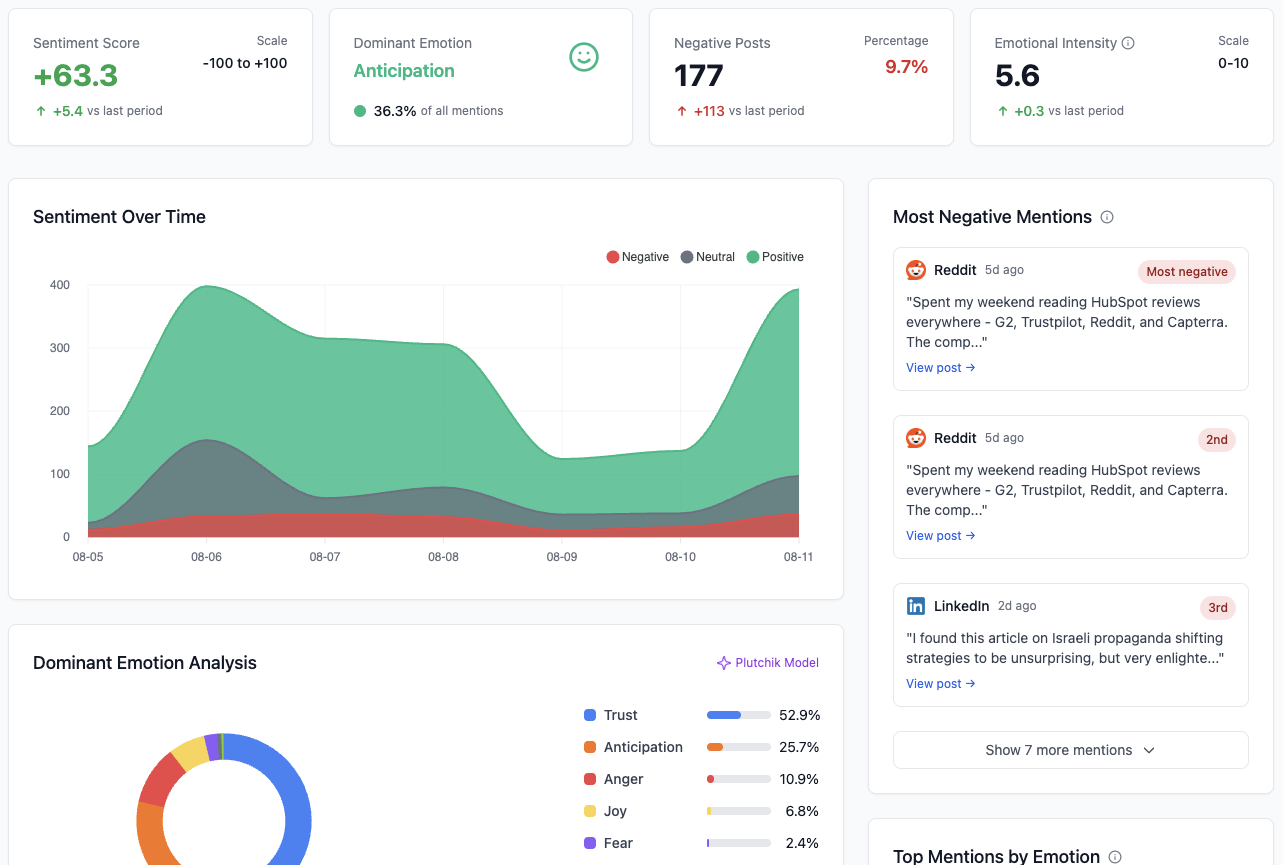
Sentiment analysis has come a long way from just slapping "positive," "negative," or "neutral" labels on things. Modern tools can now pinpoint specific emotions like joy, anger, or even surprise. This is where the real gold is hidden.
Imagine a competitor launches a new feature. A basic report might show 70% positive sentiment, which sounds amazing. But what if a deeper analysis reveals that most of that "positivity" is actually surprise, not excitement? That completely changes the story. It could mean the market was caught off-guard or the feature doesn't really align with what customers wanted.
By analysing the emotional drivers behind conversations, you can uncover subtle weaknesses in a competitor's strategy. For instance, you might discover their customers feel frustrated by slow response times on X, even if their overall sentiment is positive. This is a clear opportunity for you to win over customers with superior, more responsive service.
Understanding the nuance of public feeling is a huge part of any successful social strategy. We break this down even further in our guide to sentiment analysis for social media.
Analysing Content and Engagement Patterns
Now it’s time to dig into the "why" behind the numbers. Don't just glance at a competitor's top-performing posts; pull them apart to figure out what makes them tick. This means looking for patterns.
- Content Formats: Are they crushing it with short-form video on Instagram Reels, detailed text posts on LinkedIn, or interactive polls on X? See what consistently drives the most engagement.
- Content Pillars: What are their go-to topics? Are they focused on educational content, behind-the-scenes stories, or user-generated content?
- Posting Times: Look for a connection between when they post and when they get the most traction. This can reveal when your shared audience is most active.
- Brand Voice: How do they sound? Witty and informal, or authoritative and buttoned-up? A consistent voice can be a massive differentiator.
For example, a boutique hotel might notice their biggest rival gets huge engagement from user-generated photos of guests by the pool. That’s a clear signal their shared audience values authenticity over polished, professional shots. It’s a powerful insight you can immediately use for your own content calendar.
Uncovering Audience Demographics and Psychographics
Finally, take a close look at who is engaging with your competitors. Knowing their audience helps you sharpen your own targeting and messaging. Most social listening tools provide pretty detailed breakdowns here.
Key Audience Insights to Look For:
| Data Point | What It Tells You | Strategic Action |
|---|---|---|
| Demographics | The age, gender, and location of their followers. | Confirms if you’re reaching the same market or reveals an untapped segment. |
| Interests & Affinities | Other brands, hobbies, and media their audience follows. | Uncovers potential partnerships or content themes that would resonate with your own audience. |
| Key Influencers | The most influential accounts talking about your competitor. | Identifies potential collaborators or industry voices you should be monitoring. |
Discovering that a key competitor has a surprisingly young audience on TikTok, despite their corporate image, is a huge opportunity. It might signal that an entire demographic is being underserved by brands with a more relatable voice—a gap you could be perfectly positioned to fill. This is how you turn data into a genuine roadmap for growth.
Putting Your Competitive Insights Into Action
Alright, you've done the heavy lifting. You’ve gathered the intelligence and sifted through the data. Now for the most important part: turning those findings into a concrete strategy that actually gives you an edge. This is where you stop observing and start executing.
The goal here isn't to create some fancy report that gets filed away and forgotten. It’s about building a living, breathing feedback loop that keeps your strategy sharp and responsive. The market doesn't stand still, and neither should your approach.
Organising Your Findings with a SWOT Framework
The classic SWOT analysis (Strengths, Weaknesses, Opportunities, Threats) is the perfect way to get your thoughts in order. It’s a simple but powerful framework that forces you to look at your data from every angle, making sure you don’t miss any strategic openings or lurking pitfalls.
Let's break down what to look for in each quadrant, specifically for social media:
- Strengths: Where are you consistently winning? Maybe your engagement rate on LinkedIn blows everyone else out of the water, or your response time on X is lightning-fast. These are your proven advantages.
- Weaknesses: Time for some brutal honesty. Where are you falling behind? Perhaps your follower growth has flatlined while a rival’s is taking off, or your video content just isn't getting the views.
- Opportunities: These are the gaps you've spotted. A competitor might be completely ignoring Reddit, leaving a huge opening for you. Or maybe you've noticed no one in your space is using interactive polls to engage their audience. This is where you can innovate.
- Threats: What’s on the horizon that could hurt you? This could be a new, well-funded competitor muscling in, or a shift in platform algorithms that plays right into a rival's hands.
A well-executed SWOT analysis does more than just list facts—it tells a story. It shows you exactly where to double down, where to shore up your defences, and where to make your next big move.
From Analysis to Strategic Pivots
With your SWOT complete, it's time to prioritise. The key is to make specific, actionable changes based on what you've found. This isn't about a massive overhaul overnight; it’s about making smart, data-informed tweaks.
Let's say your analysis reveals a top competitor is crushing it with high-budget, slick video ads on Instagram. Your first instinct might be to try and match them, but that's a tough game to win if you don't have the same resources.
The real opportunity is in the pivot. Instead of copying them, your analysis might show they have zero presence on community-focused platforms like Reddit. Your strategic pivot? Dominate the relevant subreddits with authentic, community-driven content that builds trust in a way their polished ads never could.
Refining Your Content Calendar and Brand Voice
Your competitive insights should directly shape what you post and how you say it. Let’s imagine you’re a UK-based sustainable fashion brand.
| Insight from Analysis | Actionable Content Tweak |
|---|---|
| Competitors focus on polished product shots. | Launch a user-generated content campaign featuring real customers. |
| Rivals' brand voice is formal and distant. | Adopt a warmer, more transparent tone, sharing behind-the-scenes stories. |
| No one is creating educational content on fabric sourcing. | Create a "Sustainable Sourcing" series for Instagram Stories and Reels. |
These aren't just random ideas; they're strategic moves designed to fill a gap your social media competitive analysis uncovered. This process transforms your content calendar from a simple schedule into a powerful competitive weapon. And the demand for these sharp strategies is only growing. The UK's social media analytics market is set to expand from USD 729 million to a staggering USD 2,485.9 million in the next five years. You can explore more about the growing demand for social analytics to see why staying ahead is so critical.
Creating an Ongoing Feedback Loop
The biggest mistake you can make is treating this analysis as a one-off project. Your competitors are always changing their game, and so are the social media platforms. To stay ahead, you have to build this into your regular routine.
- Schedule Regular Check-ins: Block out time every month or quarter to refresh your data and revisit your SWOT analysis. What’s changed?
- Automate Your Monitoring: Use a social listening tool to keep a constant pulse on what your competitors are up to. This automates the data collection, freeing you up to think strategically.
- Share Insights Across Teams: The gold you're digging up is valuable beyond the marketing department. Customer feedback should go to the product team. Sentiment trends can help the sales team refine their approach.
By embedding this cycle of analysis, action, and review into your workflow, you create a system that doesn't just help you catch up—it keeps you one step ahead.
Common Questions About Competitor Analysis
Even with a solid plan, you’re going to run into questions once you start digging into the data. This section is your quick-fire guide for those moments, covering everything from how often you should be doing this to what to do when the results feel a bit… awkward.
How Often Should I Run a Competitor Analysis?
This is the big one, and the honest answer is: it depends. If you’re in a fast-moving space like consumer tech, you might need a monthly check-in. For a more stable B2B industry, a quarterly review is probably fine.
But whatever you do, avoid the "set it and forget it" trap. The best approach is a hybrid one:
- A Quarterly Deep Dive: This is your big, comprehensive review. You'll update your SWOT analysis, benchmark all your key metrics, and present the findings to your team. Think of it as your strategic reset.
- Ongoing Monitoring: Set up a social listening tool to keep a constant, automated pulse on things. Track competitor mentions, new campaigns, and any sudden shifts in sentiment. This way, you catch major threats or opportunities in real-time instead of waiting three months for the next report.
It’s like owning a car. You get a full MOT once a year, but you're still glancing at the fuel gauge and listening for weird noises on every single drive.
Which Tools Are Right for My Budget?
The market for analysis tools is massive, with everything from free options to enterprise platforms that cost thousands a month. The good news? You don’t need the most expensive tool to get genuinely useful insights.
If you're just starting out or the budget is tight, you can get a surprisingly long way with manual analysis and the free analytics built into platforms like Meta Business Suite. A well-organised spreadsheet will be your best friend.
Once you start to scale, investing in a dedicated social listening tool becomes a no-brainer. It automates all the tedious data collection, freeing you up to actually think about strategy. Look for affordable tools that give you the essentials—mention tracking, sentiment analysis, and basic competitor reports—without the hefty price tag of the legacy software giants.
The price of the tool doesn't matter nearly as much as how well it fits your specific goals. An affordable tool that’s brilliant at tracking Reddit conversations is far more valuable than a pricey one that ignores it, especially if Reddit is where your audience lives.
What if My Competitors Are Not Very Active on Social Media?
Don't see this as a roadblock. See it as an opportunity. If your direct competitors have a weak social media presence, it often means there's an underserved market just waiting for someone to step in and lead the conversation.
Instead of getting bogged down analysing their non-existent activity, shift your focus:
- Indirect Competitors: Who else is solving the same customer problem, even if they have a different type of product? See what they're up to.
- Aspirational Brands: Look at leaders in completely different industries who are absolutely killing it on social media. What can you borrow from their content strategy, community building, or brand voice?
- Audience Conversations: This is the most important one. Use social listening to track keywords and topics relevant to your industry. Find out what your potential customers are actually talking about, what questions they’re asking, and what their biggest pain points are. You can then build a content strategy that directly addresses those needs, filling the massive void your competitors have left open.
What Do I Do if the Analysis Shows We Are Underperforming?
Discovering your brand is lagging behind can be a tough pill to swallow, but let's be honest—it's the entire point of the exercise. Don't get discouraged; get strategic. Uncomfortable truths are what spark real improvement.
First, get specific about where you’re weak. Is it your engagement rate? Follower growth? The sentiment around your brand? Pinpoint the exact problem.
Next, use your competitor data as a textbook. If a rival's video content is getting ten times the engagement, break down why. Is it their editing style? The topics they choose? Their calls to action? Deconstruct their success.
Finally, treat these findings as your new set of priorities. Don’t frame it as "we're failing." Frame it as "we've just identified our biggest opportunities for growth." This simple shift in mindset turns a negative finding from something demoralising into a powerful motivator for the whole team.
Ready to stop guessing and start winning? ForumScout gives you the competitive intelligence you need to find leads, spot weaknesses, and engage communities faster. Monitor every conversation about your competitors across Reddit, X, news, and more—all in one simple dashboard. Start your free 7-day trial and see what they're saying.